
How central Vietnam can ease pain of natural disasters
For central Vietnam to truly ‘live with floods,’ it needs fundamental, long-term solutions built on three key pillars, including reorganizing living space, restoring natural ecosystems, and strengthening community capacity.
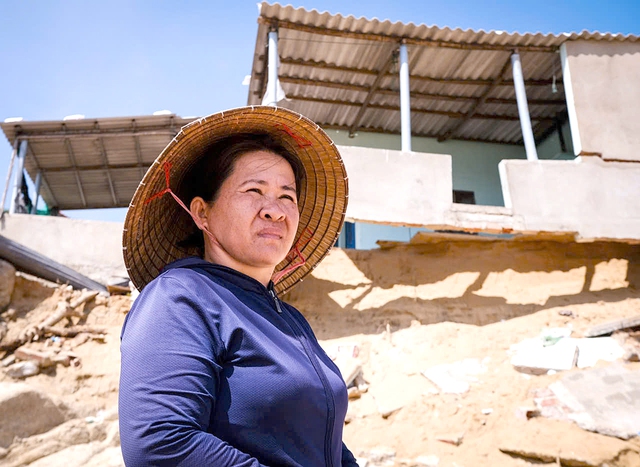
A house of 44-year-old Tran Thi Ly in Phu My Dong Commune, Gia Lai Province, south-central Vietnam collapses after its foundation was eroded by sea waves during storm Kalmaegi, the 13th storm to hit the East Vietnam Sea in 2025. Photo: Tan Luc / Tuoi Tre
Many residential areas, schools, medical facilities, and even town centers across the region are located in zones with extremely high disaster risk.
Landslides, flash floods, and coastal erosion have turned some communities into persistent danger hotspots.
An urgent priority is the relocation of households from high-risk areas.
Resettlement must go hand in hand with livelihoods, ensuring access to farmland, administrative centers, schools, hospitals, and industrial parks.
At the same time, authorities should strictly prohibit the allocation of new residential or production land in areas already identified as high-risk.
Natural disasters are unpredictable, making human preparedness essential.
Vietnam needs a multi-level early warning system from national to provincial and commune levels, integrating satellite data, weather radar, and automated rainfall sensors.
It is also important to upgrade transport infrastructure and flood drainage systems, while solid community flood shelters, which are elevated and capable of accommodating hundreds of people, should be built in every low-lying commune.
Besides, disaster preparedness skills should be incorporated into school curricula, with annual evacuation drills at the commune level.
The introduction of mandatory disaster insurance for housing and assets in high-risk areas should also be considered, with state support for insurance premiums for poor households.
Central Vietnam can reduce disaster-related losses through comprehensive changes from planning, forests and infrastructure to livelihoods.
Environmental restoration is equally critical. Multi-layer native forests should replace single-species acacia and cajuput plantations that burn easily and retain little water.
Small hydropower plants must be reviewed comprehensively, with unsafe projects dismantled or converted into flood-regulation reservoirs under a clear roadmap.
Priority should also be given to the development of multi-purpose reservoirs in upstream river basins such as the Huong, Thu Bon, Ba and Ca rivers, serving both flood control in the rainy season and water storage in the dry season.
Coastal protection requires urgent restoration of mangroves and lagoon systems in areas such as Hue, Quang Tri and the former provinces of Binh Dinh and Phu Yen to weaken storm surges and prevent erosion.
Recent abnormal and intense rainfall and flooding across Da Nang, Gia Lai, Dak Lak, Khanh Hoa, and Lam Dong have resulted in devastating human and economic losses.
According to the Ministry of Agriculture and Environment, as of November 27, widespread floods had left 98 people dead and 10 others missing, destroyed 426 homes, damaged 2,066 others, and inflicted estimated economic losses of VND14.352 trillion (US$545 million).

Minh Duy - Trinh Minh Giang / Tuoi Tre News
Link nội dung: https://news.tuoitre.vn/how-central-vietnam-can-ease-pain-of-natural-disasters-103251217170657152.htm