
How Decree 282 applies and what evidence needed to curb karaoke noise in Vietnam
The government’s Decree 282/2025, which took effect in mid-December and replaced Decree 144/2021, is expected to remove long-standing bottlenecks in dealing with noise pollution, but grassroots authorities are still struggling, hampered by a lack of equipment, manpower, and technical procedures to handle violations effectively.
Instead of regulating noise by time frame, the new decree focuses on the actual level of noise generated, regardless of whether it occurs during the day or at night.
From December 15, karaoke singing or the use of portable loudspeakers can be penalized at any hour if the sound exceeds allowable limits, not just late at night as before.
Huynh Van Minh, chairman of An Xuyen Ward in Ca Mau Province, southern Vietnam, told Tuoi Tre (Youth) newspaper that before Decree 282 came into force, authorities could only handle noise-related cases as disturbances of public order, mostly after 10:00 pm.
The new regulation provides a clearer legal framework that allows officials to deal with violations at any time and in any place.
“However, the ward currently has no specialized sound-measuring equipment, while the officials have not yet been trained to measure noise intensity for enforcement purposes,” Minh said.
“We will send some officials to training courses so they can use measuring devices and resolutely handle cases of deliberate noise-making that affect others, especially excessively loud singing in residential areas."
In Ly Van Lam Ward, also in Ca Mau Province, vice-chairman Dang Van Nam said Decree 282 has received strong public support and gives local authorities firmer legal grounds to address noise violations.
“However, since the decree took effect, the ward has not yet imposed any fines," Nam said.
“We have only issued reminders and widely disseminated the regulations so that people can be aware of the penalties and comply voluntarily."
An official from My Tho Ward in Dong Thap Province echoed similar concerns.
Despite regulations that provide for relatively high fines, enforcement remains difficult out of a lack of specialized measuring equipment, procedural hurdles, and limited public awareness.
“To impose penalties, authorities must prove that noise levels exceed permitted standards, but measurement and assessment are not easy to carry out,” the official added.

Strengthening evidence base
Lawyer Nguyen Hong Linh of the Ho Chi Minh City Bar Association said that Article 9 of Decree 282 stipulates administrative penalties in the fields of security, public order, and social safety, as well as the prevention of social evils and domestic violence.
Specifically, violations of regulations on maintaining public quiet are subject to a warning or a fine of VND500,000-1 million (US$19-38).
However, the provision merely lists prohibited acts and corresponding penalties without clearly defining what level of noise constitutes a violation or offering a concrete definition of noise.
As a result, enforcement remains challenging.
Authorities cannot rely on subjective judgment or personal feelings, but must assess the actual impact on public quiet, taking into account the context, timing and frequency of the noise, as well as complaints from surrounding residents, particularly in cases where violators claim they do not know what counts as noise.
Under the decree, task forces may still take action, but they must demonstrate that the behavior affects public quiet and that the violator continues after being reminded.
If evidence is insufficient, authorities may only issue reminders and request that the behavior stop.
In cases where residents report loud karaoke but the music has been turned off by the time officials arrive, enforcement can still be based on other lawful evidence, such as audio or video recordings, verification reports, or statements from nearby households.
Such evidence must clearly show the time, location, and degree of impact to serve as grounds for handling the case.
When faced with conflicting reactions, authorities should combine enforcement with education–explaining legal provisions on maintaining public quiet, especially during rest hours in residential areas, to raise awareness and prevent repeat violations.
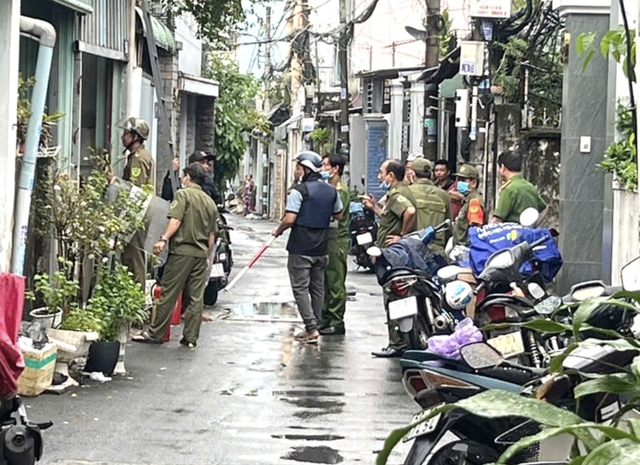
Officers in Tang Nhon Phu Ward, Ho Chi Minh City handle a fight related to noise between two households on Street 275, November 1, 2025. Photo: Minh Hoa / Tuoi Tre
From karaoke singing to market loudspeakers: a chorus of noise
For many residents, noise pollution is a daily ordeal.
A woman in Ca Mau Province said she feels stressed every morning when going to the park for exercise, as multiple groups blast portable loudspeakers at the same time.
At home, a neighboring clothing shop uses outdoor speakers to attract customers, while evenings are filled with the sound of karaoke next door.
“As an elderly person, I avoid confrontation and just endure it,” she said.
“I only hope the authorities will patrol and handle these issues regularly so people can live in peace."
Similarly, Ly Dung Tien, a resident of Thoi Binh Commune in Ca Mau, lives near a household workshop and hears saws and grinding machines daily, sometimes late into the night.
“I’ve talked to the owner, so he tried to arrange daytime shifts,” he said.
“Tolerance helps, but when it doesn’t, authorities need to step in and act firmly.”
Ho Van Vu, also in Thoi Binh Commune, said loud singing and amplified street vendors have disrupted his life from early morning until noon for years.
Nguyen Van Teo, a resident of An Xuyen Ward, described himself as ‘allergic’ to karaoke noise after being subjected to it day after day.
“It’s not even parties – whenever they’re free, they sing at maximum volume,” Teo bemoaned.
“I hope the new decree will make them think twice. Authorities must strictly penalize those who lack community awareness."
Beyond residential areas, noise pollution is also widespread at markets across the Mekong Delta region.
Many vendors use loudspeakers to advertise their goods from early morning until late evening, affecting residents’ health and sleep.
Nguyen Van T., who lives near a market in My Tho Ward, Dong Thap Province, said that at midday, opening a window would expose him to ear-splitting announcements.
“It’s exhausting,” he said.
Nguyen Van Ho, a resident near My Tho Market, complained that midday rest is often shattered when vendors stop right in front of his house.
“I understand they’re earning a living, but the prolonged noise wears everyone down,” he said.
However, M., who sells duck eggs on Nguyen Trung Truc Street in My Tho Ward, said he has operated there for months without complaints.
“Everyone uses loudspeakers to sell, so I do the same. If others shout louder, you have to be even louder to attract customers,” he said.
Tuoi Tre News
Link nội dung: https://news.tuoitre.vn/how-decree-282-applies-and-what-evidence-needed-to-curb-karaoke-noise-in-vietnam-103251223143952307.htm