
How wetland conservation is reviving farming in Vietnam's Dong Thap Muoi
Tram Chim National Park, Vietnam’s fourth Ramsar site, is widely regarded as the 'green lungs' and natural reservoir of the Dong Thap Muoi region in the Mekong Delta.
Today, it stands at the center of a collaborative effort by local authorities, scientists, and farmers to protect its fragile wetlands while securing sustainable livelihoods for nearby communities.
Preserving Tram Chim’s habitats
As Cao Thai Phong, deputy director of Tram Chim National Park, has witnessed a drastic shift in the park’s natural water cycle in recent years.
Driven by upstream development and climate change, incoming water flows have changed dramatically, bringing shorter flood seasons, lower peak water levels, and longer, hotter dry seasons.
These shifting weather patterns have heightened the risk of forest fires and placed severe stress on the park’s wetland ecosystems.
In response, Phong and his staff have focused on three main priorities: restoring native habitats through nature-based solutions, deploying thermal drones and satellite imagery to track fires and water levels, and directly involving surrounding communities in conservation efforts.
Meanwhile, Tran Triet, a lecturer at the University of Science under the Vietnam National University–Ho Chi Minh City, who has studied wildlife at the national park, notes that the acidic wetland ecosystem characteristic of Dong Thap Muoi now survives almost exclusively within Tram Chim’s core zone.
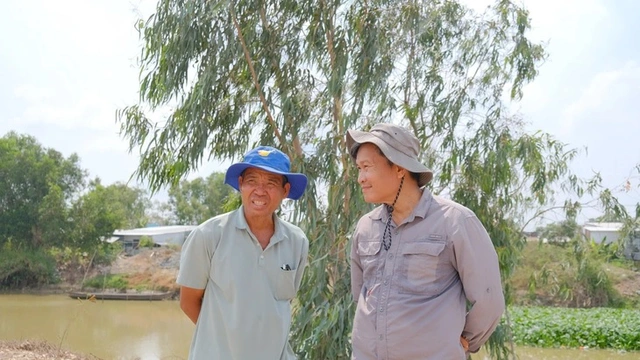
Dr. Tran Triet (right) discusses an ecological rice farming model with farmers in the buffer zone of Tram Chim National Park in Dong Thap Province, southern Vietnam. Photo: Dang Tuyet / Tuoi Tre
He attributes much of the park’s recent ecological recovery to a shift in water management, moving away from maintaining rigid water levels and toward restoring a more natural flood-and-drought cycle.
“Alongside regulating water levels, the park uses controlled burns to reduce dry brush and pumps in water during dry spells to maintain soil moisture,” Triet said.
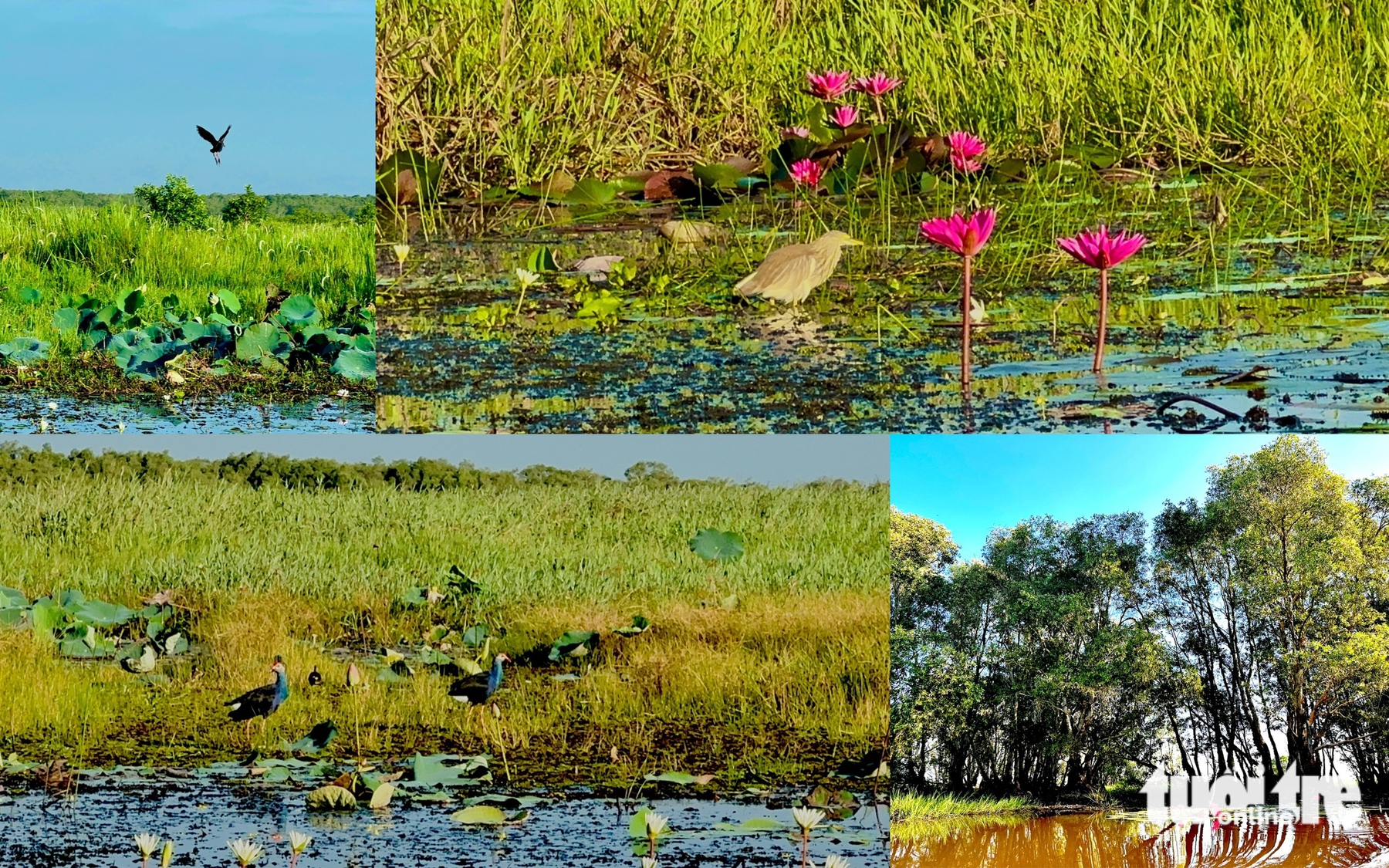
As a result, populations of waterbirds and migratory species have steadily increased, with several returning to nest after years of absence. Plant diversity has also rebounded, signaling a successful ecosystem recovery.
The return of the sarus crane to the wild is seen as a particularly promising milestone, though rebuilding the population of this iconic bird remains a long-term challenge. To support this goal, a 2022–32 conservation program is currently underway.
The initiative aims to restore the species through captive breeding and wild reintroduction while rehabilitating its natural feeding grounds and grasslands.
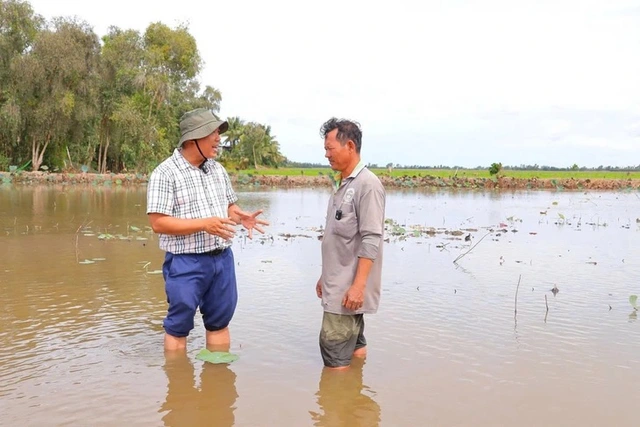
Trinh Phuoc Nguyen (L), deputy director of the Climate Change Institute at An Giang University under the Vietnam National University–Ho Chi Minh City, shares cultivation techniques with a lotus farmer in Dong Thap Province, southern Vietnam. Photo: Van Tien
Nature-based farming in buffer zone
In the buffer zone surrounding Tram Chim, farmers have begun transitioning roughly 150 hectares of rice paddies to eco-friendly farming practices.
Local authorities in Tram Chim Commune are encouraging more growers to adopt these models as part of a broader push toward green, low-emission agriculture.
A newly launched project is also funding flood-adaptive livelihoods around the park. By promoting integrated systems like rice-fish and lotus-fish farming, which work in harmony with seasonal flooding, the project helps farmers move away from intensive triple-crop rice farming.
This shift is expected to cut production costs, boost incomes, and build stronger climate resilience.
Trinh Phuoc Nguyen, deputy director of the Institute of Climate Change at An Giang University, highlights nature-based agriculture as one of the most effective strategies for adapting to climate change.
He explains that integrated models, such as rice-lotus-fish rotations or growing two rice crops followed by one lotus crop, cut chemical pesticide use, enrich the soil, conserve water, and increase yields.
Field trial data show that these methods can reduce fertilizer use by roughly 47 percent and cut overall production costs by 30 percent, while increasing crop yields by around five percent.
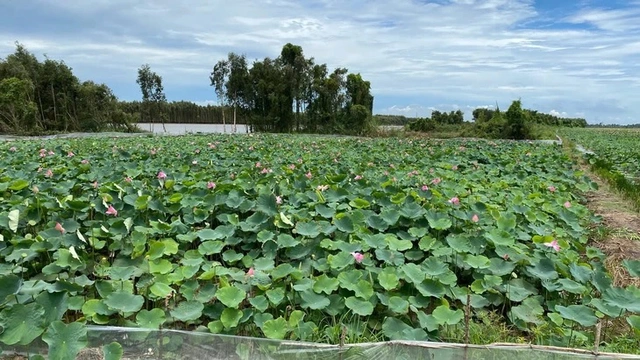
Lotus farmers in Thap Muoi Commune, Dong Thap Province, southern Vietnam receive technical support from the farmers’ union and scientists to adopt nature-based farming practices. Photo: Van Tien
Nguyen asserts that Dong Thap Province should continue expanding flood-season rice cultivation, restoring wild fish habitats, and improving water retention to recharge groundwater reserves.
Multi-layered, multi-species orchards are also demonstrating high potential in the buffer zone. Nguyen Hoai Bao, a lecturer at the University of Science, points out that unlike monoculture farms, these polyculture orchards act as 'biodiversity islands' that shelter birds, insects, and amphibians.
“In Tram Chim’s buffer zone, these orchards function as vital biological corridors, connecting the wetland ecosystem with surrounding agricultural land,” Bao said.
Building resilience for sustainable development
Le Ha Luan, director of the Dong Thap Department of Agriculture and Environment, stated that the province is combining infrastructure projects with strategic policy shifts to build climate resilience.
Beyond upgrading irrigation systems, the province is expanding water-monitoring technologies and encouraging farmers to adopt climate-smart crops and water-conserving farming methods.
In 2025, Dong Thap allocated over VND770 billion (US$29.3 million) to irrigation projects, rice production support, and water storage infrastructure.
Paired with nature-based agricultural models, these investments aim to safeguard both local ecosystems and rural livelihoods for the long term.
A remnant of the ancient plain of reeds
Spanning 7,313 hectares in Tam Nong District, Dong Thap Province, Tram Chim National Park protects one of the last remaining fragments of the original Dong Thap Muoi (Plain of Reeds), a vast freshwater floodplain that once stretched across 700,000 hectares of Vietnam’s Mekong Delta.
Recognized in 2012 as the 2,000th Ramsar site in the world, and the first in the Mekong Delta), Tram Chim is widely celebrated as the region's 'green lungs' and natural water reservoir. The park shelters a remarkably rich ecosystem.
It is an avian haven, home to over 230 waterbird species, representing nearly a quarter of all bird species in Vietnam, including globally threatened birds such as the Bengal Florican, Painted Stork, Black-faced Spoonbill, and the iconic sarus crane, the world's tallest flying bird.
The flora and aquatic life there include over 130 higher plant species across open floodplains dominated by wild rice (Oryza rufipogon), spike-sedge, lotus swamps, and roughly 3,000 hectares of Melaleuca (cajeput) forest. It also supports more than 150 freshwater fish species, including rare fauna like the Giant Barb and Clown Featherback.
Today, with approximately 50,000 people living in its surrounding buffer zone, Tram Chim stands at the center of a collaborative effort by local authorities, scientists, and farmers to preserve its wetlands while securing sustainable livelihoods for nearby communities.
Van Giang / Tuoi Tre News
Link nội dung: https://news.tuoitre.vn/how-wetland-conservation-is-reviving-farming-in-vietnams-dong-thap-muoi-103260805101813776.htm