
India-Vietnam ties: When the sky is no longer the limit
There are moments in international relations when diplomacy quietly evolves into something far more powerful: a shared vision.
The recent high-level engagements between Vietnam and India signal precisely such a moment.
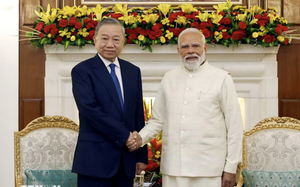
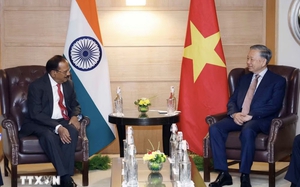
At the invitation of Indian Prime Minister Narendra Modi, Vietnam's General Secretary and State President To Lam is paying a state visit to India from May 5 to 7.
As leaders meet, statements are made, and agreements are discussed, one phrase resonates with striking clarity: “The sky is not the limit.”
In reality, what lies ahead may be even more transformative. Not just in the skies, but across rivers, cities, economies, technologies, and - most importantly - human capital.
Where water meets vision
Ho Chi Minh City, with its intricate network of waterways stretching over nearly 1,000 kilometers, has long held an untapped advantage, one that could redefine urban mobility.
Among the proposals that have emerged from bilateral exchanges is a high-speed water corridor connecting the soon-to-open Long Thanh International Airport, in Dong Nai City, to the heart of Ho Chi Minh City.
The proposed high-speed water corridor connecting the upcoming Long Thanh International Airport to Ho Chi Minh City is more than a transport solution. It is a statement of innovation.
With approximately 14 kilometers of new canal development, this initiative could dramatically reduce travel time between the airport and the city, ease congestion on already burdened road infrastructure, create a distinctive water-based mobility identity for Vietnam, and elevate tourism through efficient yet scenic transit experiences.
Executed with precision, this project could position Ho Chi Minh City among a select group of global cities where waterways are not relics of the past, but arteries of the future.
India's Kochi Water Metro stands today as a remarkable example of how tradition and technology can coexist.
As a hybrid, sustainable, and technologically integrated system, Kochi has demonstrated that water transport can be efficient, scalable, and environmentally responsible, seamlessly integrated with urban mobility systems — a commuter solution that is also an experience.
A Vietnamese adaptation, carefully contextualized to local geography, could transform connectivity across Ho Chi Minh City, extending towards the Mekong Delta and Vung Tau Ward, generate employment across operations, engineering, and services, and reinforce Vietnam's leadership in sustainable urban transport.
This is not replication. It is intelligent evolution.
At this stage, these remain conceptual proposals - preliminary, exploratory, and intended to stimulate discussion and assess long-term feasibility rather than finalized or approved projects.
Expanding horizon of cooperation
While transport is the most visible symbol of transformation, the real depth of India-Vietnam collaboration lies in its multidimensional potential.
India's Unified Payments Interface (UPI) has redefined digital transactions, making them faster, cheaper, and transparent.
A Vietnam-adapted model could reduce dependency on costly international card networks, enhance financial transparency and governance, accelerate digital inclusion, and strengthen domestic fintech ecosystems.
This is not simply a technological shift. It is a structural economic advantage.
As global supply chains recalibrate, collaboration in semiconductor training, design, and ecosystem development presents a defining opportunity.
India's growing semiconductor ambitions, combined with Vietnam's manufacturing strengths, could lead to joint training programs for highly skilled technical talent, the development of semiconductor design and testing ecosystems, and strategic positioning within global electronics value chains.
This is where partnership transitions from infrastructure to intellectual capital leadership.
As regional dynamics evolve, deeper engagement in defense and maritime security strengthens resilience, stability, and mutual trust.
India's experience in managing complex infrastructure ecosystems complements Vietnam's rapid growth in port modernization, airport operations, and integrated logistics networks.
At the heart of all progress lies education. Through deeper academic partnerships, India and Vietnam can train future-ready professionals in high-impact sectors, strengthen research and innovation capacity, and build leadership across industries and governance.
Because infrastructure builds cities, but education builds nations.
Having spent over two decades in Vietnam, I have witnessed the natural alignment between India and Vietnam.
Today, this partnership is no longer limited to cooperation. It is advancing toward strategic co-creation at scale.
If the past defined India-Vietnam relations through diplomacy, the future will define it through integration: of systems, ideas, technologies, and talent.
From waterways to semiconductor ecosystems, from green energy transitions to digital financial architectures, this collaboration is poised to move to the next level of global relevance.
Because sometimes, the sky is not the limit.
Sometimes, it is only the beginning.
Dr. Majo George, Dean of the Faculty of Economics at the Ho Chi Minh City University of Economics and Finance
Link nội dung: https://news.tuoitre.vn/india-vietnam-ties-when-the-sky-is-no-longer-the-limit-103260507164520085.htm