
Indochinese tigers at Vietnam's Phong Nha-Ke Bang receive medical care from int'l, local experts
Seven Indochinese tigers at Phong Nha-Ke Bang National Park in Quang Tri Province, north-central Vietnam, have undergone routine health checks and vaccinations as part of efforts to ensure their long-term care and welfare, according to the park's Wildlife Rescue, Conservation and Development Center.
The week-long health examinations, which began on August 24, have been conducted in coordination with Four Paws Viet, the Vietnamese sister organization of Four Paws International, an international animal welfare charity, and Hanoi-based Center for Natural Conservation and Development.
International and local veterinary and animal welfare experts have participated in the health checks and related care.
The seven tigers have undergone comprehensive health checks to detect early signs of changes in their physical condition and behavior, as well as potential diseases.
The examinations have included general checkups, dental, skin and coat, eye and ear examinations, and assessments of their musculoskeletal systems.
Blood samples have been collected for hematology and biochemical tests, while fecal samples have been examined for parasites.
Ultrasound, X-rays or endoscopy have also been performed when necessary.
These examinations and tests have aimed to assess each tiger's health and provide a basis for adjusting its diet, exercise regimen, enclosure hygiene and environmental enrichment accordingly.
Vaccination plans have been designed based on disease risks, epidemiological conditions, the individual health of each tiger and biosafety requirements at the facility.
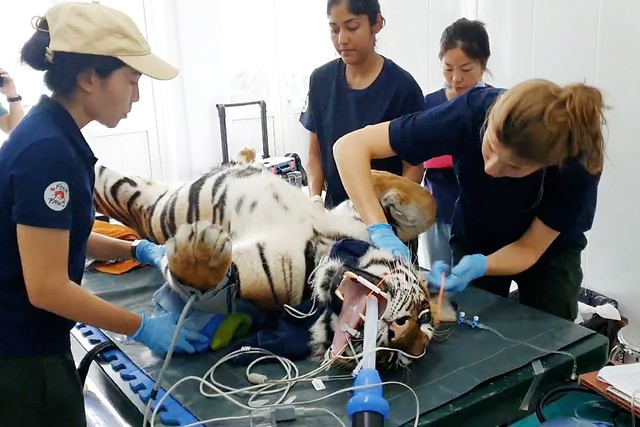
One of the seven Indochinese tigers undergoes a medical test performed by international and local experts at Phong Nha-Ke Bang National Park in Quang Tri Province, north-central Vietnam. Photo: Quang Ha / Tuoi Tre
As members of the cat family, the tigers have been vaccinated against infectious diseases such as rabies, feline panleukopenia, feline viral rhinotracheitis and calicivirus infection, among others.
The seven Indochinese tigers were seized by police in central Nghe An Province as exhibits in a criminal case in August 2021.
They were subsequently taken to Pu Mat National Park in Nghe An for care before being transferred to Phong Nha-Ke Bang National Park in March 2022.
All seven are now in good health and weigh between 110 and 150 kilograms.
Beyond maintaining suitable living conditions, the center must ensure the tigers' health and mobility while minimizing changes to their natural behaviors, according to experts.
The regular health checks and vaccinations are part of a broader, science-based and long-term wildlife management and care program, according to the Wildlife Rescue, Conservation and Development Center.
During the program, experts have also trained the center's staff in anesthesia and recovery monitoring, wound treatment, surgical assistance and the safe operation of animal enclosures.
The training is expected to boost the center's on-site veterinary capacity and enable its staff to take a more active role in caring for rescued wildlife.
The Indochinese tiger (Panthera tigris corbetti) is currently considered functionally extinct in the wild in Vietnam.
Tigers are classified under Group IB of Vietnam’s strictly protected species (Decree 06/2019/ND-CP), making hunting, capturing, keeping, or trading them punishable by up to 15 years in prison under the Penal Code.
Authorities regularly bust illegal trafficking rings, confiscating live cubs and frozen carcasses smuggled across borders or kept in illegal basements.
Facilities such as the Hanoi Wildlife Rescue Centre, Pu Mat Rescue Centre, and Four Paws Bear Sanctuary Ninh Binh care for confiscated tigers, though captive-bred and rescued tigers cannot currently be reintroduced into the wild.
For wild tigers to ever return to Vietnam, conservationists emphasize that long-term habitat restoration, aggressive anti-snaring enforcement, prey recovery, and bilateral reintroduction frameworks would be mandatory prerequisites.
REFERENCE MORE
Vinh Tho – Hoang Tao / Tuoi Tre