
International financial center opens in Ho Chi Minh City, set to attract global capital
Vietnam’s International Financial Center (IFC) in Ho Chi Minh City officially began operations on Sunday, marking a major milestone for the country’s financial sector and setting a clear roadmap to attract global capital.
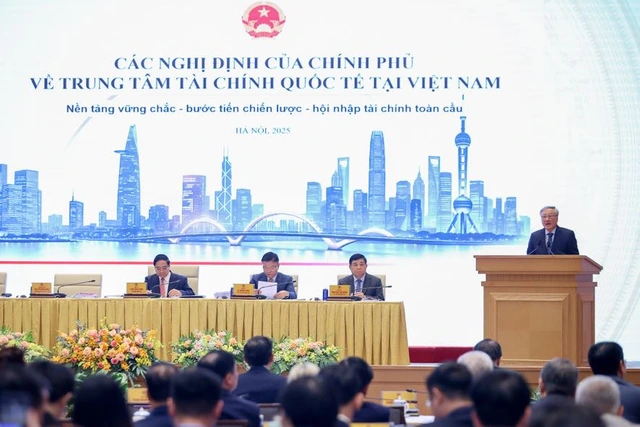
Vietnam’s Permanent Deputy Prime Minister Nguyen Hoa Binh speaks at the Hanoi conference announcing the country’s first international financial center, December 21, 2025. Photo: Nhat Bac
The launch came after the government announced the establishment of Vietnam’s first international financial center at a Hanoi conference on the same day, chaired by Prime Minister Pham Minh Chinh.
The conference also unveiled related government decrees and a prime ministerial decision establishing the IFC’s Executive Council, headed by Permanent Deputy Prime Minister Nguyen Hoa Binh, with vice-chairs drawn from key ministries, sectors, and local authorities.
According to the Ministry of Finance, Vietnam’s IFC is being developed under a ‘one center, two destinations’ model, with core facilities in Ho Chi Minh City and Da Nang, reflecting the country’s ambition to build a modern, multi-nodal financial hub aligned with international standards.
Infrastructure, site planning
Speaking at a seminar organized by Tien Phong (Vanguard) newspaper on Saturday, Bui Hoa An, deputy director of the Ho Chi Minh City Department of Construction, said the department has been tasked with developing infrastructure for the IFC in the city.
The Ho Chi Minh City IFC will cover about 900 hectares across Saigon, Ben Thanh, and An Khanh Wards on the eastern bank of the Saigon River in the Thu Thiem New Urban Area.
Enterprises and financial institutions within the zone will benefit from preferential government policies, giving the location and planning a clear competitive edge.
Bui Hoa An emphasized that the IFC is not only the ambition of Vietnam’s southern economic engine but also a core national strategy to elevate the country’s position and attract global financial institutions, investment funds, and leading fintech players.
Three-phase development plan
Quach Ngoc Tuan, deputy director of the Ho Chi Minh City Department of Finance, outlined a three-phase ‘oil spill’ expansion strategy for the IFC in the southern metropolis.
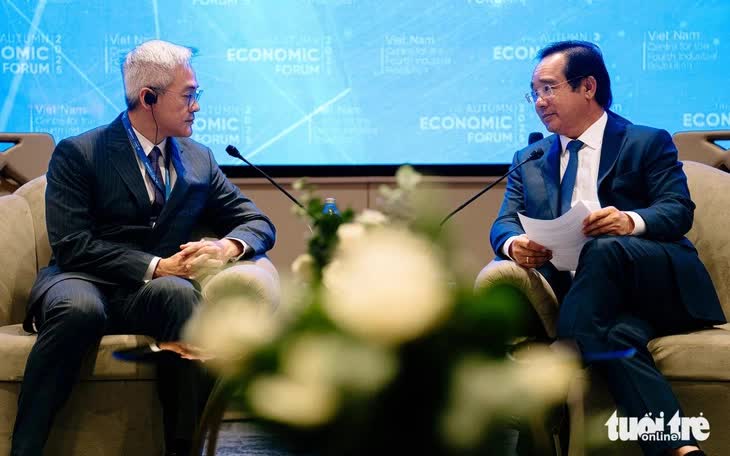
In the first two phases, existing infrastructure in the city’s key business facilities will be maximized, with buildings at 123 Truong Dinh Street and 8 Nguyen Hue Street repurposed as headquarters for the IFC’s governing bodies, enabling immediate operations.
The long-term vision focuses on the third phase, concentrating resources to build a large-scale, ultra-modern financial hub in Thu Thiem.
Envisioned as the future ‘Wall Street of Southeast Asia,’ the Ho Chi Minh City IFC will feature smart financial towers, advanced digital infrastructure, and international-standard workspaces designed to host major global financial players.
Talent, incentives, innovation
Human capital is central to the Ho Chi Minh City IFC’s global ambitions.
Officials and civil servants have undergone specialized training in major financial hubs such as London, New York, and Singapore, equipping them to manage a world-class financial center.
This is complemented by preferential policies on taxes, fees, and land use, alongside streamlined one-stop administrative procedures to reduce compliance costs for investors.
A regulatory sandbox will foster fintech innovation, allowing startups to test new products and services in a flexible, risk-controlled environment.
Together, these measures aim to build a highly skilled workforce and an attractive investment climate to support the Ho Chi Minh City IFC’s growth.
Expected global capital inflows
Huynh Anh Tuan, CEO of Vikki Bank Securities, said Vietnam will require substantial capital inflows through 2030 to sustain growth.
The Ho Chi Minh City IFC, together with plans to upgrade the stock market from frontier to emerging status, could serve as a major conduit for foreign investment.
Nguyen Tri Hieu, director of the Institute for Global Financial and Real Estate Market Research and Development, described Vietnam’s first IFC as an inevitable step in the country’s global integration, estimating that its facilities in Ho Chi Minh City and Da Nang could attract around US$20 billion in 2026 and up to $50 billion within three years.
Phung Anh Tuan, secretary general of the Vietnam Association of Financial Investors, emphasized that success depends on aligning Vietnam’s legal and regulatory framework with global financial standards, noting that international recognition and robust legal protections are essential to attract long-term capital from major financial centers.
Vinh Tho - Anh Hong - Ngoc An / Tuoi Tre News
Link nội dung: https://news.tuoitre.vn/international-financial-center-opens-in-ho-chi-minh-city-set-to-attract-global-capital-103251221154948923.htm