
Int’l experts highlight key priorities for Vietnam’s high-income ambition
International experts have outlined a series of measures Vietnam needs to take to sustain economic growth and improve productivity to become a high-income country.
At an in-depth discussion session, as part of the Autumn Economic Forum 2026 held in Ho Chi Minh City, on Wednesday, Fazurin Jamaludin, the International Monetary Fund’s resident representative in Vietnam and Laos, identified productivity improvements as one of the most important requirements for achieving the country’s growth ambitions.
Vietnam needs not only to increase investment but also to ensure that resources are allocated and used efficiently, according to the IMF representative.
He highlighted the effectiveness of public investment and the distribution of resources and credit among businesses.
Investment projects, particularly in infrastructure, must deliver the expected results and returns to help boost overall productivity.
Jamaludin warned that shortcomings in the public investment framework, particularly its ability to ensure effective resource allocation, could become an obstacle to Vietnam’s development ambitions.
He also stressed that businesses’ inability to access financing suited to their needs could hinder the recovery of total factor productivity (TFP).
TFP is an indicator of how efficiently an economy combines resources such as capital and labor in the production process.
“One of the issues we have identified is the uneven allocation of resources and credit among businesses operating in Vietnam,” he said.
Meanwhile, Weichuan Xu, a representative from the International Finance Corporation (IFC), sees the cost of capital as one of the biggest challenges facing the economy.
He noted that bank lending rates of 13-15 percent were placing considerable pressure on firms seeking to invest and consumers looking to borrow.
Xu said the government needed to find solutions to this challenge while gradually improving the operational efficiency of public institutions and upgrading infrastructure.
Regarding Vietnam’s ambition to become a high-income economy by 2045, Xu said that the country might not reach the required income threshold within the target timeframe.
Nevertheless, he emphasized that Vietnam’s economy continued to grow and was strengthening its position in Southeast Asia and global supply chains.
He described the 2045 ambition as a highly challenging goal, adding that flexibility would be essential in pursuing it.
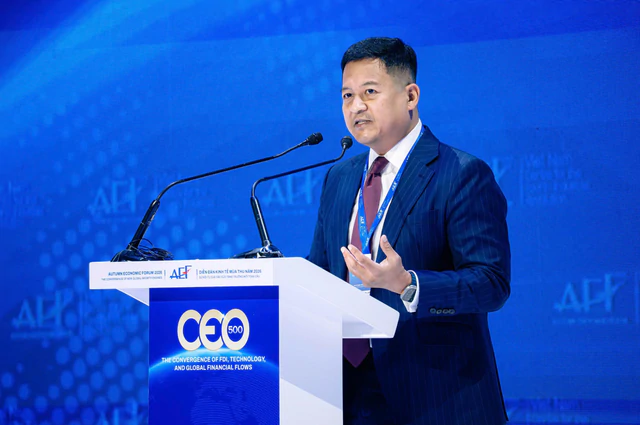
Fazurin Jamaludin, the International Monetary Fund’s resident representative in Vietnam and Laos. Photo: Thanh Hiep / Tuoi Tre
From mass production to higher value creation
Speaking at the Vietnam-UK Business Forum 2026 on Thursday, Mariam J. Sherman, World Bank division director for Vietnam, Cambodia and Laos, said Vietnam’s growth model, built on an abundant labor force, capital accumulation and trade integration, had driven impressive economic development over the past four decades.
However, she warned that these traditional growth drivers were gradually reaching their limits, making a transition toward higher-value economic activities increasingly necessary.
Sherman cited figures showing that a manufacturing worker in Vietnam generates some US$6.7 in value added per hour.
Meanwhile, around 85 percent of jobs in the export sector remain concentrated in manufacturing activities, particularly assembly.
According to the World Bank representative, although Vietnam’s exports are becoming increasingly sophisticated, employment opportunities for domestic workers have not developed at a corresponding pace.


She recommended helping domestic businesses upgrade their technology, management capabilities and compliance with international standards so they can participate more deeply in higher-value segments of global supply chains.
These include product design, engineering, logistics and applied research.
Alongside business upgrading, workforce training must also be more closely aligned with actual market demand.
Sherman pointed out that the proportion of exporting businesses reporting shortages of appropriately trained workers had risen from five percent in 2009 to 20 percent in 2023.
She stressed that the widening gap between education and training programs and businesses’ actual needs, particularly in engineering and digital technology, was an issue Vietnam needed to address.
Tieu Bac - Nghi Vu / Tuoi Tre News
Link nội dung: https://news.tuoitre.vn/intl-experts-highlight-key-priorities-for-vietnams-high-income-ambition-103261030152715569.htm