
Japan intensifies fight against workplace harassment
TOKYO -- Businesses in Japan are working to address increasingly complex demands and expectations related to workplace anti-harassment measures.
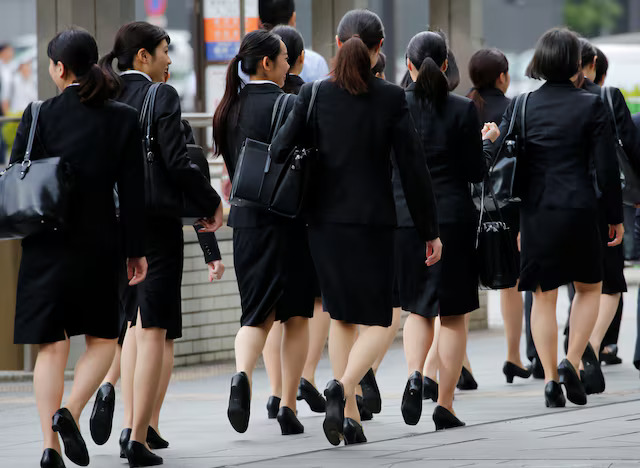
Female office workers wearing high heels, clothes and bags of the same color make their way at a business district in Tokyo, Japan, June 4, 2019. Photo: REUTERS/Kim Kyung-Hoon
This year marks four decades since the equal employment opportunity law came into force, and 20 years since employers were first required to take measures to prevent sexual harassment.
Reflecting progress in women's participation in the workforce and the wider society, as well as a rising number of nonregular employees, workplace relationships have become increasingly diverse.
At the same time, companies are under greater pressure to maintain appropriate relationships not only among employees, but also with customers and job-hunting students.
Although social norms on sexual harassment and related issues have been gradually defined through court rulings, the complete eradication of such misconduct remains a distant goal.
Added protections
When the equal employment opportunity law took effect in 1986, it prohibited gender discrimination in hiring and promotion but contained no provisions on sexual harassment.
It was not until the 1997 amendment that companies were first required to give due consideration to preventing such behavior in the workplace.
A subsequent revision in 2006 strengthened these obligations and made it mandatory for employers to prevent sexual harassment against both men and women.
Companies are now required to establish internal rules, raise employee awareness through training, and set up consultation desks for those seeking advice or support.
If an incident occurs, employers must conduct fact-finding investigations, discipline perpetrators appropriately, provide care and support for victims, and implement measures to prevent recurrence.
According to Masato Hara, a professor of labor law at Seikei University, because harassment cases sometimes include behavior that does not rise to the level of a crime, companies' responses tend to be polarized.
One group actively implements preventive measures, believing that creating a comfortable working environment directly leads to improved performance, Hara said.
The other group, however, is hesitant to act, due to the time, effort and cost involved, he added.
Hara pointed to the advantages of clearly codifying a ban on harassment, noting that "it helps narrow the gap in how committed different companies are to such efforts and promotes initiatives across society as a whole."
Over the past decade, legal obligations to prevent "maternity harassment" in the workplace, discriminatory treatment related primarily to pregnancy and childbirth, as well as "power harassment," meaning abuse of authority by supervisors and colleagues, have been steadily strengthened.
In June 2025, the law for the comprehensive promotion of labor policies was amended to enhance protections for employees against customer harassment, or egregiously disruptive or abusive behavior by customers.
Abusive customers
With the amended law scheduled to come into force as early as October, the Labor Policy Council, an advisory body to the labor minister, is currently deliberating guidelines on the preventive measures and other steps that companies will be required to implement.
A key challenge in dealing with customer abuse is how to maintain healthy relationships with customers while safeguarding employees.
Companies must respond firmly to any conduct that violates employees' human rights.
At the same time, some customer complaints are legitimate, and the boundary between reasonable and unreasonable demands is not always clear.
In a survey conducted by the Japan Business Federation, or Keidanren, some respondents expressed concern about the difficulty of determining what constitutes an unreasonable demand.
The planned guidelines are expected to include concrete examples--such as "psychological attacks, including slander and abusive language" and "intimidating behavior, such as shouting"--and to urge companies to clearly set out their response policies and establish consultation systems.
In addition, each industry is working to develop its own guidelines, reflecting actual conditions on the ground.
In the case of sexual harassment, mandatory preventive measures were not introduced until nearly 20 years after the equal employment opportunity law came into force.
The delayed response caused immense suffering among victims and resulted in serious losses of human resources for companies.
This history indicates that the business community must proactively recognize and address new patterns of harassment, rather than waiting passively for legislation to catch up.
Hara said, "Harassment becomes a problem when an individual fails to respect another person's dignity," emphasizing the importance of "consistently applying the principle of mutual respect."
Japan's experience suggests that, rather than responding in a piecemeal "whack-a-mole" fashion to evolving forms of harassment that continue to emerge as social issues, companies must be prepared to update their management practices continually in line with the principle of respect for human dignity.

Link nội dung: https://news.tuoitre.vn/japan-intensifies-fight-against-workplace-harassment-103260304173314438.htm