
Japan takes on seafloor rare earth mining for domestic production
TOKYO -- The Japanese government is taking on the challenge of mining critical minerals, including rare earths, from the seabed around Minamitorishima, a Japanese remote island in the Pacific, with an eye to realize domestic rare earth production in the future.
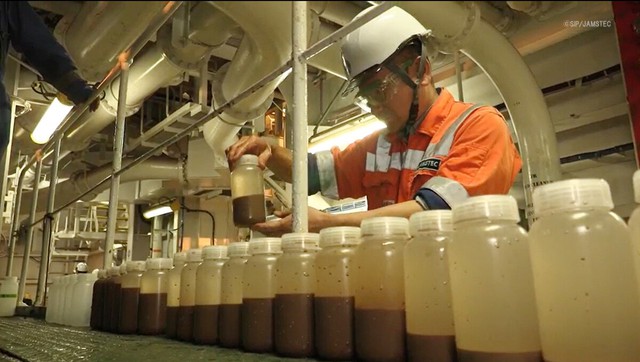
Rare earth-containing mud retrieved from the seabed near Minamitorishima in February. Photo: Courtesy of JAMSTEC
Securing such minerals is a matter of vital importance for Japan, which is poor in natural resources.
In February this year, the country succeeded in a test collection of rare earth-bearing mud at a depth of 6,000 meters below the surface of the sea near the island in the Tokyo village of Ogasawara.
While commercialization is targeted in 2028 at the earliest, the government faces the challenge of striking a balance between the importance of the mining for economic security and its economic viability.
Rich mineral resources are believed to lie in the ocean floor around Minamitorishima. Cobalt-rich crusts and manganese nodules have been found there. Cobalt and manganese are used for electric vehicle batteries.
Furthermore, the presence of mud containing scarce and expensive heavy rare earth elements such as neodymium and dysprosium has also been confirmed, and development is being promoted under government leadership. Neodymium and dysprosium are needed for high-performance motors used in EVs and wind power generators.
"We have promoted technical development over the years to make the world's first attempt" at deep-sea rare earth mining, Shoichi Ishii, an official of the Cabinet Office who leads the rare earth-rich mud development project.
In the ongoing initiative, the Cabinet Office and the Japan Agency for Marine-Earth Science and Technology, or JAMSTEC, adopted a method in which some 600 pipes, each around 10 meters long, were connected from the Chikyu deep-sea drilling vessel and a mining device at the tip enclosed the mud, mixed it with seawater and pumped it up.
"We were nervous until the mining device reached the seabed," Ishii said. "We are relieved that the test succeeded."
The government and JAMSTEC conducted a pipe connection test off the coast of Ibaraki Prefecture, northeast of Tokyo, in 2022 and improvements have been made since then.
The government plans to assess the economic feasibility of rare earth recovery by mining 350 tons of mud per day in 2027, securing a related budget of 16.4 billion yen for fiscal 2025.
The industry ministry expects that the profitable threshold for the ocean floor mining will be 3,500 tons of mud per day.
To realize mining on this scale, it will be necessary to upgrade vessels and dewatering facilities.
"It will cost a tremendous amount," a senior official of an economy-related government agency said.
China holds an overwhelming share in the global rare earth market and has repeatedly weaponized it, including by tightening export controls whenever the Japan-China relationship deteriorated.
Thus, the importance of securing a stable supply of rare earths and reducing dependence on China has been highlighted in terms of economic security.
"We should act with a perspective focused on protecting our country," Japanese economic security minister Kimi Onoda said, indicating a willingness to tolerate high costs for the ocean floor mining.

Link nội dung: https://news.tuoitre.vn/japan-takes-on-seafloor-rare-earth-mining-for-domestic-production-103260507163548073.htm