
Japan to consider promoting use of unnecessary inherited land
Japan's Justice Ministry is set to start full-scale discussions on a review of a system in which the state takes over inherited land plots under certain conditions, in order to promote transactions of such land.
In about three and a half years since the system was introduced, the government took over unnecessary land in more than 3,200 cases. But sales have been slow as many of the sites are difficult to use.
The government will explore ways to make effective use of unnecessary land by seeking demand from private-sector companies and local governments before it takes over such plots under the system.
Reflecting the country's falling population, there has been an increase in cases in which individuals struggle to manage plots of land they inherited, with many of them saying that they have no plans to use the land and that the management costs are heavy.
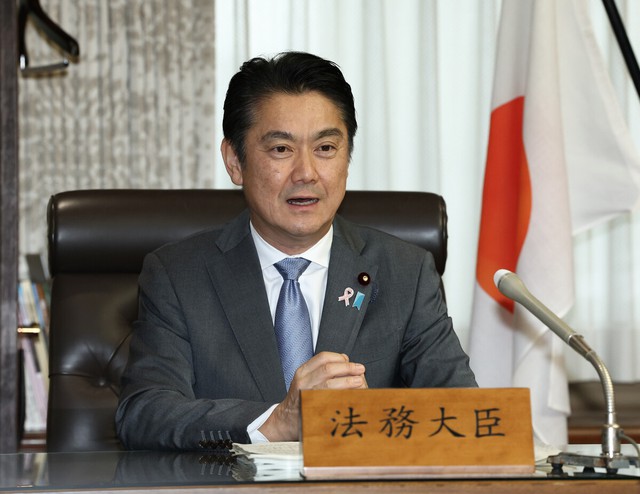
Japanese Justice Minister Takashi Yamashita speaks in an interview on Oct. 26.
In light of the situation, the government launched the system to take over such unnecessary land in April 2023 to prevent an increase of unclaimed land.
Under the system, the ownership of land is transferred to the government with a payment of 200,000 yen in management costs in principle for the period of 10 years, except for cases in which massive management and disposal costs are needed. Residential land is managed by the Finance Ministry, while the Agriculture, Forestry and Fisheries Ministry is in charge of managing farmland and forests.
By the end of September this year, the government received 6,125 applications for land ownership transfer under the system, with necessary procedures completed for 4,582 of the total cases. The state took over land in 3,231 cases.
Meanwhile, the government disapproved 189 applications due to reasons such as vehicles or trees remaining on the land plots concerned to hinder proper management.
In September, the Justice Ministry announced the results of a survey covering 2,157 people, including applicants and lawyers. Of the users of the system, 73 pct said that they are satisfied with the outcomes of the government's screenings of their applications.
Of the applicants, 23.5 pct said they spent less than 50,000 yen demolishing buildings or removing grass on the land, 24.7 pct between 200,000 yen and less than 500,000 yen, and 21.2 pct 1 million yen or more.
More than 50 pct said they think the management fee paid to the government is high.
One respondent said, "It took a long time from the application to an on-site visit (by government officials), so I was asked to remove the grass again, which cost me more (than initially expected)."
Another said that the management fee for forests is too high.
Of the land plots taken over by the government, only some have been sold while many other sites have problems, such as being slopes and having only small areas, and therefore are not marketable.
Given increases in the number of land plots that are not expected to be used and in management costs, some in the ruling Liberal Democratic Party are calling for tougher requirements for land takeover by the government under the system.
"A careful study is needed for a possible revision of the system," a Justice Ministry official said.
Last month, the ministry started to post on its website sale information for land managed by the Finance Ministry and the Agriculture, Forestry and Fisheries Ministry.
The Justice Ministry will discuss ways to make effective use of land that do not depend on the government's takeover.
Specifically, it will consider a mechanism to match applicants under the existing land takeover system and potential land users, while seeking demand from private corporations and local governments.
If it is necessary to revise a related law, the government would aim to submit an amendment bill to the ordinary parliamentary session of 2028.

Link nội dung: https://news.tuoitre.vn/japan-to-consider-promoting-use-of-unnecessary-inherited-land-103261115180220104.htm