
Japanese capital inflows into Vietnam set to rise as SSIAM, DCI seek financial partners
Japanese capital is expected to flow into Vietnam through expanded investment and business channels, as Vietnam's SSI Asset Management Company (SSIAM) and Japan's Daiwa Corporate Investment (DCI) have signed a memorandum of understanding (MoU) to promote investment cooperation and seek to connect Vietnamese businesses with more than 20 regional banks, as well as Japanese credit rating agencies.
The MoU was signed in Tokyo on Monday in the presence of Vietnam's Party General Secretary and State President To Lam, who is on an official visit to Japan from Sunday to Wednesday, and senior Japanese leaders.
The agreement builds on more than 15 years of cooperation between the two sides, extending their partnership beyond investment fund management to connecting Japanese regional banks and business communities with the Vietnamese market.
A key focus is mobilizing medium- and long-term capital through the Daiwa-SSIAM Vietnam Growth Fund IV, which the two companies will jointly manage, with Japanese regional banks participating as investors.
The partnership also aims to open additional financing channels for Vietnamese businesses, including direct lending, mezzanine financin, and co-financing.
Beyond financing, the two sides seek to connect Vietnamese companies with the extensive customer networks of Japanese regional banks, creating opportunities for business cooperation, technology transfers, joint ventures, and mergers and acquisitions (M&A).
Under the arrangement, DCI will leverage its network of Japanese regional banks and financial institutions, while SSIAM will identify and introduce Vietnamese companies with growth potential and suitable capital-raising needs.
Speaking to Tuoi Tre (Youth) online newspaper, SSIAM general director Nguyen Ngoc Anh said the two sides were already approaching and holding discussions with more than 20 regional banks, as well as credit rating agencies in Japan, to advance the initiative.
"Quality and the ability to execute each transaction are our top priorities. SSIAM expects to disburse funds for two to three transactions in the fourth quarter of 2026, gradually turning the initiative into reality," she said.
Anh said the initiative's success would be measured in the longer term not only by the amount of capital mobilized but also by the number of businesses gaining access to medium- and long-term funding and the substantive business partnerships established between the two markets.
What makes Vietnam attractive to Japanese investors?
According to Anh, several factors are strengthening Vietnam's appeal to Japanese financial institutions.
Japan's Rating and Investment Information (R&I) recently upgraded Vietnam's foreign-currency issuer credit rating from BB+ to BBB-, with a stable outlook, marking the first time an international credit rating agency has assigned Vietnam an investment-grade rating.
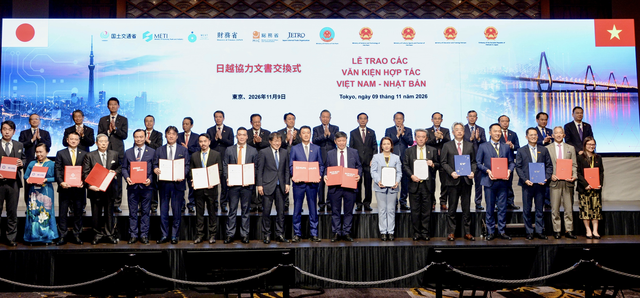
The ceremony for the exchange of cooperation documents between Vietnam and Japan, including an MoU between SSI Asset Management Company (SSIAM) and Daiwa Corporate Investment (DCI), witnessed by Vietnam's Party General Secretary and State President To Lam and senior Japanese leaders in Tokyo, November 9, 2026. Photo: SSI
The upgrade could help Vietnam attract more Japanese capital, as R&I is recognized by Japan's Financial Services Agency and the BBB- rating may enable the country to meet capital allocation requirements imposed by certain Japanese financial institutions.
Vietnam's growth prospects, substantial demand for medium- and long-term capital, and increasingly prominent role in regional supply chains are also attractive to Japanese investors.
Meanwhile, slower growth in credit demand in some parts of Japan is prompting regional banks to seek opportunities in new markets and support their corporate clients' overseas expansion, Anh noted.
When evaluating investment opportunities in Vietnam, Japanese partners place particular emphasis on corporate governance, financial transparency, cash flow generation, debt repayment capacity, competitive positions, and long-term growth prospects.
They also assess companies' management capabilities, legal compliance, risk management and environmental, social and governance (ESG) standards, while seeking long-term partnerships rather than purely financial returns.
However, differences in accounting standards, information disclosure requirements and legal frameworks, as well as foreign exchange risks and limited exit opportunities, remain challenges for Japanese investors in Vietnam.
For cross-border financing, investors also carefully assess whether loan maturities and the intended use of funds are aligned with borrowers' cash flow generation and debt repayment capacity.
Japanese investment in Vietnam may go beyond traditional FDI
Anh described the outlook for Japanese investment in Vietnam's capital market as positive.
The official visit to Japan by Party General Secretary and State President To Lam has provided fresh political and economic momentum for bilateral cooperation, creating favorable conditions for agreements between financial institutions and businesses in the two countries to translate into concrete programs and transactions, she said.
Vietnam is entering a development phase that requires substantial medium- and long-term funding for infrastructure, manufacturing, technology, energy, and business expansion.
Meanwhile, Japanese investors bring strengths in long-term capital, risk management, technology and corporate networks, making the two markets highly complementary.
Notably, Japanese investment in Vietnam is expected to extend beyond traditional foreign direct investment (FDI) into a wider range of channels, including equity investments, investment funds, cross-border lending, co-financing, mezzanine financing, strategic partnerships and mergers and acquisitions.
DCI's investment profile
DCI, which is wholly owned by Japan's Daiwa Securities Group, specializes in private equity fund management and has been active in the investment sector since 1982.
As of the end of March 2026, DCI had established 95 funds with a cumulative investment value of approximately 477.7 billion yen (nearly US$3.02 billion) and invested in 2,382 businesses, with 673 initial public offerings (IPOs) recorded among them.
The firm has also expanded its investments across Asia, including Vietnam, China and Taiwan, and has maintained a representative office in Ho Chi Minh City since 2009.


Vinh Tho – Binh Khanh / Tuoi Tre News
Link nội dung: https://news.tuoitre.vn/japanese-capital-inflows-into-vietnam-set-to-rise-as-ssiam-dci-seek-financial-partners-103261109192112539.htm