
Japanese man helps awaken remote village in Vietnam’s far north
More than a decade ago, Lo Lo Chai was a quiet village at Vietnam’s northernmost tip in Lung Cu Commune, Tuyen Quang Province, little known even to domestic travelers, but today it has become a lively and attractive tourist destination bustling with visitors, thanks in part to a Japanese traveler.
The tourist behind that transformation is Yasushi Ogura, a soft-spoken Japanese man whose fascination with Vietnam’s landscapes and ethnic minority cultures gradually helped change the fate of the village, which was named one of the world’s best tourism villages in 2025 by the United Nations Tourism Organization.
Over the years, he quietly helped develop a small community-based tourism model that encouraged villagers to preserve their traditional homes while welcoming visitors.
Now nearing 70, Ogura lives simply in Hanoi, renting a modest home and owning no car, yet says he is content knowing his choices have brought happiness not only to himself but also to many others.
Love for Vietnam
Ogura’s connection with Vietnam began more than three decades ago when he first visited in 1995 as a tourist and quickly fell in love with a country that was still poor but full of warmth and friendliness.
Ho Chi Minh City and Can Tho City in southern Vietnam were among the first places he explored, where the scenery and food culture captivated him.
When he returned in 1999 and traveled to Hanoi and the mountainous northwest, he discovered another side of Vietnam.
At the time most international travelers only knew Sa Pa in northern Lao Cai Province, but Ogura ventured deeper into the northern highlands and was fascinated by the dramatic landscapes and rich cultures of the ethnic minority communities there.
He was especially impressed by the vibrant traditional clothing worn in the mountain villages, with its intricate craftsmanship and striking colors.
Almost every year he returned with a camera to capture the scenery and the warm faces of the people he met, and because cameras were rare then villagers were delighted to receive pictures of themselves.
He even developed the photos and mailed them back to the people he had photographed.
One day a young Vietnamese girl who received her picture wrote him a letter. Even though he was deeply touched, he could not read it because it was written in Vietnamese.
Determined to understand the message, he began teaching himself the language and spent five years studying it.
Discovering Lo Lo Chai
In 2013, at the age of 56, Ogura retired early so he could devote more time to traveling in Vietnam.
Among all the places he had visited, Tuyen Quang held a special place in his heart.
In 2014, while exploring villages near the northern border, he discovered Lo Lo Chai, a small community of about 100 Lo Lo ethnic minority households near the Lung Cu Flag Tower.
Many families still lived in traditional rammed-earth houses surrounded by stone fences and topped with yin-yang tiled roofs, architecture that Ogura found both beautiful and unique.
But he also noticed a worrying trend as improving living standards encouraged some villagers to replace these traditional homes with modern concrete houses.
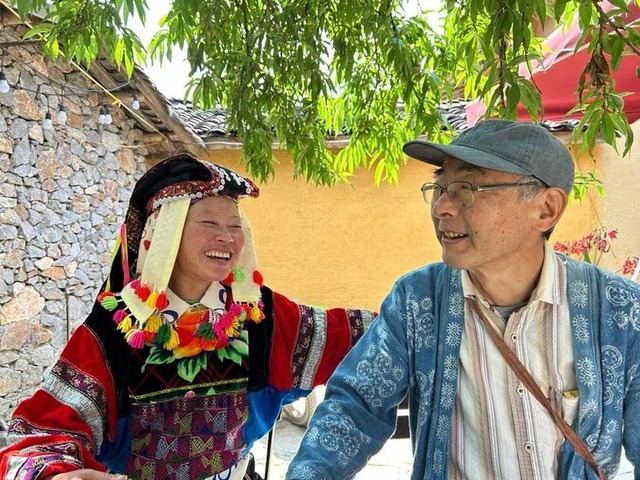
Yasushi Ogura (R) talks with the owner of Cuc Bac Coffee, a café he helped establish in Lo Lo Chai Village, Lung Cu Commune, Tuyen Quang Province, northern Vietnam. Photo: Supplied
To him, the century-old houses were not just homes but valuable cultural assets that could support community-based tourism.
If tourism could bring income, he believed, villagers would have a reason to preserve them.
The café that changed a village
Ogura decided to create a small tourism model that villagers could follow.
He found the opportunity at the home of Diu Di Chien, whose well-preserved rammed-earth house and stone fence made it an ideal setting.
He suggested opening a coffee shop to serve travelers visiting Lung Cu, and the family agreed.
Using VND200 million (US$7,600) from his own savings, he helped build a coffee counter, proper restrooms, and improve the surroundings, while two volunteers from Hanoi trained the family in coffee-making and hospitality.
At first the family did not even know what coffee was.
Over time they built a successful café that attracted travelers, which Ogura named Cuc Bac Coffee.
The business allowed Chien’s children to attend university and sparked broader change.
As tourism grew, other families opened homestays and small businesses, traditional houses were preserved, and villagers began earning more stable incomes.
Today Lo Lo Chai is widely recognized as one of the world’s best tourism villages.
Diu Thi Huong, Chien’s daughter, said the village was once little known and impoverished before Ogura arrived.
Tourism soon transformed local life as houses were preserved, incomes improved, and children gained better educational opportunities.
Huong graduated from the Hanoi University of Science and Technology, while her younger brothers are now attending university.
Vision for sustainable tourism
Ogura’s work did not stop with Lo Lo Chai.
He hopes other ethnic minority villages in Tuyen Quang can follow a similar path of community-based tourism, where local residents remain the true hosts and benefit directly from their natural and cultural resources.
Such villages, he believes, can become ‘living museums’ that preserve traditional landscapes, culture, and everyday lifestyles.
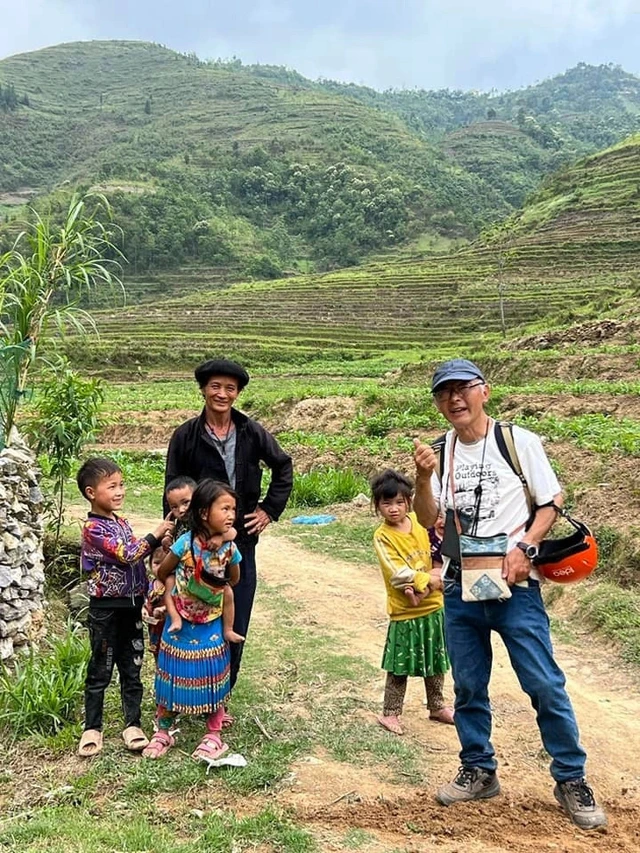
Yasushi Ogura (R) poses for a photo with local residents in Lo Lo Chai Village, Lung Cu Commune, Tuyen Quang Province, northern Vietnam. Photo: Supplied
“I want people to understand that even daily life here can become a tourism resource without massive investment,” Ogura said.
In recent years he has continued traveling through remote mountain communities while proposing tourism development ideas to local authorities.
In 2025 he joined local authorities in supporting the repair and construction of six rammed-earth houses in a Hmong village in Dong Van Commune, Tuyen Quang, contributing VND10 million ($380) from his own pocket to each house.
He hopes sustainable tourism will allow young people to build livelihoods in their hometowns instead of leaving for uncertain jobs in distant cities.
After more than 30 years of visiting Vietnam, the Japanese traveler who once arrived as a curious tourist has quietly become something more.
To many people in the mountains of Tuyen Quang, Ogura is simply the kind man who helped awaken a village.
Vinh Tho - Thien Dieu / Tuoi Tre News
Link nội dung: https://news.tuoitre.vn/japanese-man-helps-awaken-remote-village-in-vietnams-far-north-103260316172800277.htm