
Japanese property giants deepen their push into a booming Indian market
Japanese real estate developers are wading further into a tricky Indian market and more of their peers are expected to get their feet wet, drawn by rising rents in a rapidly growing economy as well as low construction costs.
First case in point is Mitsui Fudosan, Japan's biggest property developer, which forayed into India in 2020, partnering with local developer RMZ Real Estate to build an office complex in Bengaluru.
Mitsui Fudosan could embark on fresh investment of 30-35 billion yen ($190-$225 million) or more in projects with either RMZ or other developers, said two sources with knowledge of the plans.
Last month, members of Mitsui Fudosan's management team were in Mumbai and the region around the capital New Delhi looking at opportunities, they added, declining to be identified as the information was private.
Mitsui Fudosan declined to comment. RMZ declined to comment on the potential new investment.
RMZ Real Estate CEO Avnish Singh did say, however, that Japanese developers are kicking into higher gear now that trust with local partners has been established.
"The floodgates can open and have opened," he said.
Sumitomo Realty and Development, Japan's No.3 developer which describes Mumbai as its second engine of growth after Tokyo, has committed $6.5 billion across five projects in the city, including two sites added this year.
It is also scouting for land around a soon-to-be operational Navi Mumbai city airport for new investment, said a senior industry source familiar with its strategy. The source declined to be named because the information was confidential.
Sumitomo Realty did not respond to a request for comment.
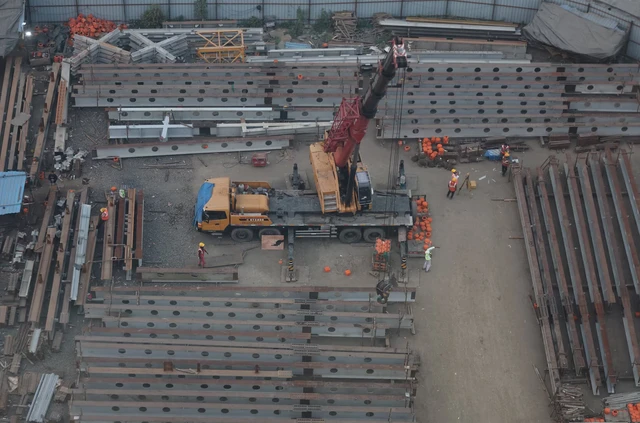
Construction workers at an office space construction site by Japanese firm Sumitomo Realty's India unit in Mumbai, India, November 26, 2025. Photo: Reuters
Sleeves rolled up
Japanese companies are far from the only overseas investors keen on Indian property. U.S. investment firm Blackstone, for example, is India's biggest commercial landlord, and roughly half of its $50 billion in Indian assets are in real estate.
Like Blackstone, most foreign players purchase existing assets given India's notorious reputation for construction delays that can leave prospective tenants and buyers high and dry. Although reforms in recent years have improved construction timelines and created a new framework to resolve disputes, acquiring land can be very slow, involving much red tape.
"Japanese investors are one of the few willing to take development risk. They like to roll up their sleeves," said Singh.
Despite red-tape headaches, the returns can be worthwhile.
"Expected returns in the Japanese market are maybe around 2-4%. In India, you can easily expect 6-7%," said Seiji Ota, a partner at Deloitte India who focuses on Japanese investments in the country.
Ota and Singh said a number of other Japanese developers want to make their first foray into India and are assessing opportunities to develop office, retail and hotel projects.
Japanese companies and funds have boosted investment in overseas real estate by a fifth this year, according to a survey by Sumitomo Mitsui Trust Research Institute conducted in September.
While the U.S. and Australia remain long-favoured markets, interest in India notably spiked, with 41% of those surveyed intending to invest, up 6 percentage points from a year earlier.
Low costs and climbing rents
One key draw for Japanese developers is India's low labour costs. Hiring an electrician or a plumber, for example, costs just $2 an hour.
Constructing premium office buildings of up to 20 floors costs more than $8,000 per square metre in New York, around $5,300 in London and $4,000 in Tokyo, but is just $656 in Mumbai, data from real estate consultancy Turner & Townsend shows.
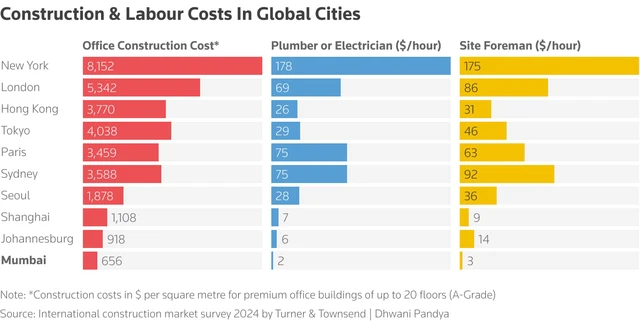
A graphic showing a comparison of construction and labour costs in top global cities. Photo: Reuters
Just as importantly, rents for premium office space have surged in India on the back of economic growth that has averaged 8% over the past three fiscal years.
Mumbai's Bandra Kurla Complex - its central business district - led growth in commercial rents for the Asia Pacific region in the third quarter with a jump of 14.2%, according to CBRE, a commercial real estate services and investment firm.
That was followed by Tokyo's central five wards which rose 10.2%, while India's national capital region and Seoul's central business district both climbed over 9%.
Japanese firms' preference for designing a building from scratch allows them to bring in technology not used in India.
Sumitomo Realty's first project in Bandra Kurla Complex is using a steel structure that enables very wide floor plates and thus pillar-less offices - something that Indian developers cannot do yet, said the source familiar with its strategy.
The firm expects to charge a 30%-40% premium over normal rents in the area for this design feature, the source added.
JPMorga will be a tenant in the building, according to two sources and a copy of the lease. The U.S. bank did not respond to a request for comment.
Other Japanese developers in the Indian market include Daibiru Corp, which started with investments in office deals in two cities last year. It is now scouting for land and could even look at developing residential buildings and data centres, said Anand Jayaraman, South Asia CEO of its parent Mitsui O.S.K. Lines.
($1 = 155.8600 yen)

Reuters
Link nội dung: https://news.tuoitre.vn/japanese-property-giants-deepen-their-push-into-a-booming-indian-market-103251201122949919.htm