
Journalists must maintain warm, attentive focus on audience
More than 40 journalists from 30 countries, including four from Vietnam, gathered at the World Journalists Conference 2026 in Seoul on Monday to discuss the role of media in times of crisis and the growing use of artificial intelligence in newsrooms.
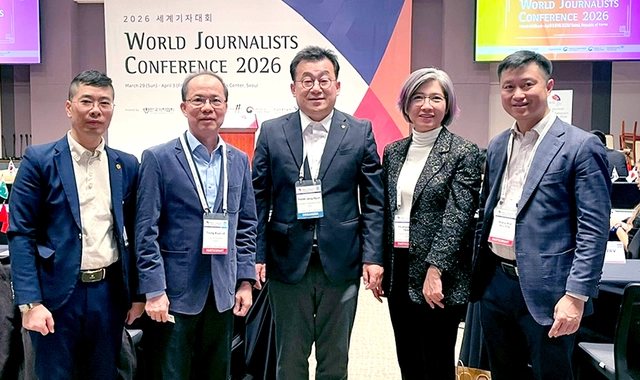
Park Jong Hyun (C), president of the Journalists Association of Korea, poses with Vietnamese journalists at the World Journalists Conference 2026 in Seoul, South Korea, March 30, 2026. Photo: Collaborator
The discussions were held in two sessions titled 'Democracy and Journalism at a Crossroads: The Role of Media in Times of Crisis' and 'AI in Newsrooms: from Practice to the Next Phase.'
Park Jong Hyun, president of the Journalists Association of Korea, said that amid ongoing tensions that broke out in late February between the U.S., Israel, and Iran, misinformation and hate content were spreading widely, underscoring the need for journalists to provide accurate and objective reporting.
“Journalists are those who record," Park said.
"At the same time, they are those who carry small lights.
"When those lights come together, the world becomes brighter.
"We must maintain a warm and attentive focus on the people we serve.”
Participants exchanged views and professional experience on covering major global events, as well as on applying technology, particularly AI, in journalism.
Many said AI has already been widely adopted in newsrooms worldwide, raising questions about how it can best support journalists in processing data, verifying information, and producing multimedia content more quickly and efficiently.
Speakers agreed that AI should be used to complement journalists by maximizing its strengths while limiting its weaknesses, stressing it cannot replace human judgment or accountability.
They said the goal of using AI in journalism is to better meet increasingly diverse audience demand for information.
The annual conference has been hosted by the Journalists Association of Korea since 2013, with support from South Korea's Ministry of Culture, Sports and Tourism, Ministry of Foreign Affairs, and Korea Press Foundation.
Xuan Trung