
Meet 'kings' of Ca Mau's waters: Giant crabs, jumbo tiger prawns, million-dong specialties
Ca Mau, Vietnam's southernmost province in the Mekong Delta, is home to some of the country's most remarkable seafood giants, from crabs weighing nearly 2kg to tiger prawns longer than 30cm, with some specimens fetching hundreds of dollars each.
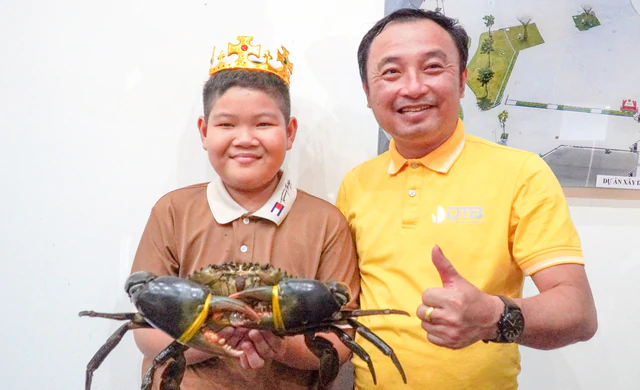
Du Thai Binh (R) poses with his record-breaking Ca Mau crab. Photo: Thanh Huyen / Tuoi Tre
The king crabs from Ca Mau's mangrove forests
With more than 365,000 hectares of crab farms, Ca Mau accounts for about 78 percent of Vietnam's crab-farming area and 53 percent of the country's total crab output, producing more than 36,000 metric tons annually.
The province has long been known as 'Vietnam's crab capital.'
In February, Ca Mau authorities officially recognized a giant local crab weighing 1.82kg as Vietnam's largest.
The crab had been purchased by Du Thai Binh, deputy director of Du Thai Binh Co. Ltd. in Nam Can Commune, from a local shrimp-and-crab farmer for VND7.5 million (US$300).
In 2022, Binh's company also won first prize in a sumo crab competition with a crab weighing more than 1.42kg, taking home a cash prize of about $600.
During selection rounds for giant crabs to be displayed and entered in crab festivals, Binh had owned female crabs carrying roe that weighed up to 1.1kg, as well as several male crabs weighing more than 1.8kg.
According to experienced crab traders and farmers in Ca Mau, common green-clawed and red-clawed mud crabs typically reach maximum weights of around 1.5kg for males and less than 1.2kg for females.
Only the locally native green mud crab, which inhabits ecological shrimp-and-crab farms beneath coastal mangrove forests, can grow beyond 1.5kg and even exceed 2kg.
Nguyen Hoang An, chairman of the Cai Bat Fisheries Cooperative in Hung My Commune, Ca Mau Province, who has decades of experience farming crabs in the Nam Can area, said the green mud crab is distinguished by its large claws and deep lotus-purple color.
The species burrows deep into hollows beneath mangrove apple and mangrove trees, making it difficult to catch.
A crab weighing more than 2kg must have grown naturally for at least two years. Record-sized crabs are always male, as their larger claws give them an advantage during mating season.
Male crabs also tend to live longer than females in aquaculture ponds.
When ready to carry eggs, female crabs swim toward river mouths and the open sea to spawn. If kept too long in enclosed brackish-water ponds, they will eventually die.
The harsh conditions of nature and the mangrove ecosystem have helped shape the giant crabs for which Vietnam's southernmost region is renowned.
Chasing giant tiger prawns in the open sea
While the giant crabs of Ca Mau thrive beneath mangrove forests, its giant tiger prawns come from the sea.
At a 2026 competition to find the province's heaviest tiger prawn, held as part of the second Ca Mau Shrimp Festival, the first prize went to a 380.9-gram prawn measuring 34.3cm.
It belonged to Tu Van Toan, director of Chi Toan Co. Ltd. in Phan Ngoc Hien Commune, and earned him a VND15 million ($600) prize.
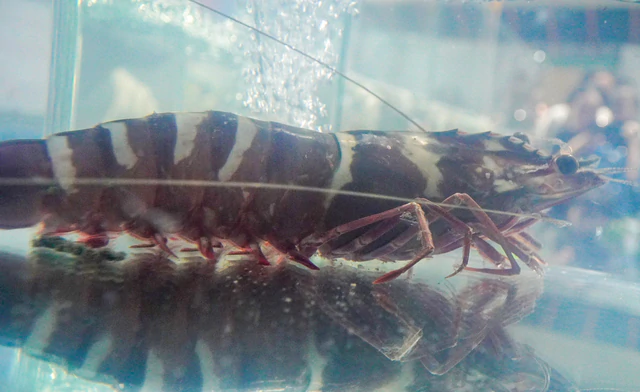
Ca Mau's 2026 heavyweight tiger prawn weighs nearly 400 grams. Photo: Thanh Huyen / Tuoi Tre
For Toan, tiger prawns weighing around 400 grams are not uncommon on his family's fishing trips.
However, after learning about the competition at short notice and facing unfavorable offshore weather, his boat could not venture as far out as it normally would in calmer conditions.
He therefore selected only the two largest prawns available at his seafood depot to enter the contest.
Explaining why farm-raised tiger prawns rarely exceed 300 grams, Vo Chi Cong of the Ca Mau Fisheries Sub-Department said they are usually harvested while still relatively young, in line with pond maintenance cycles.
Brackish-water conditions also limit their growth.
Tiger prawns reach their full size and sexual maturity only after moving out to sea, where they inhabit sandy-muddy seabeds at depths of 20 to 50 meters.
There, salinity exceeds 30 parts per thousand and strong currents create conditions for them to grow into giants.
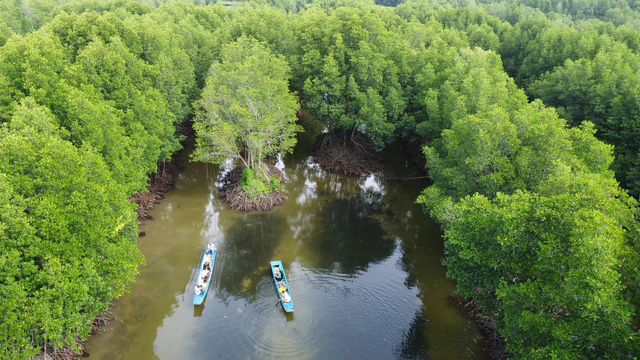
Coastal mangrove forests provide an ideal habitat for crabs and shrimp to grow to extraordinary sizes. Photo: Thanh Huyen / Tuoi Tre
For those in the trade, the value of a broodstock tiger prawn depends not just on its weight but also on its health and reproductive capacity.
Each year, boats operated by Chi Toan Co. Ltd. catch thousands of broodstock tiger prawns weighing between 200 and 400 grams using specialized nets.
Occasionally, the nets haul in prawns weighing more than 600 grams. However, Toan said such oversized prawns are often too old to reproduce effectively, making them less attractive to hatcheries.
Healthy female prawns weighing between 200 and more than 300 grams can fetch VND5-10 million each ($200-400).
Each female can produce around one million young prawns per spawning cycle and can be used for three to four cycles on average.
Getting these valuable broodstock prawns safely to hatcheries in Khanh Hoa, Da Nang and Hai Phong is a race against time.
Toan began working as a hired hand at sea at the age of 17. After 30 years in the fishing trade, he now owns a fleet of 10 vessels: six fishing boats and four boats used to collect catches and deliver supplies.
The fishing boats remain at sea for more than three months at a time. Tiger prawns bury themselves in sandy seabeds during the day and emerge to feed at night, so fishermen must time their net-setting with the tides.
Once brought aboard, the prawns are immediately placed in oxygenated tanks before being transferred to supply boats, which take turns rushing them back to shore.
Toan carefully schedules each boat's arrival to match hatcheries' orders.
A healthy broodstock prawn may be worth VND5 million ($200), but if delivery is delayed by just three or four days and the prawn weakens, it may have to be sold for meat at less than VND200,000 ($8).
In the past, traders gathered in speedboats alongside fishing vessels near the Rach Goc estuary to buy and sell broodstock tiger prawns.
Those busy trading days are now a thing of the past, as rising fishing costs and financial risks have driven many out of the business.
Today, only seasoned fishermen like Toan remain, continuing to supply valuable broodstock for Vietnam's shrimp industry.
Turning giant tiger prawns into a high-value delicacy
Beyond supplying broodstock and selling fresh prawns to restaurants, Ca Mau's giant tiger prawns, with just five to 10 prawns per kilogram, are also turned into premium specialties through traditional local craftsmanship.
At the second Ca Mau Shrimp Festival in 2026, whole giant dried tiger prawns made by the Ba Khia Dam Doi Cooperative in Cay Ke Hamlet, Quach Pham Commune, Ca Mau Province, drew particular attention from visitors.
Priced at VND2.5 million per kilogram ($100), or roughly $10 per prawn, they cost nearly twice as much as regular dried tiger prawns.
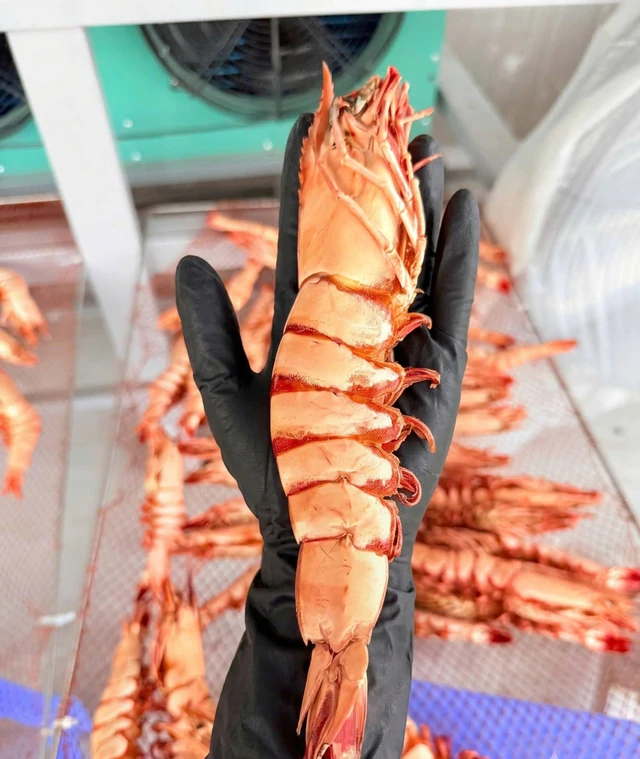
Giant dried tiger prawns made from fresh prawns weighing around five per kilogram sell for about VND2.5 million ($100) per kilogram. Photo: Thanh Huyen / Tuoi Tre
Tran Thi Xa, director of the Ba Khia Dam Doi Cooperative, said the secret behind this premium specialty lies in the strict selection of raw ingredients.
Only about two percent of tiger prawns raised in natural shrimp-and-crab farms reach the desired size of five to 10 prawns per kilogram, making them scarce.
Once harvested, the prawns must be transported immediately to the processing facility and kept alive with a continuous supply of oxygen.
Xa said chilling the prawns in ice water before boiling would cause the roe in their heads to break apart, diminishing both its rich flavor and visual appeal.
After being boiled at a carefully controlled temperature, each prawn is meticulously shaped by hand before going straight into a drying machine for 24 hours to retain its shape and freshness.
The prawns are then placed in a greenhouse to dry naturally under the sun for two more days, giving the meat a firm yet tender texture without becoming hard or chewy. They are then vacuum-packed.
One kilogram of fresh giant tiger prawns yields just 10 to 15 dried prawns after processing, each weighing 70 to 100 grams.
The finished prawns retain their natural bright red color, with no blackening around the heads.
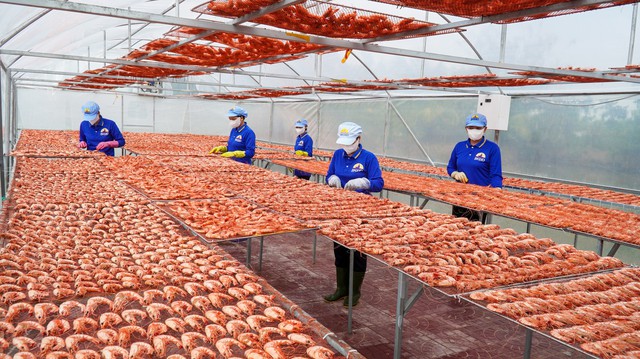
The Ba Khia Dam Doi Cooperative specializes in making giant dried tiger prawn products to add value to local specialties. Photo: Thanh Huyen / Tuoi Tre
Along the waveswept coast and beneath the vast mangrove forests of Vietnam's southernmost province, nature has nurtured seafood species that grow far beyond their usual size.
Beyond record-breaking weights and extraordinary sizes, each giant crab and tiger prawn tells a story of the local people's hard work, deep understanding of nature, and determination to bring Ca Mau's local specialties to greater prominence.



Van Giang - Thanh Huyen / Tuoi Tre News
Link nội dung: https://news.tuoitre.vn/meet-kings-of-ca-maus-waters-giant-crabs-jumbo-tiger-prawns-million-dong-specialties-10326112716492321.htm