
'Mini dinosaurs' thrive on Vietnam's semi-arid sands, creating niche rural livelihood
On the windswept sand dunes of Vietnam's south-central coast, farmers are raising sand lizards, reptiles locally nicknamed 'mini dinosaurs,' in semi-wild enclosures that have turned once-barren land into a source of income.
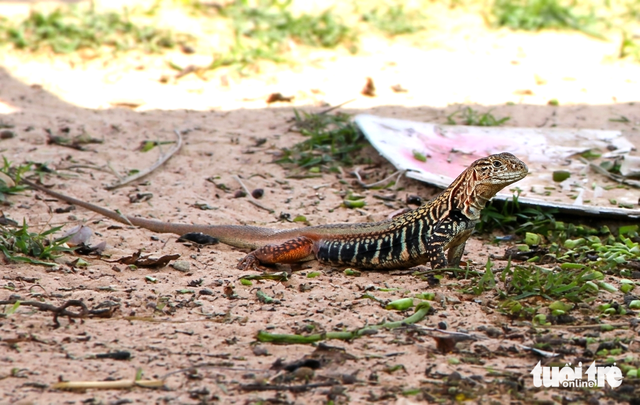
A sand lizard crawls across a sand enclosure at a breeding farm in Hoa Thuy Village, Ninh Phuoc Commune, Khanh Hoa Province, south-central Vietnam, June 2026. Photo: Duc Cuong
What began as a small-scale experiment by a handful of households in Hoa Thuy Village, Ninh Phuoc Commune in Khanh Hoa Province, has grown into one of Vietnam's main breeding centers for sand lizards, supplying both meat and breeding stock to other parts of the country.
At midday in June, thousands of lizards of varying sizes can be seen digging burrows, searching for food, and basking on the hot sand inside brick-walled enclosures built to mimic their natural habitat.
The reptiles, native to coastal sand dunes in the region, are well adapted to dry conditions, require little care and feed mainly on vegetables and fruit, keeping production costs relatively low.
"Years ago, this area was mostly unused sand because nothing could be grown here," said farmer Nguyen Cang, who has been raising sand lizards for more than a decade.
"People saw that wild lizards were hardy and resistant to disease, so some began catching and raising them.
"They eat vegetables, require little maintenance, and can be sold at relatively high prices because demand is strong."
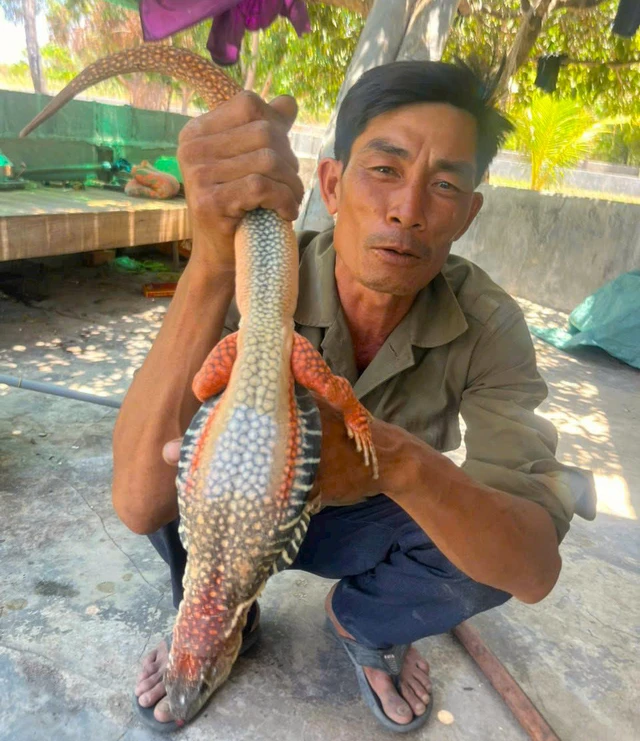
A farmer holds a sand lizard at a breeding farm in Hoa Thuy Village, Ninh Phuoc Commune, Khanh Hoa Province, south-central Vietnam, June 2026. Photo: Van Tam
Farmers typically build perimeter walls about one meter high, with deep foundations to prevent the animals from burrowing out, while preserving sandy conditions that resemble their natural environment.
Female sand lizards lay one clutch of around five to 10 eggs each year and reproduce best in loose sand, allowing farmers to gradually develop self-sustaining breeding stocks.
Some large male lizards can weigh close to one kilogram and are known for their colorful appearance and rough skin, which has led locals to compare them to miniature dinosaurs.
Farmer Nguyen Van Tam raises about 10,000 sand lizards and sells both meat and breeding stock to customers inside and outside the province.
He said sand lizards from the region are popular in cities including Da Nang City, Ho Chi Minh City, and Can Tho City because their meat is considered firm, lean, and flavorful.
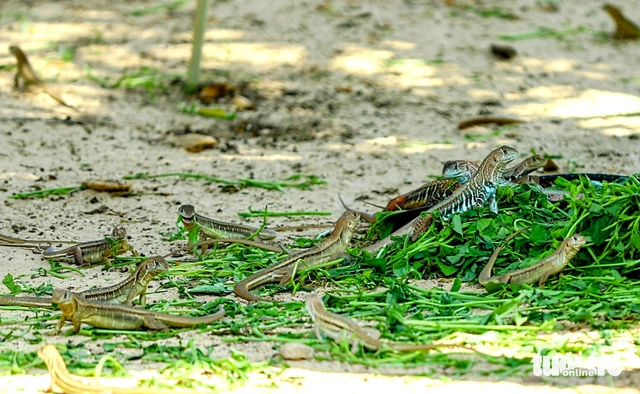
Sand lizards feed on vegetables at a breeding farm in Hoa Thuy Village, Ninh Phuoc Commune, Khanh Hoa Province, south-central Vietnam, June 2026. Photo: Duc Cuong
Market prices currently range from VND600,000 (US$23) to VND800,000 ($30) per kilogram for meat and VND500,000 ($19) to VND600,000 per kilogram for breeding stock.
"Because the climate is hot year-round and the sand remains dry, the lizards move around constantly and dig burrows every day," Tam said.
"That makes the meat firmer and sweeter than lizards raised in more humid environments."
After about eight months, the animals are ready for sale.
Tam said he can earn between VND6 million ($228) and VND10 million ($380) per month from lizard sales alone.
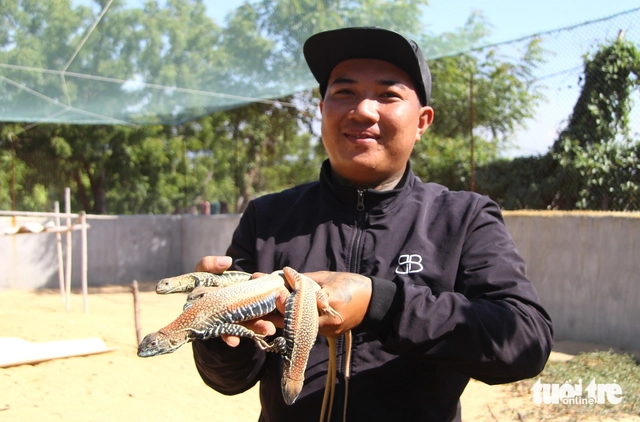
Farmer Nguyen Van Tam holds sand lizards at a breeding farm in Hoa Thuy Village, Ninh Phuoc Commune, Khanh Hoa Province, south-central Vietnam, June 2026. Photo: Duc Cuong
Many households have also begun raising wild rabbits in the same enclosures to increase returns without significantly increasing infrastructure costs.
Wild rabbit meat sells for about VND600,000 to VND650,000 ($24.7) per kilogram, while breeding rabbits fetch between VND700,000 ($26.6) and VND900,000 ($34.2) per kilogram.
Nguyen Huu Luan, chairman of the Vietnam Fatherland Front Committee in Ninh Phuoc Commune, said sand lizard farming has expanded steadily over the years as breeders learned to reproduce the animals in captivity rather than relying on wild-caught stock.
The commune now has more than 100 households raising sand lizards across about 20 hectares of enclosures, producing more than 10 metric tons of meat annually, he said.
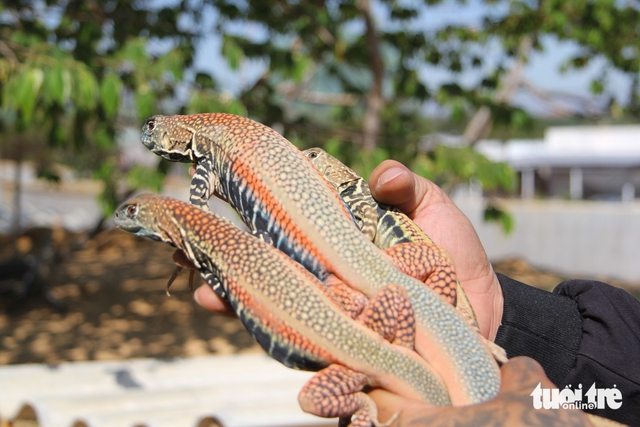
A farmer holds sand lizards at a breeding farm in Hoa Thuy Village, Ninh Phuoc Commune, Khanh Hoa Province, south-central Vietnam, June 2026. Photo: Duc Cuong
Bao Anh - Duc Cuong / Tuoi Tre News
Link nội dung: https://news.tuoitre.vn/mini-dinosaurs-thrive-on-vietnams-semi-arid-sands-creating-niche-rural-livelihood-103260620161843273.htm