
Most female rhinoceros beetles mate only once in lifetime: study
TOKYO -- A group of researchers including Wataru Kojima, an associate professor of animal ecology at Yamaguchi University's Graduate School of Sciences and Technology for Innovation, has found that most female Japanese rhinoceros beetles mate only once in their lifetime, which is rare for an insect.
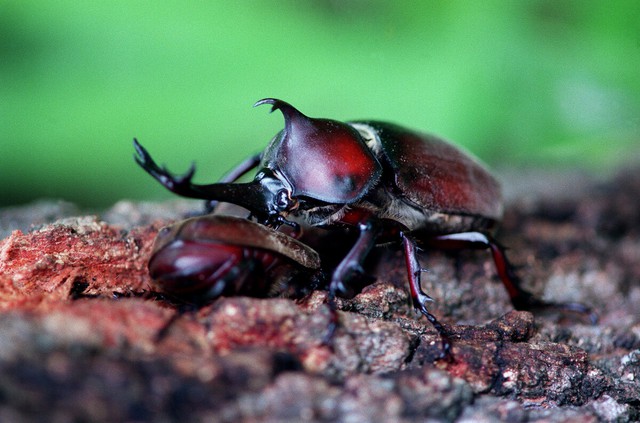
Japanese rhinoceros beetles. Photo: Jiji Press
Usually, females of other insect species mate on multiple occasions.
The pre-mating behavior of the Japanese rhinoceros beetle, known as the 'king of insects' in Japan, has been well documented, such as males fighting each other using their characteristic horns.
Their post-mating behavior, however, remains largely unknown.
The research team's paper was published in an international journal on animal ecology earlier this month.
For its study, the group raised and studied 85 females.
One to 28 days after initial copulation, most females rejected mating attempts by a different male beetle.
As the lifespan of an adult Japanese rhinoceros beetle is a maximum of about two to three weeks in the wild, mating is programmed to be a once-in-a-lifetime event for the insect due to the low likelihood of encountering the same mating partner again, according to the team.
During mating, a male transfers a capsule-shaped spermatophore, containing sperm and nutrients, to a female.
In a separate experiment, the team found that using a spermatophore smaller than a regular one did not affect the number of eggs laid or the hatching rate.
This suggested that females receive sufficient sperm to reproduce from a single mating session, regardless of spermatophore size.
"While many female insects mate multiple times, the Japanese rhinoceros beetle is an exception," Kojima said.
"Further studies would help us clarify why single copulation behavior is a minority" in the insect world, he said.

Link nội dung: https://news.tuoitre.vn/most-female-rhinoceros-beetles-mate-only-once-in-lifetime-study-103260317171029633.htm