
New standing and a $37.2bn thrust for Vietnam
The recent working visit of Party General Secretary To Lam to the United States was more than a series of diplomatic engagements between nations sharing an interest in global peace. It marked a pivotal high-level encounter between two comprehensive strategic partners at a decisive historical juncture.
The historic meeting between General Secretary Lam and U.S. President Donald Trump, which wrapped up on Saturday, reflected a shift in strategic thinking as Vietnam positions itself within the architecture of the global 4.0 economy.
The nation is moving toward an aspiring knowledge-driven power seeking mastery over digital infrastructure and strategic space.
From selling cheap goods to investing in future
In the history of Vietnam-U.S. diplomacy, rarely has there been such resonance between political vision and economic strength.
The US$37.2 billion worth of cooperation agreements – covering aircraft purchases, aviation technology, satellite systems, advanced medical equipment, and energy – is not extravagant expenditures.
The amount is strategic deposits, securing Vietnam a business-class seat on the flight into a new era.
Major procurement contracts with Boeing and leading American energy corporations do more than rebalance trade.
They directly ease tariff pressures stemming from the ‘America First’ motto.
More significantly, Vietnam is transitioning from a country once denied recognition as a market economy to one viewed as a trusted partner and strategic client, an essential step toward formal U.S. recognition of Vietnam’s market economy status.
Should that recognition materialize, billions of U.S. dollars previously lost to anti-dumping duties could remain within Vietnam’s own economy – benefiting shrimp farmers, tra fish exporters, timber producers, and steel manufacturers instead of flowing into foreign treasuries.
Yet the true opportunity extends beyond monetary value.
Washington’s consideration of removing Vietnam from strategic export control lists (D1-D3) represents a watershed.
Such a move would mark the end of a growth model dependent on raw resources and low-cost labor, opening the door to an era of high-value manufacturing and innovation.
With barriers lifted, Vietnam would gain direct access to core technologies, semiconductor machinery, and dual-use innovations.
No longer forced to rely on intermediaries or second-tier technologies, the country would import cutting-edge systems at their source, building the foundation for genuine self-reliance.
Equally transformative is the emergence of SpaceX and its Starlink satellite network in Vietnam.
For a country with more than 3,000 kilometers of coastline and a dense web of rivers, logistics should be a natural advantage.
Yet high transport costs have long persisted due to information blind spots.
The integration of satellite ecosystems with 5G connectivity promises to digitize ports, vessels, warehouses, and transport corridors.
Hard infrastructure, roads, waterways, deep-sea ports, will be converted into intelligent, interconnected systems.
The result could be a dramatic reduction in logistics costs, unlocking Vietnam’s geographic strengths and positioning it competitively on the global stage.
Within the $37.2 billion framework, healthcare agreements, particularly the introduction of proton therapy systems for cancer treatment, carry profound human significance.
Each year, billions in foreign currency have flowed abroad as Vietnamese patients sought advanced care in Singapore or the United States.
Now, some of the world’s most sophisticated treatment technologies will be available domestically.
This is not merely an investment in equipment, but also an affirmation that Vietnamese citizens deserve world-class care at home, aligning technological progress with social equity.
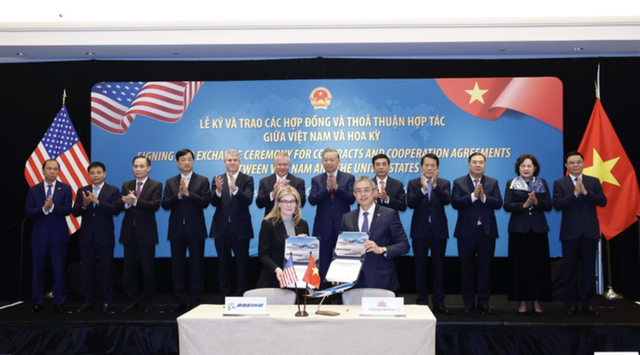
Party General Secretary To Lam witnesses the signing ceremony for the purchase of 50 Boeing 737 MAX aircraft between Vietnam Airlines and Boeing. Photo: Vietnam News Agency
Policy vision meets execution
The Washington visit was not an improvised maneuver but the execution of long-standing strategic resolutions.
Agreements on liquefied natural gas and clean energy align with Vietnam’s national energy security and green transition agenda.
Investments in aviation and satellite logistics respond to pressing infrastructure bottlenecks connecting the Mekong Delta to the Central Highlands, supported by Resolution 79.
Access to semiconductor and advanced medical technologies embodies the spirit of science, innovation, and digital transformation central to Vietnam’s industrial modernization strategy.
The push for market economy recognition seeks to level the legal playing field for Vietnamese enterprises globally, reducing international litigation risks and ensuring fairer competition.
Meanwhile, investments in high-tech healthcare ensure that development leaves no one behind according to Resolution 72 on healthcare and education.
The handshake in Washington was thus more than a ceremony.
It signaled that Vietnam has prepared legally, institutionally, and intellectually to step confidently into deeper global integration – self-reliant, resilient, and forward-looking.
Turning contracts into lift-off
After every major diplomatic breakthrough comes a critical question: how will the nation absorb the opportunity?
For $37.2 billion to become more than a contractual figure, domestic readiness is essential.
Infrastructure gateways are racing toward completion.
The Long Thanh International Airport project in Dong Nai Province, a neighbor of Ho Chi Minh City, aims to begin operations in mid-2026, preparing to accommodate a new generation fleet, including 90 Boeing aircraft expected to serve transcontinental routes and elevate Vietnam as a Southeast Asian transit hub.
Expressways stretching north to south and east to west are nearing completion, ensuring that goods from high-tech industrial parks reach ports and airports swiftly.
The groundbreaking for Vietnam’s first semiconductor chip factory in January underscored a strategic shift from purchasing advanced technology to producing it domestically.
A government credit package equivalent to VND500 trillion ($19.3 billion) is being directed not only toward large corporations but also toward cultivating a robust supporting-industry ecosystem.
Vietnam’s adaptation to the global minimum tax regime reflects another shift in mindset.
Rather than relying on tax incentives and low-cost labor to attract multinational giants, Vietnam is redirecting tax revenues toward research and development and high-quality engineering education.
The invitation is no longer to assemble, but to innovate.
Since 1995, cumulative U.S. foreign direct investment of $11.9 billion symbolized a promising beginning.
Today’s $37.2 billion agreements signal something more ambitious: a leap forward.
The visit by Party chief Lam and the assertive engagement of Vietnamese enterprises have opened a door.
Whether Vietnam steps through to emerge as a new Asian dragon depends on its collective resolve.
* This article was originally written in Vietnamese by Dr. Nguyen Thi Quy Phuong and translated by Tuoi Tre News.
Tuoi Tre News
Link nội dung: https://news.tuoitre.vn/new-standing-and-a-372bn-thrust-for-vietnam-103260222155618041.htm