
Newly discovered cave in Vietnam's Phong Nha–Ke Bang reveals thousands of rare cave pearls
A newly discovered cave named Victory in Vietnam’s Phong Nha–Ke Bang National Park contains thousands of rare cave pearls alongside extensive stalactite formations, park authorities and tour operator Jungle Boss said, describing the formations as scientifically significant geological features created over hundreds to thousands of years.
Jungle Boss, in collaboration with the management board of Phong Nha–Ke Bang National Park, recently discovered the new cave, which has been likened to a 'palace of stalactites.'
In addition to its spectacular limestone formations, the cave contains thousands of shimmering cave pearls, offering important geological insights.
According to veteran cave experts in Phong Nha–Ke Bang, the most remarkable feature of Victory Cave is not only its stalactites but also the unusually dense concentration of cave pearls, a rare geological formation previously found only in renowned cave systems such as Son Doong, Hung, and Over.
From a geological perspective, cave pearls are secondary mineral formations created in limestone caves. Their primary chemical component is calcium carbonate.
Unlike stalagmites, which grow upward from the cave floor, cave pearls are free-moving, smooth mineral spheres that accumulate in shallow pools, often forming deposits spanning two to three meters.
The formation of a fully developed cave pearl takes hundreds or even thousands of years and requires exceptionally precise natural conditions.
As rainwater seeps through limestone layers and cave ceilings, it dissolves large amounts of calcium carbonate before dripping into rock depressions or shallow calcium-rich pools on the cave floor.
There, the water releases carbon dioxide into the air, causing minerals to precipitate around a tiny nucleus, typically a grain of sand, a fragment of broken stalactite, or a small piece of animal bone.
The continuous impact of water droplets creates gentle currents that keep the nucleus rolling inside the pool.
This constant movement prevents it from sticking to the cave floor, allowing newly precipitated mineral layers to coat it evenly from all directions and gradually form concentric layers resembling those of an onion.
At the same time, continuous friction between the pearls themselves or against the rock cavity over thousands of years polishes away sharp edges, producing nearly perfect spherical or egg-shaped forms with smooth, glossy surfaces.
Le Luu Dung, director of Jungle Boss and a member of the team that surveyed Victory Cave, said the cave pearls vary greatly in size. Most are as small as mung beans or corn kernels, while some reach about the size of a table tennis ball.
"The formation of cave pearls differs from that of stalagmites. Cave pearls are created by gentle water currents flowing through cracks in the cave walls, whereas stalagmites are formed by water dripping continuously at a fixed point," Dung said.
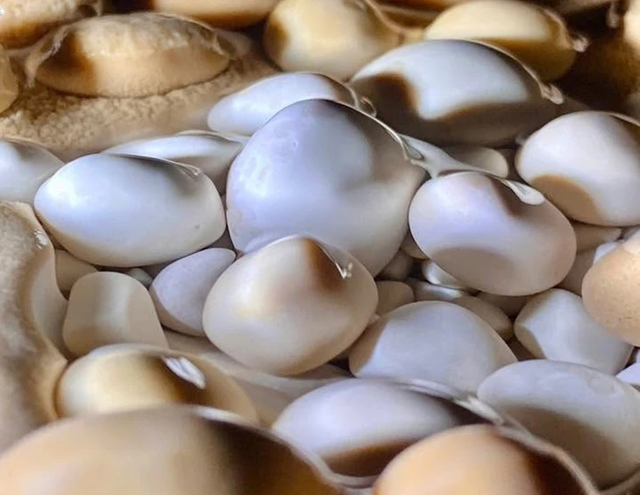
Over thousands of years, the cave pearls have developed into a wide variety of unusual shapes. Photo: Le Luu Dung
Although they possess a dazzling appearance and are called 'pearls,' cave experts emphasize that in terms of their physical properties and commercial value, cave pearls are not gemstones.
"They do not have crystal structures like diamonds, rubies, or quartz and have no monetary value in the jewelry market. Once removed from the cave environment, cave pearls lose their luster and moisture, are affected by the outside air, and become little more than ordinary stones," one expert said.
Their true value lies instead in science, geology, and conservation. Each cave pearl is considered a 'diary of time' written in minerals.
When a cave pearl is cut in half, scientists can observe hundreds of concentric growth rings similar to the annual rings of an ancient tree. By analyzing these layers, researchers can reconstruct past climate conditions, rainfall patterns, groundwater flow, and mineral concentrations over tens of thousands of years.
Dung said that because cave pearls require extremely specific natural conditions, including suitable rock cavities, appropriate calcium concentrations, and precisely balanced water flow, very few caves around the world contain these geological treasures.
Thanh Ha - Quoc Nam / Tuoi Tre News
Link nội dung: https://news.tuoitre.vn/newly-discovered-cave-in-vietnams-phong-nhake-bang-reveals-thousands-of-rare-cave-pearls-103260701125106806.htm