
No bank transfers: Why Hanoi land compensation recipients are lugging millions home the old-fashioned way
In an era of digital banking, Hanoi residents are walking out of land clearance offices lugging sacks of Vietnamese banknotes worth millions of dollars as compensation for land acquired for a major road expansion project. But why are such massive compensation payouts being handed out in physical cash instead of bank transfers?

Stacks of cash are handed out to residents whose land was acquired, then packed into sacks. Photo: Pham Tuan / Tuoi Tre
The unusual scenes emerged as several wards and communes in Hanoi distributed compensation to households affected by a project to widen National Highway 1.
On Monday afternoon, authorities in Bach Mai Ward paid out VND117 billion (US$4.5 million) in compensation and financial support to 12 households, with the largest payout reaching VND34 billion ($1.3 million).
All payments were made in cash.
Similar payouts had earlier taken place in Tuong Mai and Kim Lien Wards, where images of residents carrying sacks filled with banknotes drew widespread attention.
Why cash instead of bank transfers?
Speaking to Tuoi Tre (Youth) online newspaper on Tuesday, Le Thi Kim Hue, chairwoman of the Kim Lien Ward People's Committee, said land clearance compensation for individuals must be paid in cash under existing regulations.
"All land clearance compensation payments to individuals must be made in cash. That is the regulation," Hue said.
She explained that the funds were disbursed directly from the State Treasury in cash, without going through banks.
To help residents manage the large sums, local authorities have coordinated with banks to station employees at payment sites, allowing recipients to deposit their money immediately after collecting it.
Some residents have also contacted their banks in advance, asking employees to come to the payment sites to assist with cash deposits.
For those wishing to bring the money home, authorities have arranged police escorts and specialized vehicles to ensure their safety, Hue said.
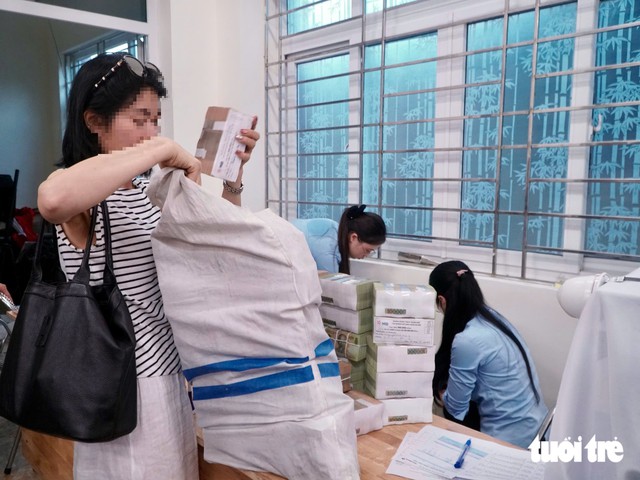
A resident packs stacks of cash into sacks to take to the bank for deposit. Photo: Pham Tuan / Tuoi Tre
An official from the Bach Mai Ward Investment and Infrastructure Project Management Board also told Tuoi Tre on Tuesday that compensation to individuals must be paid in cash under applicable legal regulations and Hanoi's rules.
For organizations, however, payments may be made through bank transfers to accounts held by their legal representatives, the official added.
Cash-counting machines work overtime
At around 3 p.m. on Monday, affected households gathered at the headquarters of the Bach Mai Ward Investment and Infrastructure Project Management Board to complete procedures for receiving their compensation.
After collecting the money, residents handed over their land use right certificates, commonly known as red books, to local authorities before packing the cash into sacks.
Some households arranged for bank employees to come to the site with cash-counting machines to help count and deposit the money immediately.
Stacks of banknotes covered tables as the machines worked at full capacity to process the payments.
In Bach Mai Ward alone, 222 households and nine organizations are affected by the road expansion project.
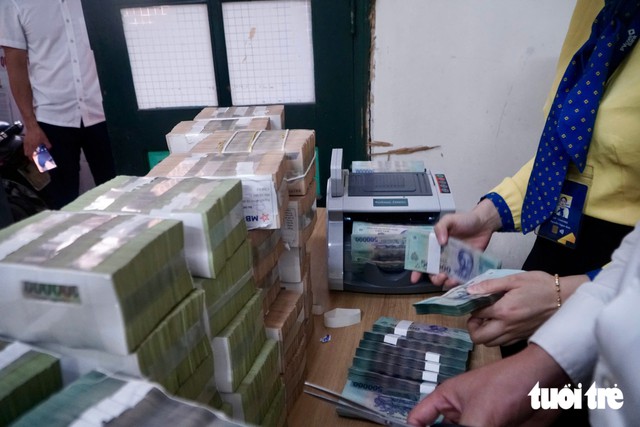
Bank cash-counting machines work at full capacity to process residents' deposits after they receive land clearance compensation. Photo: Pham Tuan / Tuoi Tre
Before Monday's payout, local authorities had conducted four rounds of compensation payments, distributing more than VND650 billion ($25.2 million) to 59 households.
Authorities are working to approve compensation plans for the remaining affected households by the end of October while addressing any outstanding concerns or complaints.
The National Highway 1 Corridor Development and Urban Redevelopment Project broke ground in May 2026 and is being implemented under a public-private partnership (PPP) model through a build-transfer (BT) contract.
The 36.3-kilometer route stretches from Beltway 1 to the Cau Gie interchange, passing through 18 wards and communes in Hanoi.
Once completed, the road will have a cross-section width of 90 meters. The project is expected to require approximately 337.3 hectares of land and is scheduled for completion in 2027.
Ngoc Nguyen - Pham Tuan / Tuoi Tre News