
No storm, but torrential rain: What is behind central Vietnam’s downpour?
Central Vietnam is experiencing widespread heavy rain despite being outside the influence of any storm, prompting experts to warn that disaster preparedness must extend beyond storms, as other weather hazards can be equally dangerous.
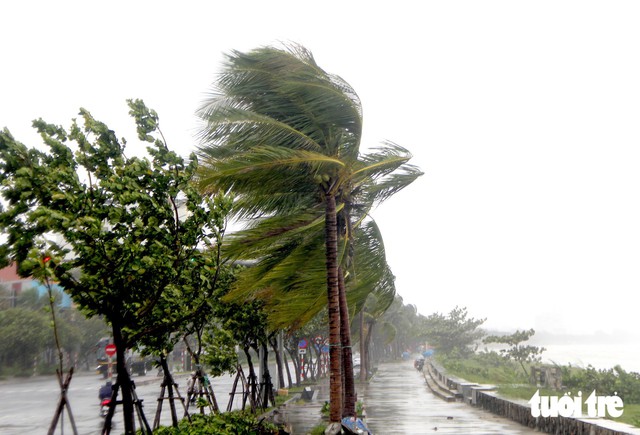
Heavy rain and strong winds hit Nguyen Tat Thanh coastal road in Da Nang on the afternoon of November 10, 2026. Photo: Truong Trung / Tuoi Tre
Strong cold-air surges, combined with upper-level easterly disturbances, the Intertropical Convergence Zone, or westerly troughs, can bring prolonged heavy rain to central Vietnam.
Bui Van Chanh, head of the Central Region Hydrometeorological Forecasting Division, told Tuoi Tre (Youth) online newspaper that residents should remain alert to these dangerous weather combinations rather than focusing solely on storms and tropical depressions.
An unusually intense early-season rainfall event
The cold-air surge that affected Vietnam from Monday to Wednesday was unusually strong for an early-season event, compared with previous cold-air outbreaks at this time of year.
Observations showed atmospheric pressure at the center of the continental cold high-pressure system reached 1,056 millibars on the morning of November 8.
Combined with a steep pressure gradient, this indicated a powerful cold-air mass moving south from the north, accompanied by a strong influx of cold air.
As the cold air reached northern Vietnam, minimum temperatures dropped to between 13.5 and 16.5 degrees Celsius, while some mountainous areas recorded temperatures below 10 degrees, including 8 degrees in Pha Din and 6.2 degrees in Sa Pa.
Temperatures also fell sharply in provinces from Nghe An to Quang Tri, bringing colder conditions.
The cold air is now weakening, and rain has eased in northern provinces. However, easterly winds continue to bring heavy rain to the south central coast, with rainfall expected to gradually subside from the afternoon of Friday.
In Da Nang, heavy rain remains concentrated in the southern coastal plains, although its intensity has eased.
Asked whether the prolonged heavy rain across several central provinces was unusual and whether similar events could occur again before the end of the year, Bui Van Chanh said November was the peak of the rainy season in central Vietnam, particularly in the area stretching from Quang Tri to Khanh Hoa.
The recent rainfall was therefore not out of season.
Central Vietnam remains in its rainy and storm season through the end of the year, so further episodes of heavy rain, storms and tropical depressions remain possible.
However, current forecasts suggest such weather activity is likely to be below the long-term average.
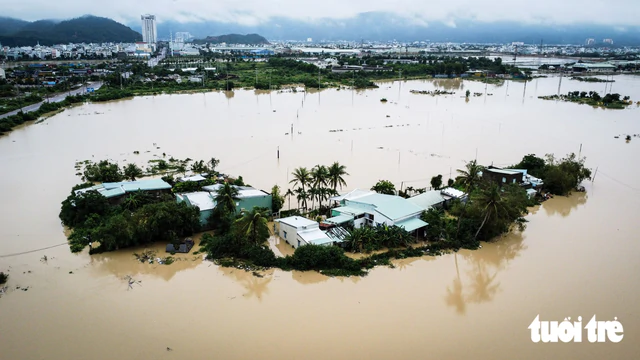
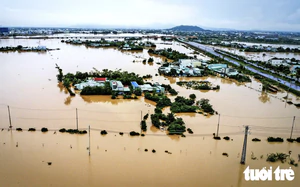
A cluster of homes in Quy Nhon Dong Ward, Gia Lai Province is surrounded by floodwaters. Photo: Tan Luc / Tuoi Tre
Staying alert to extreme rainfall risks
Beyond monitoring storms, residents in central Vietnam should remain alert to complex weather patterns that can trigger widespread heavy rain.
These include cold-air surges interacting with upper-level westerly troughs, easterly disturbances, equatorial troughs, or the Intertropical Convergence Zone.
Particular attention should be paid to combinations of cold air with upper-level easterly disturbances and wind convergence at different atmospheric levels, as well as interactions between cold air and the Intertropical Convergence Zone, westerly troughs, or storms and tropical depressions over the East Sea.
Such combinations can intensify rainfall and cause prolonged downpours lasting several days.
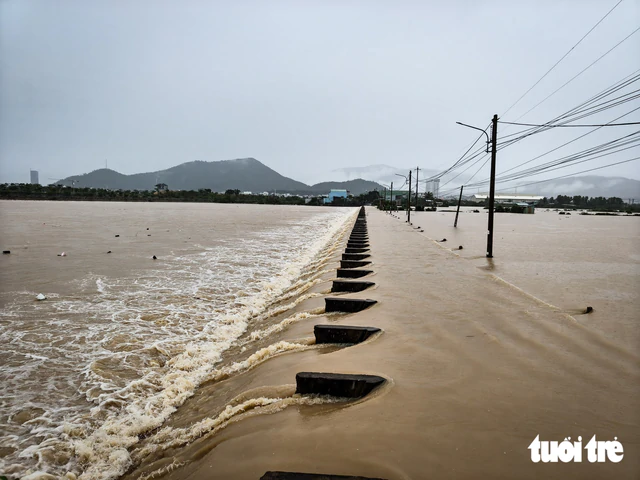
Water flows over the Ha Thanh River in Gia Lai Province on the morning of November 12. Photo: Tan Luc
Central Vietnam must move beyond a storm-focused approach to disaster preparedness.
Severe flooding does not occur only when storms or tropical depressions make direct landfall; other weather systems, particularly cold-air surges interacting with easterly disturbances or the Intertropical Convergence Zone, can also trigger exceptionally heavy rain lasting several days.
The region's short, steep river basins mean intense rainfall can quickly lead to rising rivers, flash floods, landslides and serious inundation.
Residents and local authorities should therefore closely monitor forecasts and warnings from official meteorological agencies and other reliable sources, and promptly activate disaster prevention and response measures when hazardous conditions arise.
Van Giang - Truong Trung / Tuoi Tre News
Link nội dung: https://news.tuoitre.vn/no-storm-but-torrential-rain-what-is-behind-central-vietnams-downpour-10326111221434202.htm