
Severe El Nino threatens to push Vietnam’s Mekong Delta salinity intrusion beyond historic 2019-20 level
The Mekong Delta region, located in southern Vietnam, could face severe saltwater intrusion during the 2026-27 dry season, with conditions potentially matching or even surpassing the historic 2019-20 crisis, due to the impact of an exceptionally strong El Nino.
El Nino is a climate phenomenon marked by the periodic warming of surface waters in the central and eastern equatorial Pacific Ocean, which can disrupt weather patterns worldwide, affecting rainfall and temperatures in Vietnam.
The Ministry of Agriculture and Environment has warned of potential water shortages that could threaten both domestic water supplies and agricultural production across the region.
The ministry announced on Tuesday that Deputy Minister Nguyen Hoang Hiep had signed a decision on the water resource scenario for the Mekong River Basin during the 2026-27 dry season, covering the period from November 2026 to May 2027.
Saltwater intrusion across the delta could become extremely severe during the upcoming dry season, compounded by widespread heatwaves and a low likelihood of unseasonal rainfall.
“Saltwater intrusion could penetrate deep inland, potentially reaching levels comparable to the 2019-20 dry season,” the ministry cautioned.
“At certain river mouths, salinity levels could even spike significantly higher than those recorded during the 2019-20 dry season.”
Water flows to the delta expected to fall 20%
The impact of the severe El Nino, which is forecast to persist until early summer 2027, is expected to significantly worsen weather conditions across the Mekong Delta, according to the ministry.
From now until May 2027, average temperatures in the delta are forecast to be 1-2 degrees Celsius above the long-term average.
Localized heatwaves could begin as early as February 2027, earlier than usual.
From March to May, hot conditions might become more widespread and intense.
Rainfall is also forecast to remain limited.
The first two months of 2027 are likely to see generally dry conditions, while total rainfall between March and May could be 15-40 percent below the long-term average.
Water flows from upstream areas are also expected to decline substantially.
At the Kratie monitoring station on the Mekong River, water flows from now until May 2027 are forecast to be 26-43 percent below the average for previous years, comparable to levels recorded during the same period in 2015-16.
The total volume of water reaching the Mekong Delta through the Tan Chau and Chau Doc monitoring stations is projected at some 103-133 billion cubic meters, around 20 percent below the average.
The ministry warned that water inflows into the delta could decline rapidly from January 2027 through the end of the dry season.
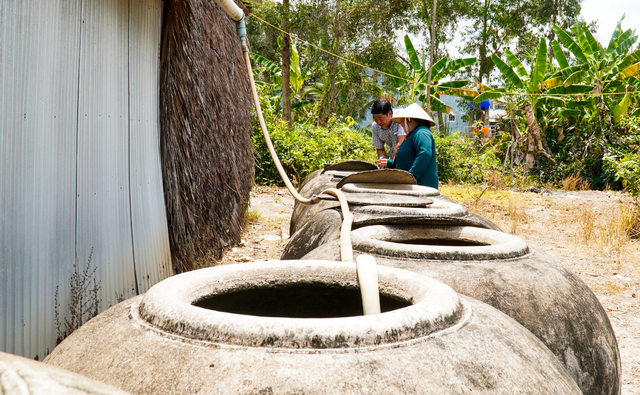
Residents in Ca Mau Province store rainwater from the last rains of the season in preparation for the upcoming dry season. Photo: Thanh Huyen / Tuoi Tre
Growing risk of water shortages for households, agriculture
During the upcoming dry season, water levels in the delta’s internal canal systems are expected to fall rapidly between December 2026 and January 2027.
Monthly average levels are forecast to remain below both historical averages and those recorded during the 2025-26 dry season.
In freshwater areas, water levels might reach their lowest point in February and March 2027, falling 0.3-0.6 meters below the long-term average.
In remote, elevated areas of An Giang Province, particularly those far from major water sources, levels in canals, waterways and small streams could drop dramatically, threatening water supplies for both household consumption and agricultural activities.
In areas transitioning between freshwater and brackish conditions, water levels are expected to decline rapidly from January 2027, with freshwater supplies beginning to come under pressure.
The lowest levels are forecast between February and April 2027.
The U Minh Thuong freshwater zone faces a particularly serious risk, with water levels potentially dropping to between -1.5 and -0.5 meters due to a lack of additional freshwater inflows.
In brackish and saline areas, water levels are also expected to decline from January to April 2027, falling below both long-term averages and those recorded during the 2026 dry season.
Based on these projections, the ministry has classified water resources across the Mekong River Basin during the 2026-27 dry season as being in a state of water scarcity.
There is a significant risk that available supplies will be insufficient to meet domestic consumption and production needs throughout the dry season.
Authorities urged to prepare water management plans
In response to the looming threat, the ministry has called on relevant ministries, agencies and local authorities to urgently develop plans for water extraction and use.
Authorities have been instructed to prepare water management strategies suited to conditions of water scarcity, particularly during the critical dry-season period from February to May 2027.
One of the most important priorities is to proactively store fresh water from the beginning of the dry season.
The ministry hinted at making full use of existing water storage infrastructure, including canal networks, reservoirs, ponds, lakes and other available facilities, to build up freshwater reserves before water shortages intensify.
Tieu Bac - Chi Tue / Tuoi Tre News