
Shangri-La Dialogue signals Vietnam's evolving position
Vietnamese leader To Lam used a keynote address at the Shangri-La Dialogue on Friday to present Vietnam as a country seeking to play a more active role in shaping the international agenda amid growing global uncertainty.
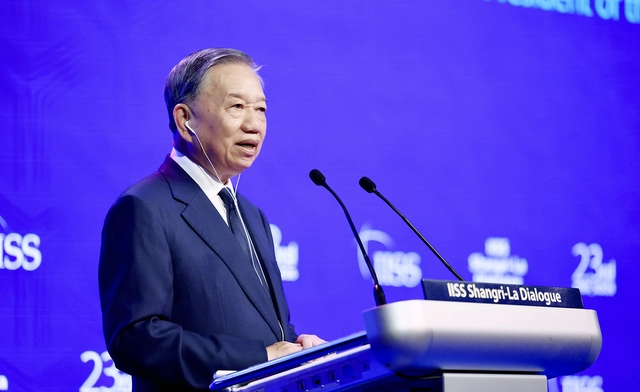
Vietnamese Party General Secretary and State President To Lam delivers the keynote address at the 23rd Shangri-La Dialogue in Singapore, May 29, 2026. Photo: Nguyen Khanh / Tuoi Tre
Speaking on the theme of 'Proactively Shaping Peace, Stability and Development in a World Undergoing Profound Changes,' General Secretary of the Communist Party of Vietnam Central Committee and State President To Lam said peace, stability and development were "the common denominator of all nations and peoples."
His speech focused on the Asia-Pacific region and Vietnam's views and proposals in response to current challenges.
He said peace could not be achieved through passive waiting but had to be proactively built, while stability should be nurtured through rules, dialogue, restraint and trust rather than deterrence alone.
Development, he said, should serve as a foundation for sustainable security.
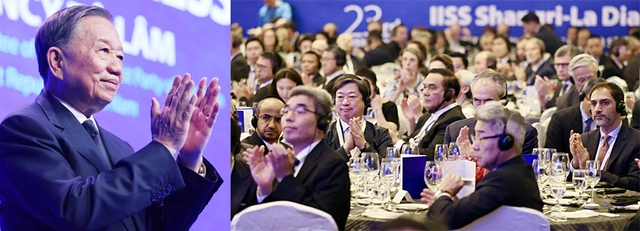
Delegates applaud after Vietnamese Party General Secretary and State President To Lam concludes his keynote address at the 23rd Shangri-La Dialogue in Singapore, May 29, 2026. Photo: Nguyen Khanh / Tuoi Tre
3 fundamental crises and solutions
To Lam identified what he called three fundamental crises facing the world: a crisis of the international order, a crisis of development models, and a crisis of strategic trust.
Of the three, he described the crisis of strategic trust as particularly dangerous because it could lead countries to view one another's actions through a lens of suspicion and insecurity.
He said the three crises were converging most clearly in the Asia-Pacific, a region that is both a dynamic center of global growth and an arena of intense strategic competition.
"Precisely because it is where these challenges converge, the Asia-Pacific must also become where solutions emerge," he said.
To help build a peaceful, stable, developed, and resilient Asia-Pacific, To Lam proposed strengthening the role of rules and dialogue in reducing risks, particularly in maritime domains.
"No country benefits when these routes become theaters of coercion, confrontation or displays of power," he said.
He also called for the development of an open and inclusive regional architecture with the Association of Southeast Asian Nations (ASEAN) at its center.
In addition, he urged governments to place human security and social resilience at the heart of sustainable security, establish responsible norms for emerging technologies and the defense industry, promote dialogue on artificial intelligence in defense and security, and ensure that humans retain ultimate responsibility for decisions with serious consequences.
He also called for stronger protection of information spaces and greater public awareness, saying societies capable of distinguishing right from wrong and maintaining consensus during periods of uncertainty would provide an important foundation for sustainable security.
To Lam further urged greater investment in preventive diplomacy, mediation, and conflict resolution mechanisms to create diplomatic off-ramps before disputes escalate into conflict.
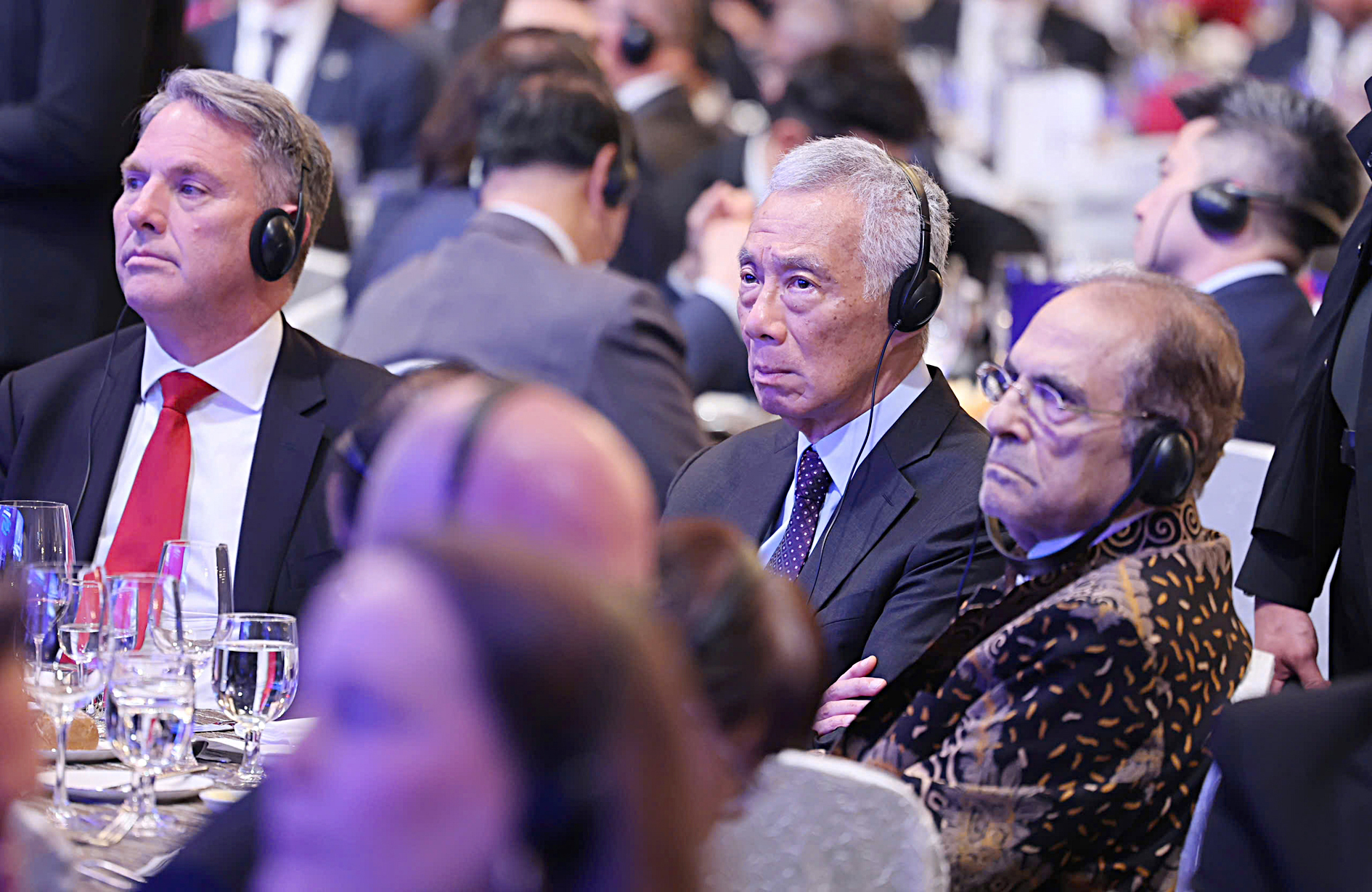
Former Singapore Prime Minister Lee Hsien Loong (C) listens as Vietnamese Party General Secretary and State President To Lam delivers his keynote address at the 23rd Shangri-La Dialogue in Singapore, May 29, 2026. Photo: Nguyen Khanh / Tuoi Tre
Vietnam's growing influence
Analysts said To Lam's role as keynote speaker reflected Vietnam's growing influence in regional security affairs.
Phan Xuan Dung, a senior research officer at the Singapore-based ISEAS - Yusof Ishak Institute, said invitations to deliver keynote addresses at the Shangri-La Dialogue were significant decisions for both organizers and participants.
He said To Lam's appearance represented recognition of Vietnam's role, credibility, and increasingly prominent voice in regional security issues.
"Vietnam is now in a position to directly present to the world how it views regional security and to propose its own framework of reference," Dung said.
He added that Vietnam's diplomacy had moved beyond a phase of 'integration for survival' toward 'integration for contribution and shaping,' particularly in areas where the country possesses strengths and credibility.
Sarah Teo, an assistant professor in the Regional Security Architecture Program, Institute of Defense and Strategic Studies (IDSS), and, coordinator of PhD Program at the S. Rajaratnam School of International Studies (RSIS), Nanyang Technological University in Singapore, said To Lam's participation reflected Vietnam's growing prominence and influence in regional affairs.
She said the appearance should not be viewed as a sudden policy shift but rather as a clearer expression of a higher international standing that Vietnam had built over time.
According to Teo, Vietnam's role also demonstrated how Hanoi could contribute to ASEAN's strategic weight and support an open, inclusive, and rules-based regional order.
With broad relations across major powers and ASEAN members, Vietnam was positioned to help build consensus, narrow differences, and strengthen ASEAN centrality, she said.
Vietnam is a reliable partner
During a question-and-answer session following the speech, To Lam said Vietnam's domestic reforms would not alter the foundations of its foreign policy but would instead help the country become a more reliable and responsible partner for the region and the world.
He described ASEAN as a strategic space closely linked to regional peace and security and said Vietnam would contribute more to strengthening ASEAN's central role as its national capabilities improve.
He said Vietnam would work with other members to make the region a strategic hub for economic growth, digital transformation, supply-chain security, maritime security, and development-gap reduction.
Asked about the Middle East crisis, To Lam said Vietnam was seeking greater self-reliance and resilience by maintaining supply chains and reserves, diversifying energy sources, expanding both import and export markets, and strengthening logistics cooperation.
He said these measures had helped Vietnam maintain production, continue attracting foreign investment, and preserve trade stability, while noting that a prolonged crisis would create additional challenges.
Message to major partners
Addressing major partners inside and outside the region, To Lam said the Asia-Pacific was an open space where all countries with legitimate interests could contribute to peace, stability, and development.
"What the region seeks is neither the mere presence nor absence of any major power. What it seeks is responsible commitment," he said.
"We recognize that competition is an enduring reality of international relations. But competition must remain bounded by law, guided by transparency, and exercised with restraint."
To Lam said the key choice facing the Asia-Pacific was not whether competition should exist, but whether competition would remain uncontrolled or be managed through responsible coexistence, dialogue, rules, and trust.
Duy Linh - Ngoc Duc - Thanh Hien - Bao Anh / Tuoi Tre News
Link nội dung: https://news.tuoitre.vn/shangri-la-dialogue-signals-vietnams-evolving-position-103260530161738615.htm