
Social norms seen as key factor in Japan's low birthrate
TOKYO -- A survey by a private-sector advisory panel found that women in Japan are more likely than men to view the disproportionately heavy burden of housework and child care placed on women as a major factor behind the country's low birthrate.
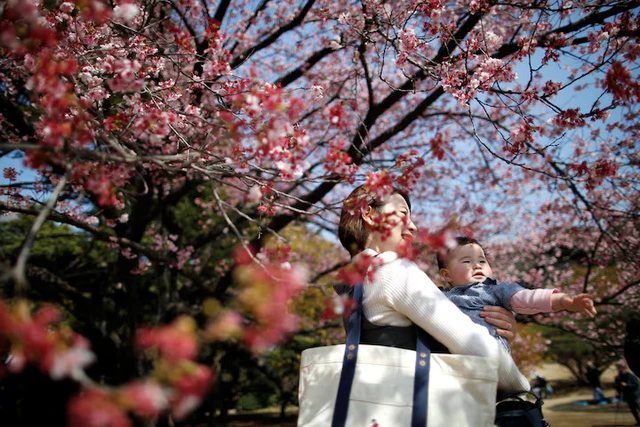
A seven-month-old baby and her mother look at early flowering Kanzakura cherry blossoms in full bloom at the Shinjuku Gyoen National Garden in Tokyo, Japan, March 14, 2018. REUTERS/Issei Kato
The findings suggest that many women feel constrained by social norms, including unconscious gender bias, which remain deeply rooted, especially in rural areas, the panel said.
Panel members warned that unless such outdated attitudes are addressed, communities in the countryside could face a serious demographic crisis.
70% of women agree
The panel, known as the Forum for the Future We Choose, brings together business and labor leaders, local government heads and researchers.
One of its co-chairs, former internal affairs minister Hiroya Masuda, also led the expert group that warned in 2014 that about 900 municipalities in Japan could eventually disappear because of population decline.
That earlier report spurred the central government to strengthen measures aimed at reversing depopulation and the falling birthrate under its regional revitalization banner.
The latest survey was conducted online in January and February this year, targeting about 22,000 people aged 18 and older across Japan.
Respondents were asked about 11 possible causes of the low birthrate and indicated their views by choosing one of the five responses--"strongly agree," "agree," "disagree," "strongly disagree," and "don't know."
On the economic burden of raising children, a large majority of both men and women said high child-rearing and education costs were a cause of the decline of births. The share was 76.2 pct among men and 81.2 pct among women, combining those who answered "strongly agree" and "agree."
The widest gender gap appeared in responses to the question of whether entrenched gender roles and marriage norms, such as the idea that men should work while women should stay at home, are contributing to the problem.
Among men, 53.0 pct said such norms were a factor, compared with 72.1 pct of women. The gap was even more pronounced among those who selected "strongly agree": 11.9 pct of men versus 26.4 pct of women, showing the proportion among women at more than double that among men.
A more detailed analysis, including regional differences, has yet to be released.
But Masuda named lingering social pressure in rural areas as a possible reason for outflows of women to Tokyo and other major cities.
"The suffocating pressure of old norms that still remains deeply rooted in rural areas may be causing women to move to Tokyo," Masuda said.
As a result, declines in the number of births and overall population may be accelerating, he added.
Communities of choice
The Japanese government is increasingly focusing on the role of social norms and unconscious bias in the falling birthrate and migration to major cities.
In formulating its June 2025 basic policy on regional revitalization, the government surveyed people who had moved to urban areas about their perceptions of rural communities. Many responses pointed to entrenched gender expectations and limited opportunities for women.
Some respondents said rural areas were seen as places where "women are expected to play only supporting roles to men, and there are no jobs they truly want to do."
Others cited local customs in which women are expected to prepare food and drinks for men at community events.
Some also described social pressure to marry and have children as "suffocating."
The policy paper says conventional measures to counter population decline have failed to adequately address the concerns of the people most affected.
It identifies as a central priority the need to "create communities chosen by young people and women," including by fostering more comfortable and inclusive workplace environments.
Masuda said local governments also have an important role to play in encouraging change among local businesses.
"Effort and ingenuity are needed to change outdated norms," he said.

Link nội dung: https://news.tuoitre.vn/social-norms-seen-as-key-factor-in-japans-low-birthrate-103260522172056344.htm