
The mystery of drums with 'ears' in Vietnam’s Central Highlands
Collector Dang Minh Tam said drums are considered sacred by people in Vietnam’s Central Highlands. They even 'pierce the ears' of the drumhead so that the drum can hear the spirits’ voices from the left and right.
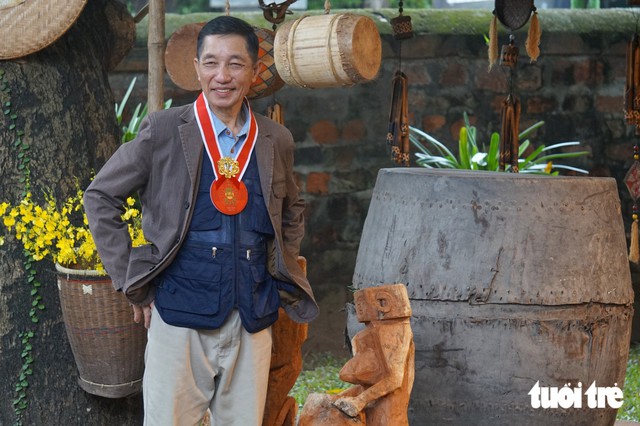
Collector Dang Minh Tam is always ready to share fascinating stories about Central Highlands drums with visitors to the ongoing exhibition at the Temple of Literature in Hanoi. Photo: Thien Dieu / Tuoi Tre
Unique drums belonging to ethnic communities in the Central Highlands, from the collection of Dang Minh Tam, a resident of Da Lat, are being showcased to visitors at the Temple of Literature in Hanoi.
The collection includes drums with 'ears' as well as drums whose buffalo-hide surfaces still retain a thick layer of hair.
Tam’s drum collection is displayed alongside drums from Doi Tam Village in Ninh Binh Province and Binh An Village in Tay Ninh Province as part of the 'Nhat Trong: One Drumbeat - A Thousand Years of Civilization' exhibition at the Temple of Literature.
The exhibition is being held as part of the second Thang Long - Hanoi Festival in 2026.
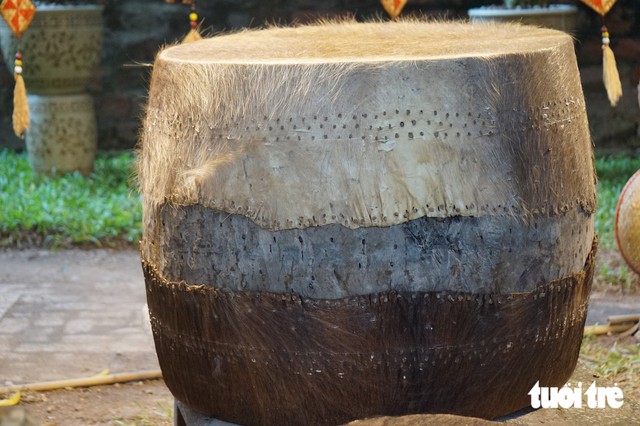
A Central Highlands drum with its original layer of hair still intact on the drumhead. Photo: Thien Dieu / Tuoi Tre
Mystery of drums once owned only by the wealthy
While the Doi Tam and Binh An drums stand out for their eye-catching colors and fashionable designs, the Central Highlands drums have attracted even more visitors, not only because of their distinctive, rustic appearance but also because of the fascinating stories behind each drum that Tam is always willing to share with anyone interested.
Speaking to Tuoi Tre (Youth) online newspaper, Tam said each Central Highlands drum tells an interesting story, and all of them carry a special sacred meaning.
People in the Central Highlands treat drums as sacred objects. As a result, the drums must be made according to strict rules, and only wealthy people could afford to own them.
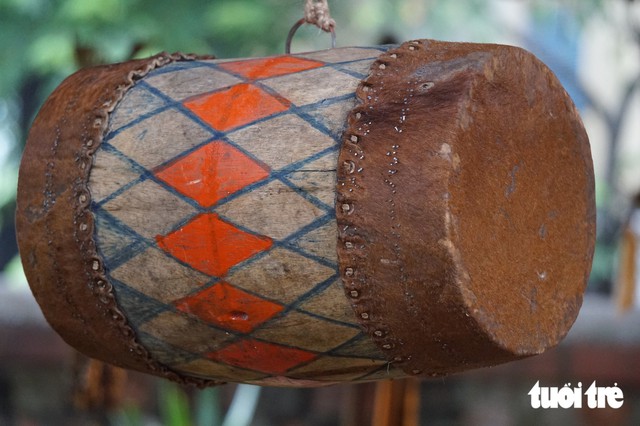
A small, colorful drum of the Jrai people in Vietnam’s Central Highlands. Photo: Thien Dieu / Tuoi Tre
There are no drum-making villages or drum shops in the Central Highlands.
When wealthy families in a village wanted to make a drum, they would first slaughter a large male buffalo and make offerings to the tree spirit, drum spirit, sky spirit, and forest spirit for permission to make the drum.
Only then would they begin selecting a tree for the drum. Unlike drums made by other ethnic groups, which are assembled from pieces of wood, Central Highlands drums are carved from a single solid tree trunk.
The tree therefore had to be a high-quality, perfectly straight trunk with a diameter of about one meter.
The tree also had to meet a number of other conditions: it could not have vines wrapped around it, a beehive on it, a broken top, or any blemishes on its trunk.
In the past, people in the Central Highlands had to venture deep into the forest to find such a tree. Today, this is no longer permitted in order to protect the forests.
Once a suitable tree had been selected, a group of seven strong young men would carry shields and spears, and bring along a 6-7kg pig and alcohol into the forest to make offerings to the tree spirit.
There were also strict taboos along the way to cut down the tree. The group was not allowed to hear a cuckoo's call, see a black snake crossing the path or encounter a dead fish.
When they reached the tree, they would dance around its trunk, slaughter the pig they had brought as an offering to thank the tree spirit, and apologize to the spirit before asking permission to cut down the tree.
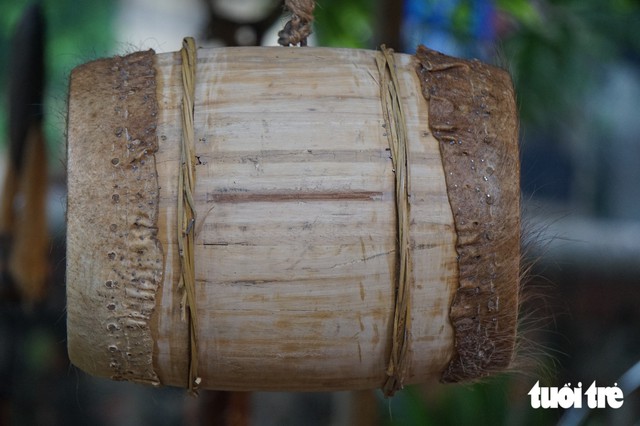
A Ba Na drum, typically small enough to be worn at the front while being played. Photo: Thien Dieu / Tuoi Tre
To determine whether the tree spirit agreed to offer itself for the making of a drum, the strongest man in the group would stand at a distance and throw an ax into the tree trunk before everyone returned home.
The next day, when they came back, if the ax was still firmly embedded in the tree, it meant the tree spirit had agreed to let the tree be cut down. If the ax had fallen, they had to continue searching for another tree.
After the tree was felled, a section of the trunk about one meter long was cut off, shaped and hollowed out into the drum body in the forest before being taken home.
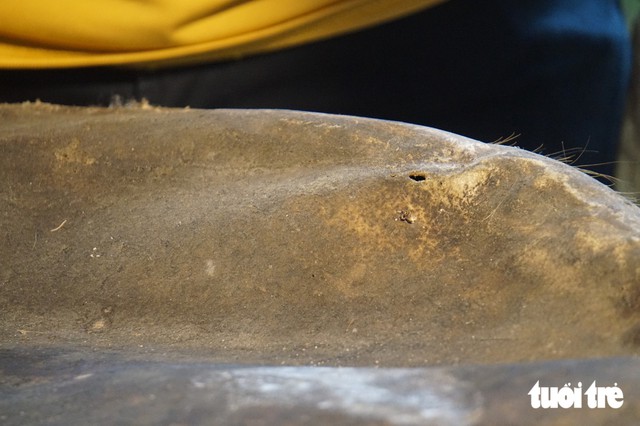
The drumhead of a Central Highlands drum features ear holes. Photo: Thien Dieu / Tuoi Tre
The drum with 'ears'
Once the drum body was brought home, the owner would slaughter a female buffalo to hold a feast for the entire village and use its hide to cover the head of the main drum.
Among some Central Highlands ethnic groups, the main drum is made only from female buffalo hide, while others make drums with both male and female heads.
The Central Highlands follow a matrilineal system, so things associated with femininity are highly respected.
The main drumhead is about 2-3cm larger than the male drumhead and is stretched very tightly.
The main drumhead is struck only during major village ceremonies, such as those to celebrate a new communal house or offerings to the water source.
By contrast, the male drumhead, made from male buffalo hide, is used only within the immediate family.
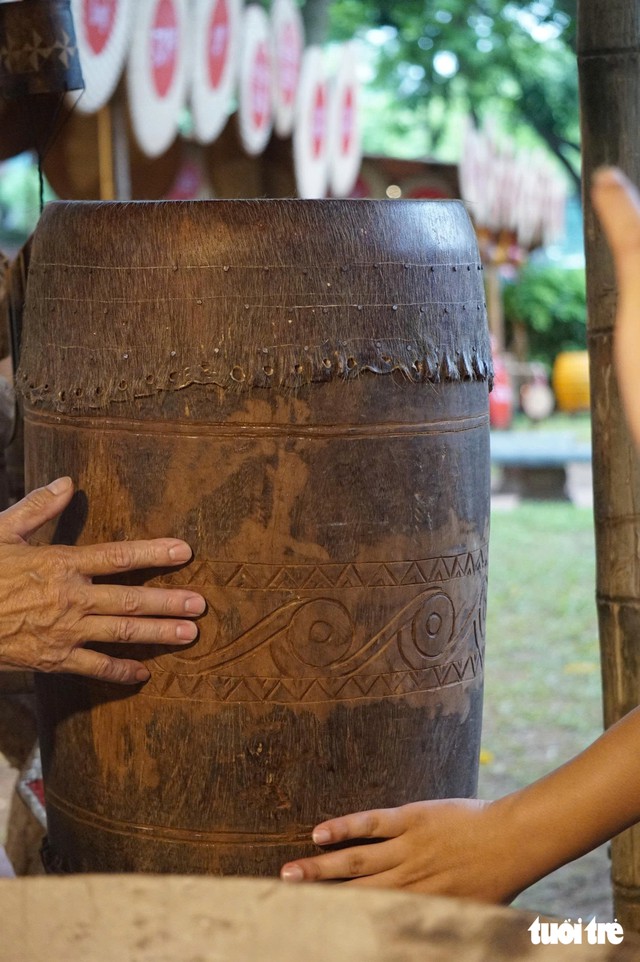
A drum with intricate patterns belonging to the K’toang Cham Hroi and Ba Na ethnic communities. Photo: Thien Dieu / Tuoi Tre
Another distinctive feature is that the main drumhead has its 'ears' pierced so the drum can hear the spirits’ voices from the left and right.
The hide used to cover Central Highlands drums can be as thick as a finger joint because local people do not thin the hide as is done elsewhere.
As a result, many Central Highlands drums still retain a thick layer of hair on the buffalo hide.
Drums in the Central Highlands are not placed on the ground but kept on chairs or in sacred positions.
In communal houses, drums are respectfully hung in the center, while in longhouses, they are placed on the sacred Kpan bench.
No one would dare turn their back to a drum or touch its drumhead. Visitors to a home are also not allowed to play the drum without permission.
For people in the Central Highlands, all of these acts would be considered disrespectful to the spirits, known as Yang.
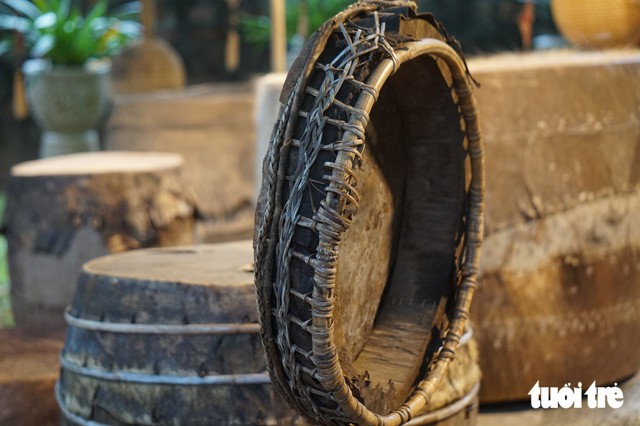
A one-sided paranung drum of the Chu Ru (Kru) and Cham people in Vietnam’s Central Highlands. Photo: Thien Dieu / Tuoi Tre
To play the drum, the owner must perform a ritual offering a chicken, a jar of rice wine and some porridge to ask permission from the spirits.
Only the drum’s owner or the village elder or chief is allowed to sound the sacred drumbeats.
Tam said that today, making a solid, one-piece drum like those made in the past is almost impossible.
As a result, Central Highlands drums are becoming increasingly rare.
- REFERENCE MORE
- REFERENCE MORE
- REFERENCE MORE

Van Giang - Thien Dieu / Tuoi Tre News
Link nội dung: https://news.tuoitre.vn/the-mystery-of-drums-with-ears-in-vietnams-central-highlands-103260916170544119.htm