
Tireless, automated, but costly: Why Vietnam firms must look beyond the robot hype
The growing use of robots at restaurants and service businesses in Vietnam is creating new customer experiences, but businesses need to assess their economic efficiency before committing to such investments.
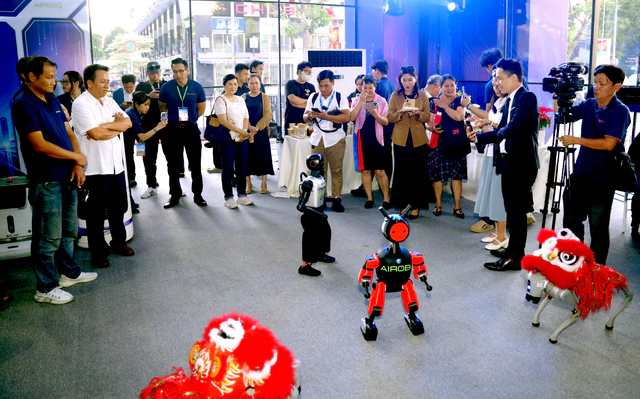
Robots perform at the Ho Chi Minh City Green Growth Products and Services Exhibition (GRECO). Photo: Cong Sang / Tuoi Tre
Customers entering a hotpot restaurant in Ho Chi Minh City may encounter multi-tier autonomous robots moving smoothly between tables, playing cheerful music as they stop to deliver trays of beef.
Reception robots equipped with touchscreens are also being deployed at technology showrooms, bank branches and hotel lobbies to greet visitors, recognize voice commands and direct them to service counters.
Their use has expanded beyond demonstrations to become part of marketing and workforce optimization efforts at service businesses in Vietnam.
Robots do not get tired or lose their temper, and they follow pre-programmed procedures consistently.
However, they can become costly obstacles rather than effective business tools when deployed in cramped spaces, crowded areas or locations where navigation systems do not work properly, according to business operators.
The same investment challenge applies to manufacturing, where purchasing technology does not necessarily translate into financial returns.
Speaking at the recent Ho Chi Minh City Green Growth Products and Services Exhibition (GRECO), Vuong Quan Truong, deputy general director in charge of technology at AICAP, said businesses often make the mistake of comparing only equipment purchase prices when evaluating robot investments.
AICAP invests in e-commerce platform development and robot operations in Vietnam.
The total cost of a robot investment can include the robot, grippers, sensors, safety systems, control software, integration with existing production lines, installation, training and maintenance, Truong said.
Integration costs can account for a significant portion of an investment when a system needs to connect multiple devices or factory management software.
Therefore, robots with similar purchase prices may have different total costs of ownership.
Integration and operational challenges
Nguyen Quoc Chi, deputy head of the Faculty of Mechanical Engineering and a senior lecturer at the University of Technology under Vietnam National University, Ho Chi Minh City, said robots could not generate value without being deployed in specific operating environments.
These include factories, production lines and service operations, where robots must be integrated into existing platforms and operating systems, he said.
System integration is a particular challenge for small and medium-sized enterprises (SMEs) in Vietnam, according to Chi.
Many businesses use machinery and equipment from different suppliers that were purchased at different stages of development.
Connecting these machines and ensuring they operate together within a unified system remains a challenge, he said.
Businesses also need personnel capable of managing data, training robots and ensuring operational safety.
Robot integration must deliver a clear return on investment (ROI), while companies must also assess spare-part availability, repair times and access to on-site technical support.
Safety is another requirement when robots are deployed in factories or public spaces.
"Ensuring the safety of workers and people around them is as important as operational performance," he said.
Truong said robots were not suitable for every stage of business operations.
"The ultimate goal for businesses should not be to own robots, but to turn technology investments into measurable improvements in productivity, quality and competitive advantages," he said.
The Ky - Duc Thien / Tuoi Tre News
Link nội dung: https://news.tuoitre.vn/tireless-automated-but-costly-why-vietnam-firms-must-look-beyond-the-robot-hype-103261103085900319.htm