
Using AI among solutions to make English a second language in Vietnam
Experts proposed a range of solutions to make English a second language in Vietnam, including creating more opportunities for real-life communication, adopting interactive teaching methods, using AI tools to personalize learning, and strengthening cooperation between schools and families, at a seminar in Ho Chi Minh City on Friday.
Experts proposed the solutions at the seminar “Towards English as a Second Language in Vietnam: Perspectives from Teaching, Policy and Practice,” organized by Ho Chi Minh City University of Foreign Languages and Information Technology in cooperation with INTESOL Vietnam and other partners.
According to experts, Prime Minister’s Decision No. 2371/QD-TTg, issued in 2025, on making English a second language in schools during 2025-35, with a vision to 2045, provides an important foundation for elevating English from an academic subject to a means of communication.
This requires solutions involving teaching methods, learning environments and technology.
Experts said it is necessary to shift from a model in which English is primarily taught as a foreign language to a second-language model in which English serves as a means of interaction, instruction and meaning-making.
One solution is to create “micro second-language ecosystems” through short-term cultural exchange programs, enabling students to move from theoretical knowledge to practical communication skills.
Learners increasingly need to communicate naturally and proactively in English. However, social norms surrounding “saving face” often discourage them from speaking.
Experts therefore suggested using AI chatbots such as ChatGPT to reduce anxiety and increase learners’ willingness to communicate in a “face-neutral” environment where they can make mistakes without fear of social judgment.
AI tools can personalize learning and provide immediate feedback on vocabulary, grammar and pronunciation.
Teaching methods also need to be renewed.
The direct method can shift the focus from language knowledge to communication skills through full immersion in English.
Project-based learning and debates can help learners gain confidence in expressing opinions, analyzing evidence and responding to others in English.
Task-based language teaching can encourage learners to take a more active role through real-life tasks.
Closer cooperation between families and schools is also needed. Teachers can act as facilitators and guide parents in creating English-learning environments at home, helping narrow the gap between classroom learning and everyday life.
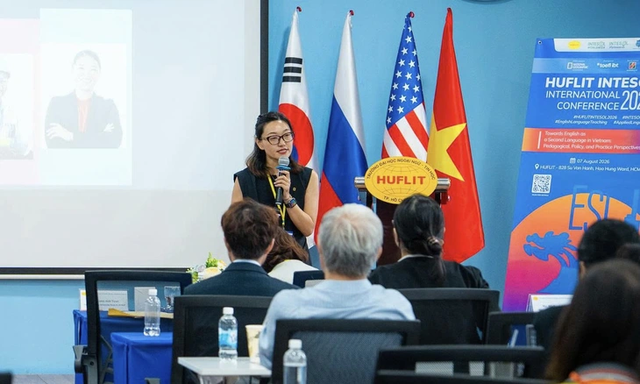
Experts proposed multiple solutions to make English a second language in Vietnam at a seminar in Ho Chi Minh City on August 7, 2026. Photo: N.T. / Tuoi Tre
Challenges to English learning
The proposed solutions address a number of existing barriers to English teaching and learning.
Experts said many university graduates still struggle to communicate effectively because the grammar-translation method remains deeply entrenched, focusing on analyzing structures rather than immersing learners in the language.
As a result, learners often have knowledge of English rather than the ability to use it for communication.
Another barrier is the lack of opportunities for practice. English is primarily taught as a foreign language and is rarely used outside the classroom.
Students have few opportunities to communicate in real-life situations, leading to a lack of confidence and fear of making mistakes.
Psychological barriers and pressure to perform perfectly can also cause anxiety when speaking in public.
Large class sizes, passive learning habits and dependence on teachers’ guidance are additional obstacles.
The influence of Vietnamese is another factor. Learners often face systematic pronunciation difficulties resulting from the influence of Vietnamese, including dropping final sounds and difficulties with monosyllabic words and tonal features.
Relying on mental translation also hinders natural speaking and listening reflexes.
Assoc. Prof. Dr. Nguyen Ngoc Vu, vice president of Ho Chi Minh City University of Foreign Languages and Information Technology and deputy head of the seminar’s organizing committee, said English is becoming increasingly essential not only for education but also for employment, international cooperation, engagement in technology and global integration.
“Moving from the traditional model of teaching English as a foreign language to developing English as a second language is not simply a change in terminology,” Vu said.
He stressed that the shift requires serious consideration of language policy, curriculum design, teaching methods, assessment, teacher training, learners, technology and language use inside and outside the classroom.
Vu also emphasized that making English a second language does not mean replacing Vietnamese or weakening the Vietnamese identity.
Instead, it would expand learning opportunities while supporting multilingualism, cultural confidence and international integration.

Thanh Ha - Minh Giang / Tuoi Tre News
Link nội dung: https://news.tuoitre.vn/using-ai-among-solutions-to-make-english-a-second-language-in-vietnam-103260808084439214.htm