
Vietnam airport operator proposes underground link between Tan Son Nhat's T1 and T3 terminals
The Airports Corporation of Vietnam (ACV) is studying a proposal to rebuild T1 Terminal at Tan Son Nhat International Airport and construct an underground connection to the newly opened T3 Terminal to improve passenger transfers.
The plans remain at a preliminary stage, with no decision yet made on demolishing the existing terminal or starting construction.
An ACV representative confirmed to Tuoi Tre (Youth) online newspaper that the corporation is studying upgrades to the airport's T1 Terminal and T2 Terminal.
However, the official stressed that the proposals are still under review and that reports suggesting construction is imminent could mislead passengers.
ACV clarified that an earlier proposal to build an underground passage linking the TCP parking facility with T1 Terminal has been abandoned.
A separate proposal to build an underground connection between T1 and T3 Terminals remains under consideration.
Tan Son Nhat International Airport currently has three passenger terminals, including T1 and T3 Terminals for domestic flights and T2 Terminal for international services.
T1 Terminal now mainly serves Vietjet flights, while Vietnam Airlines, Bamboo Airways, Pacific Airlines, Vasco, Sun PhuQuoc Airways, and several other carriers have moved their domestic operations to the new T3 Terminal, which was completed in 2025 at a cost of VND11 trillion (US$418.8 million).
T1 Terminal has a floor area of nearly 41,000 square meters and was designed to handle about 15 million passengers annually.
Before T3 Terminal opened, passenger traffic at T1 Terminal regularly exceeded its design capacity.
During peak holiday periods, the terminal handled nearly 100,000 passengers a day, resulting in congestion at check-in counters, security screening areas, and arrival and departure halls.
After years of operation and multiple partial upgrades, ACV believes the terminal's infrastructure, technology, and passenger flow design are no longer suitable for long-term demand.
As a result, the corporation is considering rebuilding the terminal instead of continuing piecemeal renovations.
Under the preliminary concept, T1 Terminal would be rebuilt as a multi-story facility with expanded passenger areas, integrated commercial services, and additional parking facilities.
A proposal prepared by consulting consortium of CPG and ADCC envisions a terminal with an initial capacity of 10 million passengers per year while allowing future expansion to 15 million passengers annually.
Building vertically on the existing site would add approximately 56,565 square meters of floor space and increase the average space available to 16 square meters per passenger during peak hours.
The proposal also includes a new VIP terminal capable of serving private jets. The facility would be able to accommodate one Code E aircraft or up to five Code C aircraft, serving heads of state, corporate executives, high-end travelers, and private aviation passengers.
ACV emphasized that the proposal remains under study and that no decision has been made to demolish the current T1 Terminal or begin construction of a new one.
Underground link between T1 and T3 Terminals
The corporation also provided further details about the proposed underground connections.
An earlier plan to build an underground passage between the TCP parking facility and T1 Terminal was intended to separate pedestrian traffic from vehicles on the surface.
However, the route was found to be technically unfeasible because of numerous existing roads, underground utilities, and the aging infrastructure of T1 Terminal.
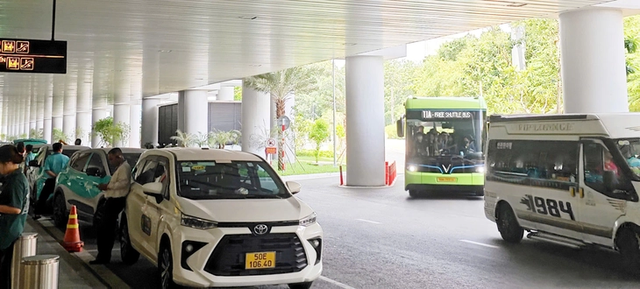
T3 Terminal is located nearly one kilometer from the T1 Terminal and T2 Terminal at Tan Son Nhat International Airport in Ho Chi Minh City, requiring transferring passengers to travel on roads outside the airport. Photo: Cong Trung / Tuoi Tre
The proposed underground connection between T1 and T3 Terminals is a separate concept. ACV has not yet released details on the design, investment cost, or implementation schedule.
The tunnel could be designed for pedestrians, shuttle vehicles, or another transport solution.
If implemented, the project would address one of the airport's current operational challenges.
T3 Terminal is located nearly one kilometer from the T1 Terminal and T2 Terminal, but there is currently no direct and convenient connection between them. Passengers transferring between terminals must travel via roads outside the airport.
For an airport located in a densely populated urban area with limited land available for expansion, building additional terminals alone cannot fully address capacity constraints.
ACV said a more important challenge is integrating the terminals into a unified system that allows passengers to transfer conveniently while reducing traffic on surrounding public roads.
According to a study by the CPG-ADCC consulting consortium, Tan Son Nhat will continue serving as Ho Chi Minh City's primary urban airport, handling mainly domestic passengers, while Long Thanh International Airport in Dong Nai Province will become the region's principal international gateway and aviation hub.
By 2030, Tan Son Nhat is expected to handle about 40 million passengers annually, with domestic travelers accounting for 75 percent of the total.
By 2050, the airport's capacity could increase to 50 million passengers a year, with domestic passengers making up around 80 percent.
Long Thanh International Airport is projected to serve 44.5 million passengers in 2030 and 77.5 million by 2050, with international travelers accounting for an increasing share of traffic.
The proposed division of roles means Tan Son Nhat will continue to play a major role even after Long Thanh begins operations, particularly in serving Vietnam's domestic air travel market.
Under the consultants' proposal, the existing T1 Terminal could be demolished during the first phase of redevelopment, while T2 Terminal would be upgraded and T3 Terminal would continue to be expanded and equipped with additional technology.
Thanh Ha - Cong Trung / Tuoi Tre News