
Vietnam airports handle 120mn passengers annually but service revenue remains modest
With more than 120 million passengers passing through 22 airports in Vietnam annually, the country’s airport network presents significant opportunities for the Airports Corporation of Vietnam (ACV) to expand its non-aeronautical revenue, which accounts for just 15 percent of its total airport operating revenue, far below the 30-40 percent levels commonly achieved by major international airport operators.
ACV, which manages 22 airports nationwide, benefits from a stable and concentrated flow of travelers, which creates favorable conditions for retail, food and beverage services, advertising, lounges, parking, and a range of other commercial activities.
However, ACV’s 2025 financial report indicated that non-aeronautical revenue contributed only around 15 percent of the total revenue generated from its airport operations.
This category includes earnings from retail stores, restaurants, duty-free shops, advertising, lounges, parking facilities, commercial leasing, and logistics services, rather than charges related directly to aircraft operations such as take-offs, landings, and ground handling.
Improving non-aeronautical revenue was a key topic discussed at ACV’s 2026 annual general meeting of shareholders held last week.
Nguyen Duc Hung, acting CEO of ACV, said that non-aeronautical revenue helps reduce the company’s reliance on landing fees, parking charges, and other aviation-related services.
At major airports such as Tan Son Nhat in Ho Chi Minh City, Noi Bai in Hanoi, and Da Nang in the namesake city, ACV has partnered with numerous businesses to operate retail outlets, food and beverage services, lounges, and duty-free shops.
A representative from a firm operating at Tan Son Nhat International Airport said that airport retail space offers clear advantages in terms of passenger traffic, but success depends heavily on location and customer flow.
Stores positioned along routes between security checkpoints and departure gates can attract thousands of passengers each day.
By contrast, even large retail spaces may struggle if they are located away from main passenger traffic patterns.
Many leading international airports operate their terminals as integrated commercial centers.
Using passenger flow data, waiting times, and customer preferences, they strategically position services to maximize spending opportunities.
For the 2024-25 financial year, Singapore’s Changi Airport generated nearly S$1.17 billion (US$905 million) from concessions and leasing activities, accounting for nearly 38 percent of its total revenue.
The airport has developed Jewel Changi Airport into a major retail and entertainment destination that attracts visitors beyond air travelers.
Meanwhile, Spain’s airport operator Aena reported nearly 1.98 billion euros ($2.3 billion) in commercial revenue in 2025, representing about 31 percent of total revenue.
Its income came from retail, dining, parking, car rentals, advertising, lounges, and real estate development.
A common feature among these operators is their approach to terminal space, parking facilities, and airport land reserves as revenue-generating assets instead of infrastructure dedicated solely to flight operations.
Currently, ACV’s non-aeronautical revenue mainly comes from terminal leasing and partnerships with companies such as service providers at Ho Chi Minh City's Tan Son Nhat Sasco and Taseco Air Service Corporation.
ACV itself is also a major shareholder in Sasco.
International models cannot be applied wholesale to Vietnam.
In 2025, Tan Son Nhat International Airport handled more than 42 million passengers, including around 24 million domestic travelers.
These passengers typically arrive close to departure times, spend less time waiting, use duty-free services less frequently, and are generally more price-sensitive.
Airport food, beverages, coffee, and lounge services also tend to be more expensive than those available outside airports.
Combined with concerns about finding departure gates, navigating queues, and avoiding missed flights, many travelers limit spending to essential purchases.
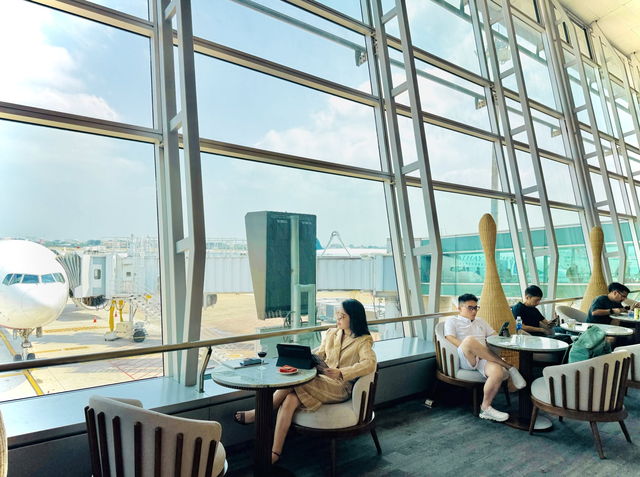
Passengers use an airport lounge, one of the services contributing to non-aeronautical revenue. Photo: S.C.
Making better use of airport space
Hung said that ACV plans to move beyond traditional leasing models to improve returns from commercial space.
The company intends to expand flexible arrangements such as revenue-sharing agreements, minimum guaranteed revenue commitments based on floor area, and franchise models tailored to specific service categories.
“ACV will continue studying and expanding effective business models to improve space utilization while reducing direct management costs,” Hung said.
Such arrangements will provide airports with a stable income base while allowing them to benefit when tenants achieve strong sales performance.
Also, service providers gain greater incentives to improve product offerings, pricing strategies, and customer service quality.
As a result, partner selection should not be based solely on rental rates.
Brand strength, product mix, pricing commitments, and operational expertise must also be taken into account.
Excessively high rents can ultimately be passed on to consumers through higher prices.
If passengers are unwilling to pay, both retailers and airports may struggle to achieve expected revenue targets.
ACV is currently working with major international duty-free operators, including China Duty Free and DFS, as well as consultants experienced in retail planning and passenger flow management.
Terminal T3 at Tan Son Nhat International Airport, the expansion of Terminal T2 at Noi Bai International Airport, and the underway Long Thanh International Airport are expected to provide additional commercial space for non-aeronautical activities.
Long Thanh, in particular, holds a significant advantage because commercial areas have been incorporated into the project from the design stage.
Nevertheless, aviation experts note that closing the gap between ACV’s current 15 percent non-aeronautical revenue share and international benchmarks will require more than simply adding new retail outlets.
The company should also redesign commercial spaces, select the right partners, maintain reasonable pricing, and diversify into new business segments such as smart parking systems, pre-flight booking services, airport hotels, and aviation logistics.
Tieu Bac - Cong Trung / Tuoi Tre News
Link nội dung: https://news.tuoitre.vn/vietnam-airports-handle-120mn-passengers-annually-but-service-revenue-remains-modest-103260622115135579.htm