
Vietnam beverage chains trim networks, optimize operations as competition pressures margins
After several years of rapid expansion, many coffee and bubble tea chains in Vietnam are shifting toward more selective growth and operational optimization as intensifying competition and thinning margins force a pullback.
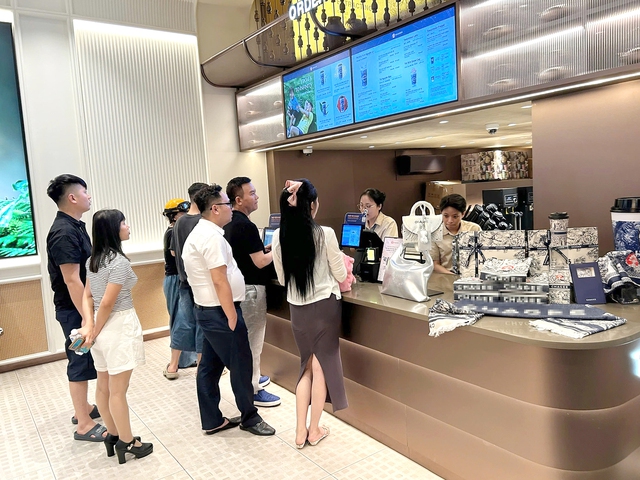
Customers queue at a beverage chain outlet in Vietnam. Photo: T.T.D. / Tuoi Tre
The country's branded coffee and milk tea shop market, valued at more than US$1.3 billion, is the third largest in Southeast Asia.
While long-term growth remains supported by a young consumer base, intensifying competition and cost pressures are prompting operators to rethink expansion-led strategies.
Shift from expansion to consolidation amid closures of weak outlets
One notable example is Mixue, a Chinese beverage chain that entered Vietnam in 2018.
The brand quickly gained popularity with low-priced drinks, typically ranging from VND25,000-30,000 (US$0.94-1.13).
This was supported by an aggressive franchising model that enabled rapid nationwide expansion.
Thien Long, a 26-year-old office worker, said he first discovered Mixue milk tea by chance and has since become a regular customer.
He often buys drinks for his family and orders via delivery apps, drawn by frequent promotions and low prices.
"They have many outlets, so they are easy to access," he said.
"I often pass by their stores, or I can just search on delivery apps and there is always a shop nearby."
Driven by its expansion strategy, Mixue reached around 1,000 outlets in Vietnam by 2023.
However, in its latest annual report, Mixue said it had closed more than 400 stores under the Mixue brand, mainly in Indonesia and Vietnam, as part of its efforts to optimize operations.
The 2021-23 period marked a boom phase for Vietnam's beverage chains.
Beyond Mixue, Vietdata, a Vietnam-based business data provider, reported that Toco Toco, a Vietnamese brand, operated nearly 500 milk tea outlets in 2023, while Taiwan's Ding Tea had around 200 stores.
However, a clearer shift toward consolidation has emerged since early this year, with more chains closing underperforming stores to control costs and improve profitability.
Chains adopt leaner, tech-driven models amid market rebalancing
The aforementioned consolidation trend is unfolding even as major players such as Phuc Long, Katinat, Highlands Coffee, and Starbucks continue to expand their networks.
According to Singapore-based market research firm Momentum Works, beverage chains across Southeast Asia are increasingly adopting 'industrialized' operating models.
These models integrate technology and standardized processes to boost productivity and improve unit economics at store level.
In Vietnam, large chains with more than 100 outlets, including Highlands Coffee, Starbucks, and Phuc Long, have introduced self-service formats where customers place orders and collect drinks at designated counters.
Some brands are also adopting automation technologies.
China's Chagee milk tea chain, for example, uses QR-coded cups to identify drink recipes, allowing machines to prepare beverages within seconds with minimal human input.
At the same time, ultra-low-cost drinks priced from as low as VND7,000 ($0.26) are gaining traction.
Brands such as Vietnam's Vien Vien Milk Tea have expanded rapidly in densely populated areas, particularly near schools and transport hubs, operating small takeaway kiosks with simplified service models.
"Even though it's not my first choice in terms of taste, I still buy these drinks because they are quick, cheap, and easy to find," said Trung Kien, a 26-year-old resident of Tan Binh Ward in Ho Chi Minh City.
Nguyen Manh Tuan, founder of Vien Vien Milk Tea, said the budget segment is not driven by a 'burn money to attract customers' strategy, but by operational efficiency and strict cost control.
He added that the takeaway-focused model helps reduce staffing needs while maintaining consistency in product quality and customer experience.
Pham Anh Tuan, Vietnam country director at Singapore-based market research firm Insight Asia, said Vietnam's beverage chain market is entering a 'rebalancing phase' after years of rapid expansion, particularly during 2021-23.
He noted that aggressive store openings have created dense networks in major cities, in some cases leading to intra-brand competition and lower average revenues.
"This is a sign of localized saturation," Tuan said.
He added that recent store closures reflect both market pressure and strategic adjustments.
Chains are increasingly removing underperforming outlets, prioritizing prime locations and upgrading store formats to improve customer experience.
Industry players also said Vietnamese consumers, particularly younger urban customers, are transitioning toward higher quality while still seeking affordable prices.
Vinh Tho - Nghi Vu / Tuoi Tre News