
Vietnam eyes $40bn carbon storage market
Vietnam could tap into a potential US$40 billion carbon storage market serving Southeast Asia, as the country mulls over the use of depleted oil and gas fields to store carbon dioxide (CO2), Minister of Industry and Trade Le Manh Hung said on Saturday.
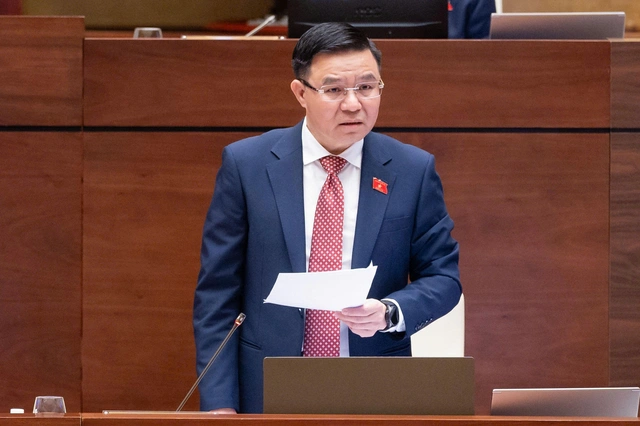
Minister of Industry and Trade Le Manh Hung speaks at a National Assembly session. Photo: National Assembly
Vietnam is working with Japan to research and pilot CO2 storage at several potential sites in the northern region.
Hung made the remarks during a National Assembly discussion on amendments to the Petroleum Law, as lawmakers considered policies for the emerging carbon capture, transportation and storage (CCS) sector.
Vietnam explores CO2 storage at depleted fields
Preliminary assessments indicate that Vietnam could develop a CCS service industry serving the broader Southeast Asian market, Hung said.
The market, together with offshore energy services associated with oil and gas operations, could have significant growth potential, he added.
A study by the Vietnam Petroleum Institute puts the potential market value at around $40 billion.
Hung said the development of offshore energy projects alongside oil and gas activities could help expand value chains and improve the efficiency of resource use.
Oil and gas facilities are energy-intensive, creating opportunities to integrate renewable energy into their operations while making use of existing pipelines, platforms, and other infrastructure.
Renewable power could also be used to produce hydrogen through electrolysis, supporting Vietnam's energy transition and emissions reduction efforts.
"This will support the energy transition and reduce emissions. This is a very new and progressive direction in the law," Hung said.
National Assembly deputy Nguyen Ngoc Son said CCS could create a new industry but warned that its long-term costs and responsibilities should not ultimately fall on the state.
CCS would enable depleted fields and existing oil and gas infrastructure to be reused, but it would also require monitoring for decades, including after petroleum contracts expire, Son said.
He proposed requiring CCS operators to provide financial guarantees or liability insurance.
"This is a financial obligation, not merely a technical issue," Son said, warning that without such a requirement, the financial burden could eventually be transferred to the state.
Deputies seek rules for converting depleted fields
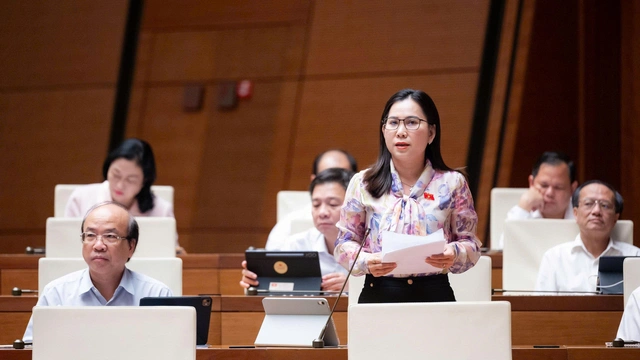
National Assembly deputy Le Thi Ngoc Linh of Ca Mau Province speaks at the session. Photo: National Assembly
National Assembly deputy Le Thi Ngoc Linh of Ca Mau Province backed the inclusion of CCS provisions in the draft law, saying the sector would be important to emissions reduction and the energy transition.
She proposed allowing depleted or soon-to-be depleted oil and gas fields to be converted into carbon storage facilities.
Existing oil and gas contractors and Petrovietnam should be allowed to research and propose such conversions within a specified period, Linh said.
Such a mechanism would allow Vietnam to make better use of existing geological data and infrastructure.
She also called for specific requirements for CCS operators to ensure environmental protection and technical safety.
Deputy Trinh Xuan An said the draft law could create new development opportunities through CCS and offshore infrastructure.
The approach would support the development of high-tech industries and move the sector beyond conventional resource extraction, he said.
An also called for national defense and security considerations to be incorporated into the development of new oil and gas activities, alongside marine economic development and the protection of maritime sovereignty.
He said the draft law should also clearly define policies for oil and gas services, covering commercial, technical, and technological activities related to petroleum surveys, oil, and gas operations and CCS.
Incentives proposed for deepwater, offshore fields
Vietnam's oil and gas projects are increasingly moving into deepwater and offshore areas, where operating conditions are more challenging, geological conditions are more complex, investment requirements are higher, and payback periods are longer, Minister Hung said.
Many small and marginal fields are not commercially viable under existing mechanisms, meaning potential projects could remain undeveloped and the state could forgo additional revenue.
The draft law therefore proposes investment incentives for the development of marginal fields in deepwater and offshore areas, along with measures to increase oil recovery rates.
"To increase oil recovery rates, in addition to scientific and technical solutions, oil and gas contractors need to invest in research. Therefore, the law sets out policies to promote science and technology development, attract investors, increase production, contribute to the state budget, and ensure the country's energy security," Hung said.
The Ky - Ngoc An - Tien Long - Thanh Chung / Tuoi Tre News
Link nội dung: https://news.tuoitre.vn/vietnam-eyes-40bn-carbon-storage-market-103260809112457319.htm