
Vietnam, India set sights on decade-long technology cooperation
Vietnam and India are seeking to deepen technology cooperation over the next five to 10 years, focusing on artificial intelligence, cybersecurity, fintech, digital infrastructure, and talent development, officials and experts said at a bilateral forum in Ho Chi Minh City on Monday.
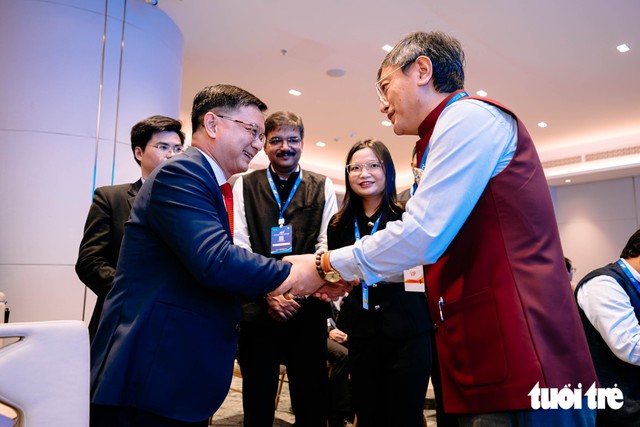
Nguyen Manh Cuong (L), vice-chairman of the Ho Chi Minh City People’s Committee, talks with Indian Ambassador to Vietnam Tshering Wangchuk Sherpa, Ho Chi Minh City, October 26, 2026. Photo: Thanh Hiep / Tuoi Tre
The Vietnam-India Future Technology Forum was organized by the Vietnam Centre for the Fourth Industrial Revolution in Ho Chi Minh City (HCMC C4IR) and the Consulate General of India in the city.
The event was part of the 2026 Autumn Economic Forum, running from Monday to Thursday at ThiskyHall Convention Center in An Khanh Ward.
The tech forum brought together Nguyen Manh Cuong, vice-chairman of the Ho Chi Minh City administration, Indian Ambassador to Vietnam Tshering Wangchuk Sherpa, representatives of management agencies, businesses, and research institutes from both countries.
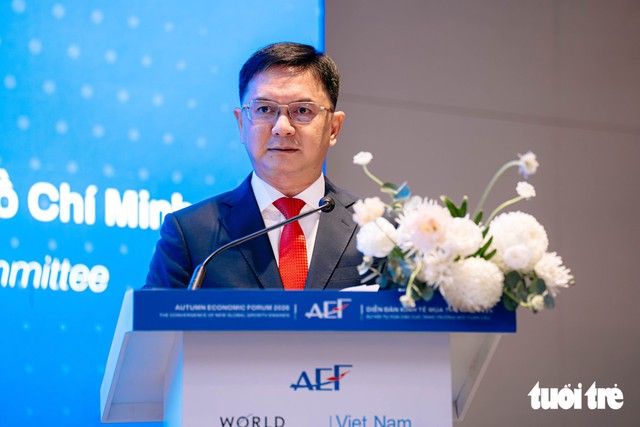
Nguyen Manh Cuong, vice-chairman of the Ho Chi Minh City People’s Committee, speaks at the Vietnam-India Future Technology Forum held in Ho Chi minh City, October 26, 2026. Photo: Thanh Hiep / Tuoi Tre
Speaking at the opening ceremony, Cuong said competitive advantages no longer depend solely on access to technology.
He emphasized the ability to conduct research, absorb and master technologies, and apply them to specific development challenges, saying that no country or city can develop all these capabilities on its own.
In May this year, Ho Chi Minh City established friendship and cooperation ties with Mumbai, India’s financial and technology hub.
Mumbai was the first Indian locality with which the southern Vietnamese city had established such a relationship.
Cuong said Ho Chi Minh City, following its administrative merger with Ba Ria-Vung Tau and Binh Duong in July last year, was positioning science, technology, and innovation as key drivers of development.
The city is building a strategic technology ecosystem covering artificial intelligence, semiconductors and integrated circuits, data infrastructure, computing, and test beds for emerging technologies.
These areas offer opportunities for Indian partners to conduct research, invest in, and test new technologies alongside Vietnamese businesses, he said.
Cuong called for bilateral cooperation to link advanced technology training with business demand, with practical needs serving as the starting point for research and technology transfer, adding that HCMC C4IR has been assigned to serve as the focal point for this cooperation.
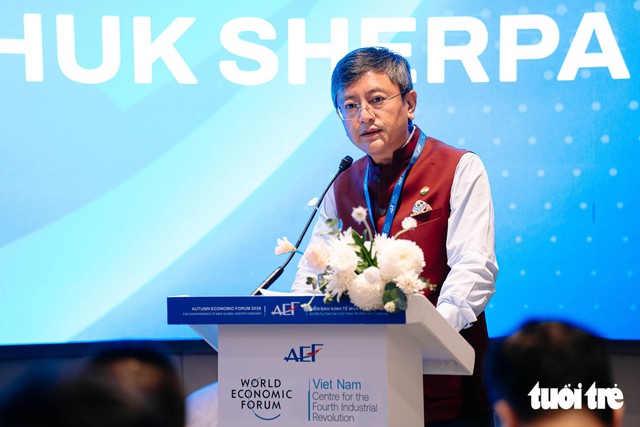
Indian Ambassador to Vietnam Tshering Wangchuk Sherpa. Photo: Thanh Hiep / Tuoi Tre
At the event, Ambassador Sherpa provided an update on efforts to advance the enhanced comprehensive strategic partnership between the two countries.
Last week, Umesh Waghmare, Deputy Minister of Science and Technology of India, visited Hanoi for the 11th session of the India-Vietnam Joint Sub-Committee on Science and Technology, the ambassador said.
Both sides agreed to cooperate in biotechnology, marine science, advanced functional materials, information technology, AI, and quantum computing.
They also agreed that the next edition of the India-Vietnam Innovation Forum, held in New Delhi in May, would take place in Vietnam.
The Indian diplomat proposed connecting the startup ecosystems of Ho Chi Minh City and Mumbai, as well as linking the Indian Institute of Technology Bombay in Mumbai with a corresponding institution in Ho Chi Minh City to facilitate exchanges between students and researchers.
In Hanoi, India is considering establishing a joint innovation center at the Hanoi University of Science and Technology in cooperation with the Indian Institute of Technology Delhi.
India also plans to hold the first meeting of a deputy minister-level working group on digital technology in Hanoi to advance implementation of a memorandum of understanding signed in May, the ambassador said.
Through HCMC C4IR, India could also offer advanced technology training programs in the South Asian country.
The diplomat said India “should and needs to learn” from Vietnam’s recent progress, including its growing emphasis on research and development and the active participation of the private sector.
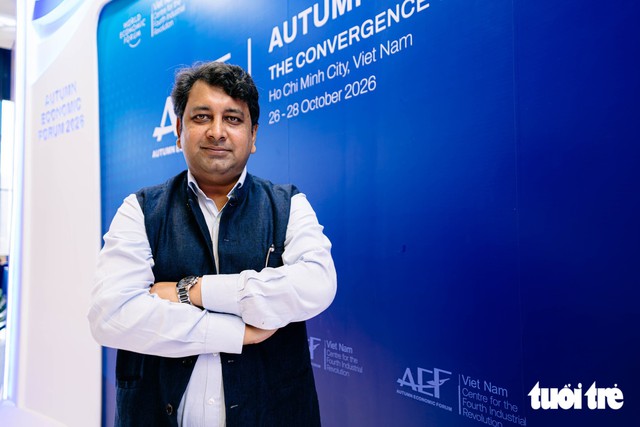
Ajit Kumar, Joint Secretary at India’s Ministry of Electronics and Information Technology. Photo: Thanh Hiep / Tuoi Tre
Speaking to Tuoi Tre (Youth) online newspaper on the sidelines of the tech forum, Ajit Kumar, Joint Secretary at India’s Ministry of Electronics and Information Technology, said all priority areas would be discussed by a joint working group established under the memorandum of understanding signed with Vietnam’s Ministry of Science and Technology.
Based on the forum’s discussions, Kumar identified public digital infrastructure as an area where cooperation could begin immediately, citing one example of India’s Unified Payments Interface, an integrated digital payment system already in operation in the country.
Other potential areas include cybersecurity, fintech, training and capacity building for young Vietnamese people in India, and cooperation between universities in the two countries.
“Technology changes every day, and with the emergence of AI, the future of technology also presents many challenges. Therefore, I believe fintech, AI applications, cybersecurity, and data processing could become key pillars of cooperation, alongside talent exchanges and capacity building,” Kumar said.
He expressed hope that Vietnam-India cooperation would become more substantive over the next five to 10 years, enabling the two countries to jointly promote the democratization of technology across the Global South, where technology should be accessible to everyone.
Minh Duy - Ngoc Duc - Thanh Hiep / Tuoi Tre News
Link nội dung: https://news.tuoitre.vn/vietnam-india-set-sights-on-decade-long-technology-cooperation-103261027121931453.htm