
Vietnam look to shake off jinx as Malaysia change arena in ASEAN Cup 2026 semi
As the 2026 ASEAN Hyundai Cup reaches its fever pitch, the upcoming semifinal clash between Vietnam and Malaysia is not just a football match. It is a high-stakes psychological war framed by a change of venue and the heavy shadow of history.
The semifinals feature a two-legged home-and-away format, with group runners-up hosting the first leg and group winners securing home advantage for the return fixture.
The action kicks off on August 15 when Singapore host Thailand at Yishun Stadium, followed by Vietnam traveling to face Malaysia at Cheras on August 16.
The decisive second legs move to Bangkok and Hanoi, with Thailand hosting Singapore at Rajamangala Stadium on August 18, before Vietnam welcome Malaysia to My Dinh Stadium on August 19. All four ties are scheduled to kick off at 8:00 pm Vietnam time (GMT+7).
While the Golden Dragons enter the tie as clear favorites, a haunting 'semifinal jinx' and a sudden stadium shift in Kuala Lumpur have created a narrative thick with drama and tension.

2026 ASEAN Hyundai Cup semifinal fixtures
The 'Bukit Jalil' factor: a missing fortress?
In a surprising turn of events, Malaysia will not host the first leg at the daunting Bukit Jalil National Stadium.
As confirmed by the New Straits Times, scheduling conflicts have rendered the national fortress unavailable, forcing the Malayan Tigers to relocate the high-stakes clash to the far more intimate Kuala Lumpur Football Stadium in Cheras.
For Vietnam, this venue change provides immediate psychological relief.
Bukit Jalil has long operated as a legendary cauldron capable of swallowing visiting teams whole.
Over 15 clashes at the region's flagship tournament, Vietnam may hold the upper hand overall with nine victories, but Malaysia's most iconic triumphs have almost always been forged inside this 80,000-seat arena.
It was here in 2010 that a roaring home crowd powered Malaysia to a decisive 2-0 first-leg semifinal win, dethroning defending champions Vietnam en route to their maiden regional title.
Even in 2018, when Vietnam raced into an early 2-0 lead in the final, the hosts summoned Bukit Jalil's fierce spirit to force a thrilling 2-2 draw before Vietnam ultimately sealed the trophy at My Dinh.
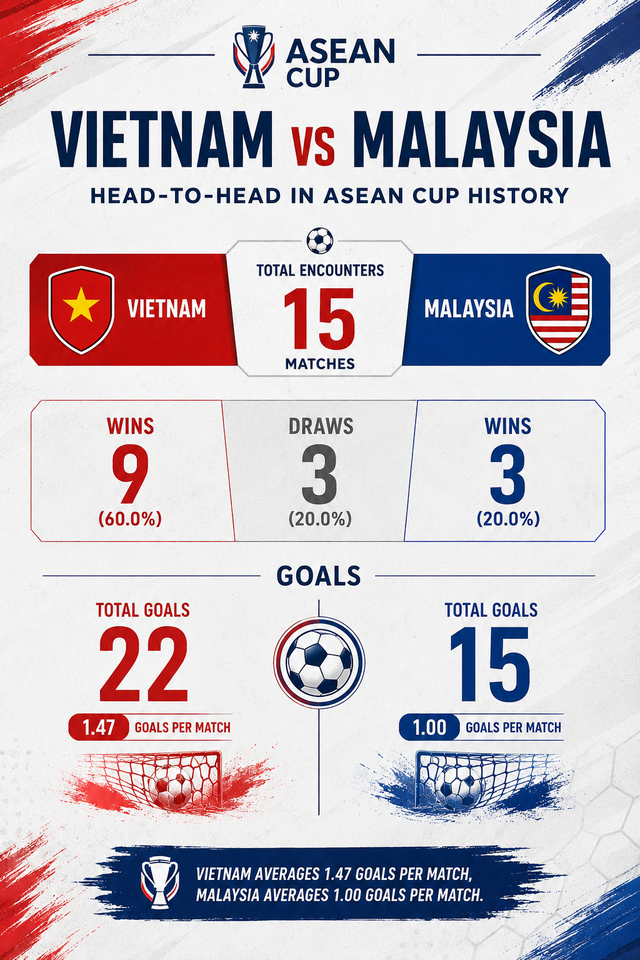
Data: Tuoi Tre
Malaysia's fiercest displays have historically relied on this iconic turf; without its suffocating pressure, the hosts lose their single most potent weapon.
Yet, the narrative is not entirely simple, as the tighter layout in Cheras could paradoxically forge an even more claustrophobic and hostile atmosphere for the visitors.
Ghosts of 2014 & semifinal curse
Malaysia's camp is playing the psychological game to perfection.
According to the New Straits Times, interim coach Tan Cheng Hoe has firmly adopted a 'no pressure on us' stance, effectively transferring the entire weight of expectation onto Vietnam's shoulders by publicly admitting the Golden Dragons are the superior side.
While Malaysia downscale to a smaller venue, the atmosphere for the second leg in Hanoi is already reaching a breaking point.
Tickets for the return fixture at My Dinh Stadium were snatched up almost instantly, with Category 1 and Category 3 passes selling out just hours after the online portal opened, according to data obtained by Tuoi Tre (Youth) online newspaper.
At its peak, the ticketing system recorded over 7,000 fans waiting in a virtual queue—a stark reflection of the massive expectations resting squarely on Kim Sang Sik's squad.
"There is no pressure on us. Vietnam are the favorites, and all the expectation rests on their shoulders," he told the Malaysian newspaper.
Yet, there is a glaring anomaly in the head-to-head record that favors Vietnam: the two most painful losses in that stretch both came in the ASEAN Cup semifinals.
The first was in 2010. Coming off their maiden regional title, Vietnam entered the tournament as heavy favorites.
However, a 0-2 defeat at Bukit Jalil in the first leg left Henrique Calisto's squad with too much ground to make up, as a goalless draw in the return fixture at My Dinh saw Malaysia advance to the final.
Four years later, in 2014, history repeated itself in even more agonizing fashion.
After securing a commanding 2-1 first-leg victory away in Kuala Lumpur, Vietnam looked destined for the final, only to suffer a catastrophic 2-4 collapse on home soil, a defeat that remains one of the most painful chapters for Vietnamese football fans.

Vietnam's Quang Hai (right) and a Malaysian rival fight for the ball during an ASEAN Cup match. Photo: FAM
To make matters worse for Golden Dragons fans, history reveals a telltale pattern: Vietnam have reached the ASEAN Cup final five times, in 1998, 2008, 2018, 2022, and 2024. Remarkably, in every single one of those successful runs, they never had to face Malaysia in the semifinals.
For all their recent dominance, the Golden Dragons are not just playing Malaysia; they are playing against their own semifinal demons.
Vietnam possess superior technical depth and an overwhelming head-to-head record over the past decade. However, Malaysia are a side that flourish on grit and the 'spirit of the underdogs.'
Without the imposing shadow of Bukit Jalil, Malaysia must rely on raw intensity and the weight of Vietnam's past failures.
Will Vietnam finally bury their 'semifinal jinx' in front of a sold-out My Dinh crowd, or will the Malayan Tigers pull off another historic heist?
The stage is set, and the ghosts of 2014 are watching.

Son Luong / Tuoi Tre News
Link nội dung: https://news.tuoitre.vn/vietnam-look-to-shake-off-jinx-as-malaysia-change-arena-in-asean-cup-2026-semi-103260811142100647.htm