
Vietnam moves to standardize EV charging infrastructure
Vietnam is set to introduce a national technical framework for electric vehicle (EV) charging stations, a move industry participants say will provide long-awaited clarity for investors, charging network operators, and consumers while supporting the country's rapidly expanding EV market.
The Ministry of Industry and Trade has been tasked with working alongside the Ministry of Science and Technology to finalize national technical standards for charging stations and charging equipment by September 30.
The regulations are expected to establish uniform requirements covering station design, grid connection, electricity metering, operational procedures, and electrical safety.
Also, the Ministry of Construction will introduce new requirements for charging and battery-swapping facilities in apartment buildings, while independent parking lots will be required to incorporate charging infrastructure into their developments.
Once the standards are issued, investors will have a clear framework for selecting equipment, designing charging stations, and estimating project costs.
For EV owners, standardized regulations could improve compatibility across charging networks, making it easier to charge vehicles regardless of brand.
A clearer regulatory framework is also expected to encourage fresh investment while providing EV users with safer and more reliable charging infrastructure.
Firms rush to expand charging networks
According to international market research firm Mordor Intelligence, the country's EV market is projected to reach US$3.7 billion in 2026, before expanding to $8.84 billion by 2031.
The charging infrastructure segment is forecast to grow even faster, increasing from nearly $81.7 million in 2025 to $459.5 million by 2034.
V-Green, backed by billionaire Pham Nhat Vuong, currently operates more than 150,000 charging ports nationwide.
The company aims to expand that figure to 500,000 ports across Vietnam.
At present, V-Green stations are compatible only with VinFast vehicles.
This year, the company plans to invest VND10 trillion ($380 million) to build 99 ultra-fast charging stations along national and provincial highways.
While V-Green focuses on the VinFast ecosystem, other operators are racing to develop open charging networks that can serve multiple vehicle brands, including BYD, Geely, and VinFast.
TMT EGreen has set a target of operating 2,100 charging stations by the end of 2026, expanding to 30,000 stations by 2030.
The company said it imported 570 charging units in May and June and recently commissioned 39 additional chargers across 18 locations.
Chinese automaker BYD has partnered with Futa EV Power, an EV charging infrastructure developer under Vietnamese transport firm FUTA Group, to jointly develop charging infrastructure, battery technology, and energy storage solutions.
Meanwhile, Charge+ has collaborated with Porsche to establish 17 fast-charging stations along a roughly 1,700-kilometer corridor, strengthening long-distance charging coverage.
Digital platform operator VETC, part of the Tasco ecosystem, has taken a different approach by integrating multiple charging operators into a single application.
After just over one month of operation, the company said it had connected more than 350 charging stations, representing roughly half of Vietnam's multi-brand EV charging network.
Users can locate stations, initiate charging sessions, and make payments through one app.
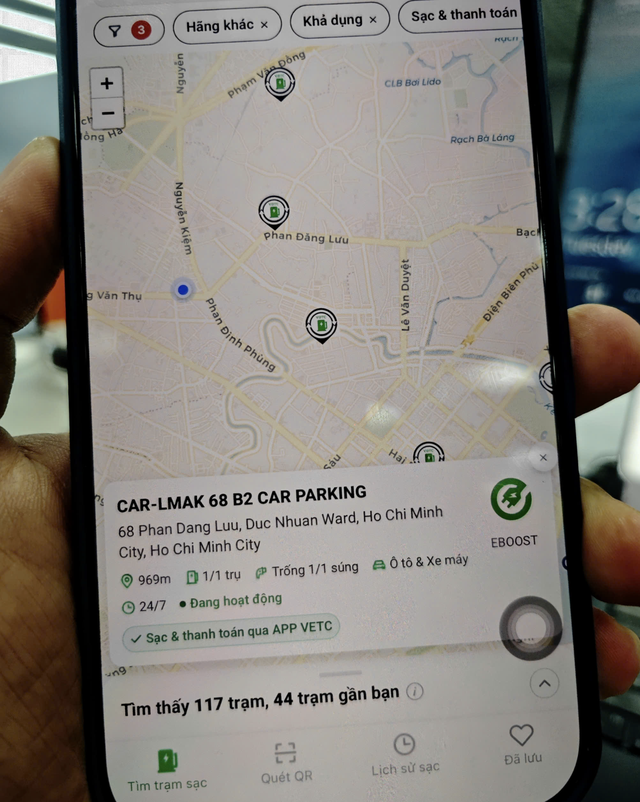
Multi-brand EV charging stations are integrated into the VETC app, allowing users to easily locate charging points and make payments. Photo: Cong Trung / Tuoi Tre
Network reliability still a challenge
Despite rapid expansion, the user experience remains inconsistent.
Some charging applications show that while multi-brand charging stations are now available across many provinces and cities, service reliability varies considerably.
At one point, TMT EGreen's application displayed only two charging stations in Ho Chi Minh City, with all charging connectors listed as unavailable.
Futa EV showed more locations, but some chargers were marked as occupied while others appeared offline due to connection issues.
VETC displayed a denser network because it aggregates multiple charging operators onto a single platform.
Pricing also differs significantly between providers.
Since July 15, TMT EGreen has charged VND3,651 ($0.13) per kWh during off-peak hours, VND4,984 ($0.18) per kWh during standard hours, and VND7,436 ($0.28) per kWh during peak periods.
Other operators maintain their own pricing structures.
Bitcharge, available at BYD Bitcar dealerships, charges between VND4,212 and VND6,048 ($0.15-$0.22) per kWh, depending on the time of day.
Esky lists charging rates of around VND7,000 ($0.26) per kWh, while V-Green maintains a flat rate of VND3,858 ($0.14) per kWh.
Tieu Bac - Cong Trung / Tuoi Tre News
Link nội dung: https://news.tuoitre.vn/vietnam-moves-to-standardize-ev-charging-infrastructure-103260729122701001.htm