
Vietnam must tackle challenges faster than other countries to reach high-income status by 2045: economist
Vietnam needs to move faster and more decisively than other countries in addressing shared challenges if it is to become a high-income economy by 2045, according to Professor Nguyen Duc Khuong of the University of Cambridge and chairman of AVSE Global - the Association of Vietnamese Scientists and Experts.
Vietnam is undergoing a major shift in its development model, with science and technology, innovation, the knowledge economy and high-quality human resources emerging as key growth drivers, Khuong told Tuoi Tre (Youth) online newspaper.
The transformation comes after decades of adjustments to the country's growth model, which has gradually moved away from heavy reliance on natural resources, labor and capital toward greater use of technology, knowledge and innovation.
Vietnam is now building an innovation ecosystem, with many businesses developing emerging technologies and moving into deep tech and core technologies.
Innovation is helping the country adopt a model that relies more heavily on knowledge, skilled workers and higher productivity.
Changes are also taking place in the way government agencies and organizations operate, supporting Vietnam's transition toward a knowledge-based economy in which science and technology play a greater role.
Vietnam cannot afford to fall behind
Artificial intelligence (AI) is creating a common challenge for countries around the world as it reshapes economies, consumer habits, workplaces and the way societies operate.
While some countries have stronger technological foundations, AI has created a new playing field for everyone, Khuong said. Vietnam therefore cannot afford to fall behind the rest of the world, as falling behind would force the country to spend more time catching up.
Vietnam must address shared challenges faster, more decisively and more effectively than other countries to build a high-income, stable, prosperous and equitable society.
The need to change the growth model also comes from the country's broader development goals and the interests of its entire population, rather than simply from rapid technological change or global economic instability.
Technology can be bought, but talent cannot
The rise of AI and digital technologies is prompting countries to invest more heavily in science and technology. Vietnam needs to strengthen research and development to create applications and products that serve not only business needs but also the goal of building a modern, civilized and equitable society.
A smart, developed and prosperous country requires strong foundations, with science and technology, digital transformation and innovation serving as key pillars.
Building those foundations requires capable people. A highly skilled and disciplined workforce, combined with strong connectivity and international integration, can help Vietnam attract resources from abroad, including technology, physical infrastructure, financial capital and talent.
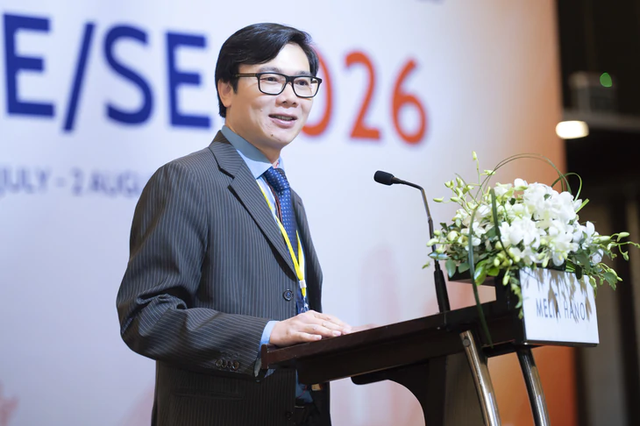
Professor Nguyen Duc Khuong of the University of Cambridge and chairman of AVSE Global - the Association of Vietnamese Scientists and Experts said Vietnam cannot afford to delay its economic transformation. Photo: AVSE
If Vietnam can become a place where these resources converge, it will have achieved half of the goal, Khuong said.
The other half will depend on how the country combines the factors of production to improve total factor productivity through the integration of technology, people, knowledge, innovation and AI.
Human resources are one of Vietnam's key development breakthroughs. In recent years, the country has sought to attract talented experts from abroad, Vietnamese living overseas and international specialists.
Vietnam is also reforming its higher education and general education systems and updating training programs to reflect technological changes. The goal is to ensure graduates can enter the labor market with skills that are relevant to businesses.
No matter how advanced technology becomes, it can be purchased with financial resources. But a country's capabilities and the capabilities of its workforce cannot be imported and must be developed domestically.
Vietnam should also make greater use of the expertise and capabilities of foreign talent.
Infrastructure, human resources are parallel priorities
Vietnam is still at a stage where it must make progress on multiple fronts, including strategic infrastructure.
Strategic infrastructure serves as the lifeblood connecting localities and economic regions across the country. Given Vietnam's geography, stretching from north to south, such infrastructure is particularly important.
Railway stations, seaports, airports, expressways and high-speed railways are essential for attracting financial capital, international experts, businesses and global corporations to Vietnam.
Without adequate infrastructure, investors may be reluctant to commit capital, establish businesses or pursue long-term strategies in the country.
Human resource development, however, requires systematic efforts and time.
Developing people cannot be accomplished overnight. The government has been investing in education and training through a gradual, long-term process.


In the coming years, investment in and reform to universities, schools and other educational institutions are expected to bring fundamental changes, with curricula updated to international standards.
This would give Vietnamese graduates the skills needed to meet the demands of domestic and international businesses.
Both strategic infrastructure and human resources are priorities, but physical infrastructure is an immediate need. Vietnam also needs soft infrastructure, including Internet connectivity, smart networks and data.
Changes to the education and training system will take longer, but this does not diminish the importance of human resource development. Building Vietnam's competitiveness over the medium and long term requires sustained investment in human capital.
Government, scientists, businesses need to form an ecosystem
Cooperation among the government, scientists and businesses should evolve into an integrated ecosystem. Only through such an ecosystem can the three groups work closely together, create synergies and generate value.
Leading professors and economic experts at scientific conferences can serve as bridges between research and policymaking, providing policymakers with knowledge and professional expertise.
The three groups do not necessarily have to come together at the same physical events. Experts and economists can bring discussions from conferences into policy meetings, allowing collaboration to continue behind the scenes within the broader ecosystem.
Long-term thinking is also essential. Policymaking cannot be viewed as a short-term process but should be part of a development trajectory spanning generations.
Scientific conferences also bring together researchers and educators who interact with students who will become the country's future leaders.
Some of these students may eventually enter public policy, and providing them with a strong foundation can help them develop better policies in the future.
Thanh Ha - Nguyen Nguyen / Tuoi Tre News