
Vietnam reviews technical infrastructure after US nationwide flight grounding
A U.S. air traffic control incident that triggered a nationwide ground stop on Friday disrupted operations at numerous airports across Canada, Europe and Asia, prompting Vietnam’s air navigation authorities to review their technical infrastructure and strengthen contingency measures.
The U.S. Federal Aviation Administration ordered a nationwide ground stop, preventing aircraft from departing U.S. airports, following ‘a communication issue impacting all Air Route Traffic Control Centers,’ Reuters reported.
Although the United States lifted the nationwide flight grounding the same day, cancellations and delays affecting thousands of flights continue to cause disruptions to aviation operations in several countries.
In Vietnam, Vietnam Air Traffic Management Corporation (VATM) has launched a review of its technical infrastructure and reinforced backup systems to reduce the risk of similar incidents.
A VATM representative said on Saturday the incident in the United States highlighted significant operational risks in air traffic management systems, particularly as aviation infrastructure becomes increasingly dependent on connectivity and data processing capabilities.
One of the most critical requirements is ensuring that backup systems operate independently of primary systems, according to VATM.
If both rely on the same cable route, equipment or transmission infrastructure, a single failure could disable both systems simultaneously.
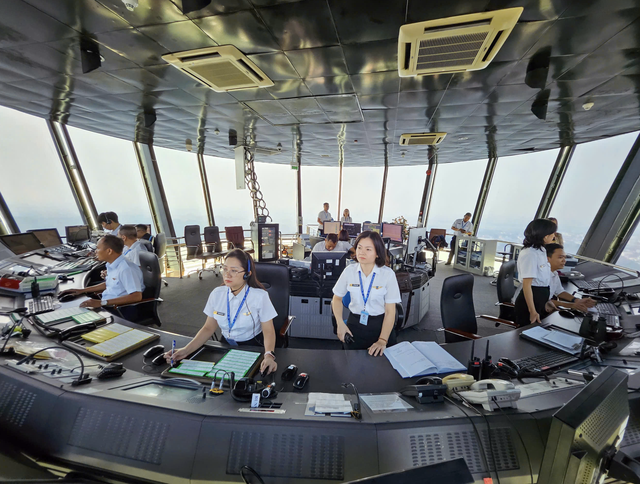
An air traffic control team on duty at Noi Bai Air Traffic Control Tower in Hanoi. Photo: VATM
To minimize this risk, VATM is developing a multi-layered backup network that combines fiber-optic cables with dedicated satellite-based very small aperture terminal communications.
The corporation also conducts regular checks to ensure that transmission routes remain independent.
VATM has invested in replacing 10 radar systems with next-generation equipment, upgraded the Ho Chi Minh City Area and Approach Control Center after more than 20 years of operation, and continued modernizing its air traffic management systems in Hanoi.
VATM also warned that risks are not limited to complete system failures.
Equipment may continue operating normally while transmitting inaccurate or corrupted data, potentially creating equally serious safety concerns.
As such, the corporation is developing a digital network operations center to monitor data quality and detect early signs of abnormalities involving transmission links, radar systems, and communications networks.
This will allow switching promptly to backup arrangements when necessary.
Alongside technical measures, the Air Traffic Flow Management Center operates around the clock, ready to adjust departure times, allocate operational capacity, and manage flight routes in response to abnormal situations.
In terms of cybersecurity, VATM said critical air traffic control systems are isolated from the public Internet, with network connections strictly controlled through dedicated firewalls.
The corporation has also introduced an integrated technical infrastructure and cybersecurity monitoring model that operates around the clock.
In particular, during the ongoing technological transition, all changes to software, system configurations, and network infrastructure must undergo risk assessments and parallel testing.
Contingency procedures must also be in place to restore previous configurations if problems arise.
Looking ahead, VATM plans to continue researching satellite-based aircraft surveillance, while exploring the use of artificial intelligence in predictive maintenance and air traffic flow management.
Tuoi Tre News
Link nội dung: https://news.tuoitre.vn/vietnam-reviews-technical-infrastructure-after-us-nationwide-flight-grounding-103261115094443914.htm