
Vietnam shifts from attracting FDI to building sustainable foreign-invested economy
Vietnam is embarking on its most significant overhaul of foreign investment policy in decades, shifting beyond a long-standing focus on attracting foreign investment to build a modern, innovation-driven and sustainable foreign-invested economy that is more closely integrated with domestic businesses and better positioned to support long-term growth.
The shift, outlined in Resolution No. 10-NQ/TW issued by Vietnam’s Politburo on June 8, comes as the country reshapes its growth model around science and technology, innovation, digital transformation, green transition, and greater strategic self-reliance amid intensifying global competition.
For nearly four decades, foreign investment has been a key driver of Vietnam's growth, supporting its rise as a major manufacturing hub through exports, job creation, and global production integration.
However, policymakers say attracting capital alone is no longer sufficient as Vietnam enters a new development phase.
Future competitiveness will depend on whether foreign investment can drive technology transfer, strengthen domestic enterprises, and generate higher value added across the economy.
From capital attraction to long-term value creation
Presenting Resolution No. 10 at a conference on its implementation in Hanoi on Tuesday, Permanent Deputy Prime Minister Pham Gia Tuc described it as a fundamental shift in development thinking rather than a routine policy update.
Instead of focusing primarily on attracting investment capital, Vietnam now aims to develop a modern, efficient, and sustainable foreign-invested economic ecosystem that contributes to building an independent and self-reliant economy while remaining deeply integrated with the global economy.
The government said that while the foreign-invested sector has made important contributions to Vietnam's development, its quality, efficiency and spillover effects have yet to match the country's potential and long-term development requirements.
Foreign-invested enterprises have brought capital, technology, management expertise, and access to international markets, but many projects remain concentrated in labor-intensive assembly with limited domestic value added.
Technology transfer remains modest, localization rates are low and linkages with Vietnamese suppliers are still weak.
The Politburo also noted persistent local competition for investment, often prioritizing quantity over quality.
Deputy PM Tuc said this approach must change, stressing that localities should not compromise the environment, natural resources, social welfare or economic security for short-term growth.
Instead, Vietnam plans to assess foreign investment based on criteria such as technology transfer, innovation, workforce development, stronger domestic supply chains, and participation in global value chains.
The resolution also shifts investment incentives from traditional input-based preferences toward performance-based support linked to project commitments and outcomes, including R&D, technology transfer, localization, and green manufacturing.
It also calls for replacing fragmented provincial competition with stronger national coordination in attracting strategic investors and for building a more transparent, predictable, and competitive investment environment.
Making foreign investment work for domestic businesses
The policy shift is accompanied by ambitious targets to attract higher-quality investment while strengthening domestic firms.
Between 2026 and 2030, Vietnam aims to attract US$200–300 billion in newly registered foreign investment, with about 75 percent expected from developed economies with advanced technology and strong management capacity.
The country also seeks more Fortune 500 firms and encourages multinational corporations to establish regional headquarters, R&D centers, and innovation hubs in Vietnam.
At the same time, Vietnam is placing stronger emphasis on linking foreign-invested enterprises with domestic companies.
By 2030, it targets localization rates of 45–50 percent in key industries and aims to integrate about 10,000 Vietnamese firms into foreign-invested enterprises' supply chains, including up to 1,000 first-tier suppliers.
The goal is to ensure foreign investment no longer operates as an isolated sector but helps upgrade domestic enterprises and strengthen national competitiveness.
Speaking at the Foreign Direct Investment (FDI) Connect 2026 forum in Bac Ninh Province on April 24, Nguyen Duc Hien, deputy head of the Party Central Committee's Policy and Strategy Commission, said Vietnam's approach to foreign investment must evolve in line with the country's development strategy.
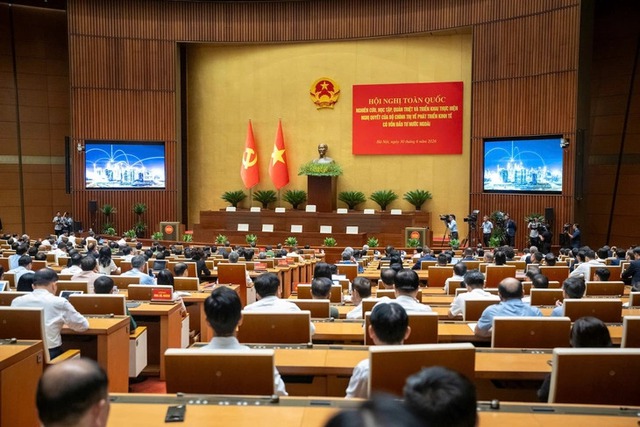
Delegates attend a conference on the implementation of the Politburo's Resolution No. 10-NQ/TW in Hanoi, June 30, 2026. Photo: Gia Han / Tuoi Tre
He said Vietnam should develop a comprehensive foreign-invested economic ecosystem while moving beyond capital attraction to building a national strategic investment platform that selectively attracts FDI based on quality, efficiency, and spillover effects.
He said the next phase of foreign investment should be built on stronger integration between multinational corporations and Vietnam's domestic business ecosystem, supported by institutional reforms, a highly skilled workforce, and a more competitive business environment.
Ho Sy Hung, chairman of the Vietnam Chamber of Commerce and Industry, echoed that view, saying Vietnam can no longer rely on low labor costs to attract investment.
He called for stronger supporting industries and more capable domestic firms that can move into higher-value activities such as design, R&D, and innovation.
Building broader international investment ecosystem
Resolution No. 10 expands Vietnam's vision beyond traditional foreign investment toward a broader international investment ecosystem spanning capital markets, financial institutions, and cross-border investment channels.
Instead of focusing solely on attracting traditional foreign investment projects, the resolution calls for developing an integrated international investment ecosystem alongside domestic enterprises, capital markets, international financial centers, free trade zones, high-tech parks, innovation centers, and logistics infrastructure.
It also encourages multinational corporations to establish regional headquarters, service hubs, and R&D facilities in Vietnam, supporting the country's ambition to become a regional center for manufacturing, services, innovation, and business operations.
Market observers say Vietnam still has significant room to expand international capital inflows beyond traditional foreign investment.
At the Vietnam Connect Forum 2026 in Hanoi on May 13, Dinh Duc Quang, country head of Global Markets at United Overseas Bank (Vietnam) Limited, said Vietnam continues to outperform regional peers in attracting foreign investment but has untapped potential in other cross-border financing channels.
He noted that nearly 50 foreign financial institutions are already operating in Vietnam, providing additional funding channels for domestic businesses and financial institutions.
However, foreign investors currently hold only about one to two percent of Vietnam's government bonds, well below levels in neighboring countries, suggesting substantial potential to attract more long-term international capital as market infrastructure and investor confidence continue to improve.
His view aligns with Resolution No. 10, which calls for a more transparent, stable and predictable investment environment supported by stronger legal frameworks, digitalized procedures, and better national coordination.
The resolution emphasizes that building a foreign-invested economy requires not only attracting projects but also creating an ecosystem where capital, technology, talent, and innovation reinforce each other.
For decades, Vietnam measured success by the volume of foreign investment and manufacturing output.
The new approach shifts the benchmark toward how effectively foreign investment strengthens technological capability, domestic enterprises, strategic self-reliance, and participation in global value chains.
Rather than simply seeking more capital, Vietnam is now focusing on ensuring that foreign investment delivers deeper, long-term contributions to innovation, productivity, and sustainable growth.
Tuoi Tre News
Link nội dung: https://news.tuoitre.vn/vietnam-shifts-from-attracting-fdi-to-building-sustainable-foreign-invested-economy-10326070212125211.htm