
Vietnam weighs solar power pricing by location
Vietnam’s Ministry of Industry and Trade has proposed calculating solar power prices by locality or socio-economic region, replacing the current three-region pricing system.
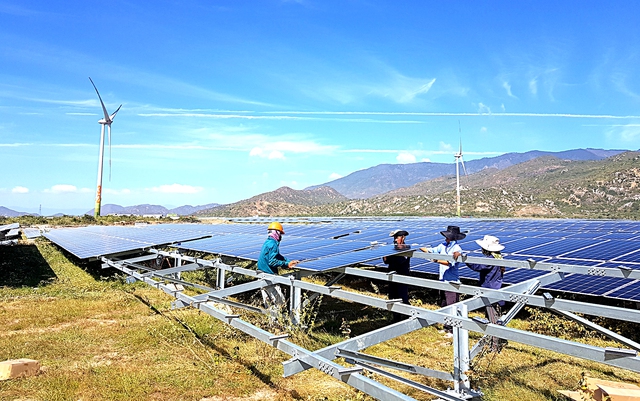
Vietnam’s Ministry of Industry and Trade has proposed new pricing frameworks for solar and wind power generation. Photo: T.TR.
The proposal is included in a draft amendment to Circular No. 09, which regulates procedures and methods for determining and approving the two price frameworks of electricity generation and imported electricity.
2 options for solar power pricing
For solar power plants, the draft introduces a definition of floating solar power plants as a basis for local authorities to implement the policy.
The definition does not cover solar power plants whose photovoltaic panels are installed on irrigation canals.
The ministry has proposed two options for determining solar power price frameworks: based on socio-economic regions under the national master plan for each period, and based on the locations of provinces and cities.
For onshore and nearshore wind power plants, the price framework would continue to be determined based on socio-economic regions under the national master plan for each period.
The ministry said renewable energy sources such as solar and wind power depend on solar radiation and wind speeds, which vary significantly among localities.
It said calculating prices by province or socio-economic region would better reflect investment costs and help attract investors to renewable energy projects.
Solar radiation differs significantly among localities
Nguyen Huu Khoa, standing member of the Scientific Council of Vietnam Energy Online, said the proposed method would be more suitable than the current three-region system because solar radiation differs from one locality to another.
Based on published PVout coefficients, Vietnam's 34 provinces and centrally governed cities can be divided into four groups based on solar radiation.
These include areas with low radiation of below 1,000 kWh per kWp per year, medium radiation of 1,000 to below 1,250 kWh, high radiation of 1,250 to below 1,450 kWh, and very high radiation of above 1,450 kWh.
Khoa said solar power purchase prices should follow the principle that areas with higher solar radiation would have lower prices.
It will then ensure a balance between the interests of the state, investors and consumers.
Phan Dang An, general director of Vu Phong Energy Group, also said the proposed adjustment was appropriate.
He said solar power development conditions vary among regions in terms of solar radiation, grid infrastructure, capacity to absorb additional power, investment costs and electricity demand.
However, An said the key challenge was not simply changing the way regions are classified but ensuring predictability for projects during the transition period.
Solar power projects require substantial investment and have long operating periods, so investors need clear transitional rules, he said.
The pricing method should also be transparent and reasonably stable over the long term to help investors mobilize capital, while input parameters can be updated based on changes in technology, capital costs and market conditions.
The pricing mechanism should be implemented alongside power development planning, grid connection and power evacuation capacity, An added.
Clear transitional rules are also needed to reduce policy risks for projects that have already been prepared for investment.
"A mechanism will only be attractive when investors can reasonably assess revenue, risks and the ability to recover their investment, thereby attracting private capital for energy infrastructure development," he said.
Under the current three-region pricing framework, the 2025 ceiling price for ground-mounted solar power is VND1,383 (US$0.053) per kWh in northern Vietnam, VND1,107 ($0.042) in central Vietnam and VND1,012 ($0.039) in southern Vietnam.
For floating solar power, the corresponding ceiling prices are VND1,686 ($0.064), VND1,336 ($0.051) and VND1,228 ($0.047) per kWh.
Projects with battery storage systems have higher ceiling prices, ranging from around VND1,150 ($0.044) to VND1,877 ($0.071) per kWh depending on the project type and region.
For onshore wind power, the ceiling prices are around VND1,959 ($0.075) per kWh in northern Vietnam, VND1,807 ($0.069) in central Vietnam and VND1,840 ($0.070) in southern Vietnam.
The maximum price for nearshore wind power is around VND1,987 ($0.076) per kWh.
The Ky - Ngoc An / Tuoi Tre News
Link nội dung: https://news.tuoitre.vn/vietnam-weighs-solar-power-pricing-by-location-103260826173054412.htm