
Vietnamese lawmakers urge stronger drone controls after Tan Son Nhat incident affected over 60 flights
Vietnamese lawmakers have called for stricter management of unmanned aerial vehicles after unauthorized drones disrupted operations at Tan Son Nhat International Airport in Ho Chi Minh City on Tuesday, affecting more than 60 flights.
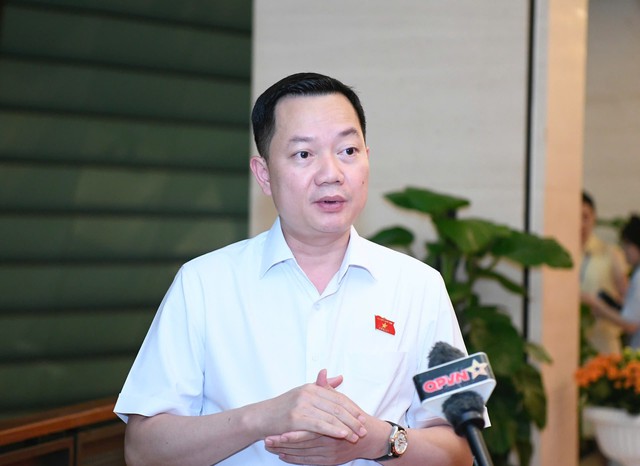
Lawmaker Trinh Xuan An, a member of Vietnam’s National Assembly Committee for Defense, Security and Foreign Affairs. Photo: Supplied
The 102-minute disruption unfolded during peak operating hours at Vietnam's busiest airport, which typically handles up to 46 takeoffs and landings per hour.
Flight operations were suspended twice—from 6:28 pm to 7:16 pm and again from 7:40 pm to 8:34 pm—after an unauthorized drone was spotted in restricted airspace.
The incident impacted more than 60 flights and accumulated 5,285 delay minutes, forcing aircraft into holding patterns or diversions and costing airlines an estimated millions of dollars.
Lawmaker Trinh Xuan An of Dong Nai City in southern Vietnam, a member of the law-making National Assembly’s Committee for Defense, Security and Foreign Affairs, told Tuoi Tre (Youth) online newspaper that the case highlights serious risks not only to aviation safety but also to national defense, security, and the management and protection of Vietnam’s airspace.
“Just one small and inexpensive drone but in the wrong place at the wrong time can cause enormous consequences for safety, the economy, and tens of thousands of passengers,” he said.
He emphasized that while Vietnam’s Law on People’s Air Defense, effective July 2025, already regulates drone registration, licensing, and restricted zones, enforcement remains a challenge.
He said the management of unmanned aerial vehicles should begin at the source, covering production, import, sales, registration, and use.
He also recommended keeping drones under conditional business sectors in the Investment Law to ensure strict oversight.
Lawmaker Pham Van Hoa of Dong Thap Province, southern Vietnam, echoed the viewpoint, saying the incident caused significant losses for airlines and passengers.
Hoa called for clear accountability, including compensation responsibilities, and suggested criminal charges if drone use endangers national defense, security or public safety.
Hoa also proposed shifting from a ‘permission to fly’ model to a clear designation of no-fly zones.
Outside those zones, drones could operate for recreation, agriculture, or industry.
“If violations occur in restricted zones, drone operators must bear full responsibility,” Hoa said.
A similar incident occurred at Tho Xuan Airport in Thanh Hoa Province, north-central Vietnam in June last year, when several flights were delayed or diverted because of an unauthorized drone.
According to the Northern Airports Authority, the airport’s authorities detected a drone operating in the area, seriously disrupting aviation operations and threatening flight safety.
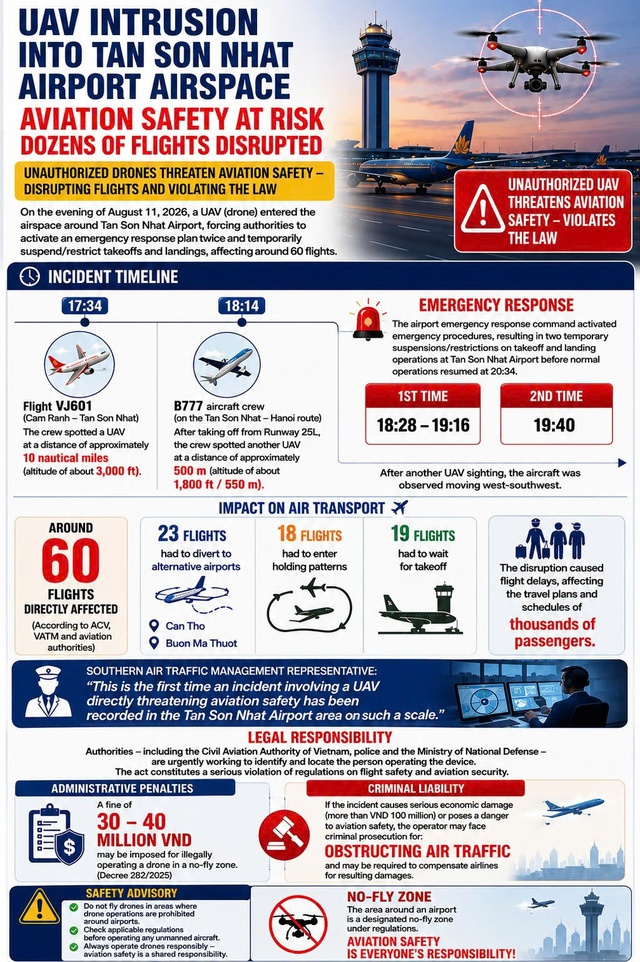
Minh Duy - Ngoc An - Tien Long - Thanh Chung / Tuoi Tre News