
Vietnamese scientists in Australia turn cockroaches into cyborg rescuers for disaster relief
Vietnamese scientists at the University of Queensland and the University of New South Wales in Australia have developed remotely controlled cyborg cockroaches that can navigate to designated locations and deliver injections, potentially allowing medical assistance to reach people trapped in areas too dangerous or difficult for rescuers to access.
The findings, published in Advanced Science, involved the giant burrowing cockroach (Macropanesthia rhinoceros), a North Queensland species measuring 84-87 millimeters in length and weighing 34-40 grams.
Electrodes and electronic devices are attached to the cockroaches’ bodies, allowing operators to steer them remotely.
Some cockroaches carry cameras to transmit images, while others are equipped with an automated injection mechanism.
Cockroaches deliver injections to hard-to-reach areas
Dr. Vo Doan Tat Thang, director of the University of Queensland’s Bio-Robotics Laboratory, told Tuoi Tre (Youth) online newspaper that cyborg insects have mainly been developed for search and reconnaissance missions over the years.
The researchers wanted to take the technology a step further by exploring whether insects could provide assistance after locating a person in distress.
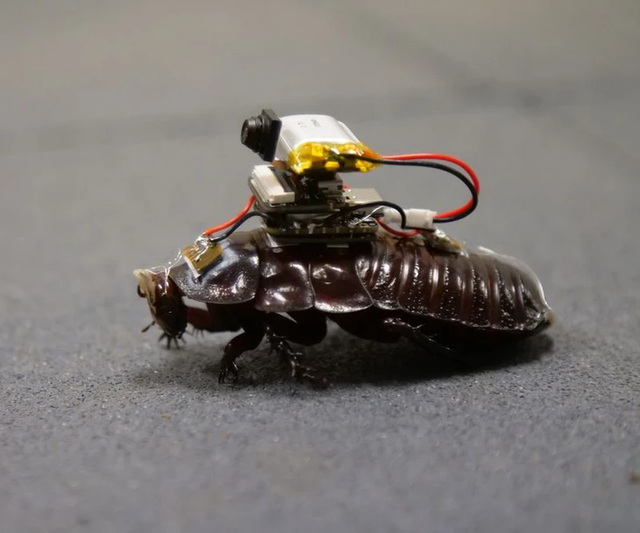
A giant burrowing cockroach (Macropanesthia rhinoceros) used in the study. Photo: Supplied
The cyborg insects remain living organisms but they are fitted with electrodes, microchips, and other electronic equipment for remote control.
The cockroaches are anesthetized while the electrodes and microchips are attached. After the equipment is removed, they have lifespans comparable to those of other cockroaches.
In separate tests of the injection mechanism, the system achieved a 90-percent success rate.
For the full mission test, the researchers used five cockroaches, with each completing five runs.
All 25 runs reached the designated target area.
In 18 runs, the cockroaches successfully completed the entire sequence of moving to the target, stabilizing their position, activating the injection mechanism, and delivering liquid to the target, for an overall success rate of 72 percent.
When the injection needle was activated at a distance of no more than 150 millimeters, the success rate reached about 95 percent.
The system uses a 31-gauge needle measuring 6 millimeters in length and a reservoir with a maximum capacity of 0.5 milliliters.
The experiments have so far been conducted only on silicone materials and ex vivo pig skin, and no treatment has been tested on humans.
The researchers said further evaluation is needed to determine the stability, concentration, and biological activity of actual medications delivered through the system.
Associate Professor Do Thanh Nho, director of the University of New South Wales' Medical Robotics Laboratory and a member of the research team, said the biomedical significance of the technology lies in its potential to deliver medical assistance to people in danger before rescue teams are able to extract them and provide treatment.
In the long term, the researchers aim to perform targeted medical interventions under human supervision in areas that conventional medical technologies cannot reach, he said.
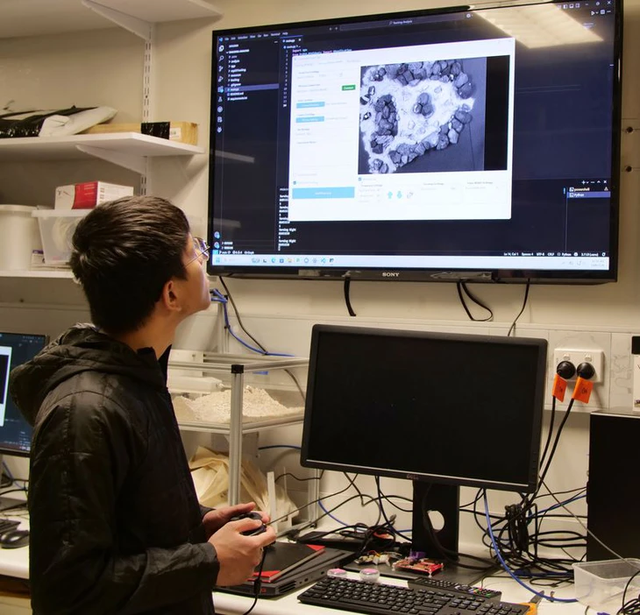
The research team remotely controls a cyborg cockroach during a test. Photo: Supplied
From lab to disaster zones
Researcher Hai Nhan Le, another member of the team, said one of the technical challenges is achieving sufficient precision while taking advantage of the insects’ natural movements.
The cockroaches must reach the correct locations and keep their body sufficiently stable for the injection mechanism to operate.
“Real disaster environments are far more complex than laboratory conditions,” Le said, adding that the next challenge is improving the system’s reliability on uneven terrain, in confined spaces and in areas filled with debris.
Other challenges include signal degradation. Bluetooth signals can weaken when passing through concrete or soil, while images transmitted over Wi-Fi can be delayed or disconnected in obstructed areas.
The hardware, autonomous control capabilities, and overall reliability of the system still require further field testing.
A cyborg cockroach performs an injection during a test. Video: Supplied
Dr. Vo Doan Tat Thang said the team’s long-term goal is to build a multi-insect system in which different cyborg insects can perform different tasks.
Some could search for survivors or carry cameras and environmental sensors, while others could transport emergency or medical equipment to locations that humans cannot yet reach.
“Our goal is not to replace rescue teams,” Thang said.
“This technology is intended to give them another means of observing, reaching and potentially assisting people in places that are too dangerous or nearly impossible to access directly.
The team hopes that within five to 10 years, with sufficient resources for further research and field testing, such insect teams could be deployed in real-world emergency situations.
Thanh Ha - Trong Nhan / Tuoi Tre News