
Vietnam's $31bn e-commerce market, among ASEAN's top 3, still struggles with counterfeits
Vietnam's e-commerce market reached an estimated US$31 billion in 2025, but counterfeit goods, false advertising and other consumer protection issues remain persistent challenges, prompting the Ministry of Industry and Trade to propose measures to strengthen consumer confidence.
To this end, the ministry's proposed scheme to develop Vietnam's e-commerce ecosystem through 2035, with a vision to 2045, calls for stronger seller verification, product traceability and platform accountability to create a safer and more transparent online marketplace.
The country’s e-commerce market reached about $31 billion in 2025, growing 25 percent and accounting for around 11 percent of total retail sales of goods and services, the ministry said.
With 60 percent of the population shopping online, Vietnam ranks among ASEAN’s three largest e-commerce markets and the world’s 10 fastest-growing countries in this field.
Shopee, TikTok Shop, Lazada and Tiki, four e-commerce platforms operating in Vietnam, generated combined sales of VND429.7 trillion (US$16.63 billion) in 2025, accounting for around 68 percent of domestic e-commerce sales.
Shopee and TikTok Shop alone accounted for 97.61 percent of the four platforms' combined sales, with respective shares of 51.15 percent and 46.46 percent.
Despite the market's rapid growth, consumer protection remains a major challenge.
The National Competition Commission under the ministry received 896 consumer complaints and reports in 2025, of which 191, or 21.3 percent, concerned e-commerce — the largest share among all goods and service categories.

Vu Hoang Hai, better known as Hai Sapa TV, a popular Vietnamese YouTuber and TikToker, promotes dried buffalo meat in a video, falsely claiming it is a specialty of northwestern Vietnam, while it was actually made from frozen buffalo meat imported from India. Photo: Screenshot from video
Authorities also required the removal of nearly 50,000 infringing products and blocked around 13,000 violating online shops that year, according to the ministry.
The ministry attributed these challenges partly to rapidly evolving technologies and business models that make it difficult for consumers to inspect products before purchase.
Livestream sales and transactions through social media have further complicated online trading, which often involves multiple technical systems and service providers.
Weak seller identification, inadequate information verification and limited product traceability allow individuals to operate multiple fake accounts and temporary online shops across different channels, making it harder to identify violators and hold them accountable, the ministry said.
Supply-chain weaknesses also pose challenges to product quality and traceability.
As of December 2025, Vietnam had 18,234 products rated three stars or higher under the One Commune One Product program, but only 48.3 percent of participating entities had established stable raw-material areas linked to value chains.
Many products are still produced on a fragmented scale and lack standardized packaging to ensure proper preservation, further complicating quality control.
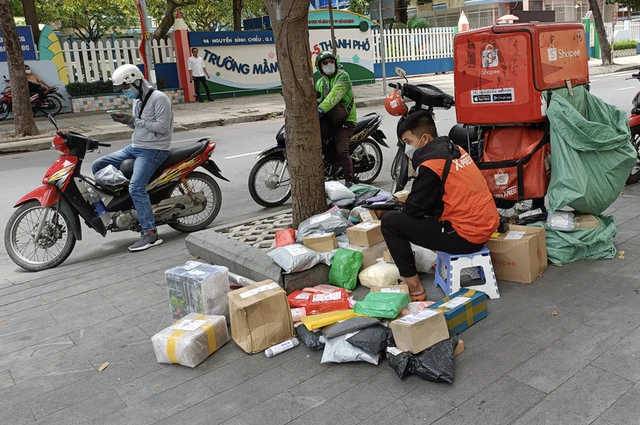
A delivery worker sits among parcels ordered online on a sidewalk in Ho Chi Minh City, waiting to deliver them to customers. Photo: Duc Thien / Tuoi Tre
Meanwhile, coordination among e-commerce platforms, sellers, delivery companies and payment providers in handling complaints, returns, refunds and warranties remains inconsistent, making it harder to resolve disputes and protect consumers.
Under the proposed scheme, the industry and trade ministry would coordinate data on sellers, product origins and transaction histories to improve early-warning mechanisms, detect violations and crack down on intellectual property infringements and goods of unknown origin.
Meanwhile, the Ministry of Public Security would lead efforts to develop coordinated regulations on identifying and verifying business operators and linking transaction data, enabling authorities to trace those responsible for violations.
The scheme also seeks to hold e-commerce platforms more accountable for monitoring product listings and improve coordination among platforms, sellers, payment providers and delivery companies in handling complaints, returns, refunds, warranties and disputes.
Other proposed measures include standardizing product quality, improving the transparency of product information and labels, expanding digital payments and gradually reducing cash-on-delivery transactions to mitigate payment risks.



Vinh Tho - Thy Nhung / Tuoi Tre News
Link nội dung: https://news.tuoitre.vn/vietnams-31bn-e-commerce-market-among-aseans-top-3-still-struggles-with-counterfeits-103261029185247756.htm