
Vietnam's AI ambitions hinge on energy sovereignty
In the global AI race, as major powers focus on advanced chips and large language models, experts say Vietnam should take a more practical approach by securing energy sovereignty to support its technology ambitions.
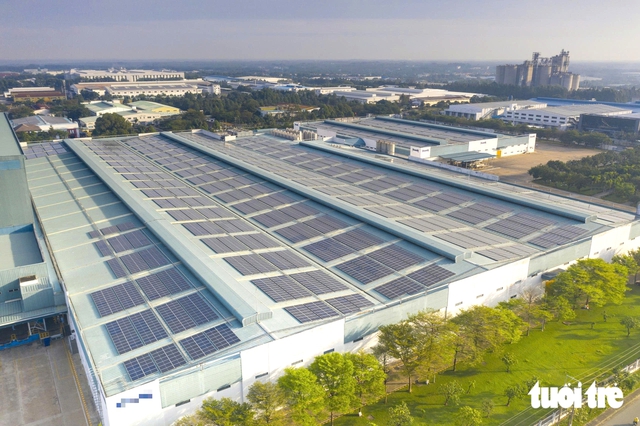
Energy is a 'front' where Vietnam can build an advantage and deepen its participation in the global AI race, experts say. Photo: Quang Dinh / Tuoi Tre
AI does not live in cloud
Vietnam is unlikely to compete with the U.S. or China in developing general-purpose AI models or controlling the supply chain for advanced chips, said James Kang, a senior lecturer in computer science at RMIT University Vietnam.
Kang said Vietnam could instead build an advantage in energy, an essential input for AI infrastructure.
AI does not operate solely in the 'cloud' but relies on physical computing systems in data centers, which consume large amounts of electricity for computing and cooling.
If a country wants to achieve genuine AI sovereignty, it has to talk about energy sovereignty, Kang added.
Vietnam currently has 41 operational data centers with a combined capacity of about 221 megawatts.
Viettel's 140-megawatt hyperscale data center in Ho Chi Minh City is among the major projects showing the growing power demand from the technology sector.
The challenge is not only to generate sufficient electricity but also to maintain a stable and uninterrupted supply for AI infrastructure.
Vietnam looks to sea for data center cooling
Cooling is a major challenge for Vietnam's data center industry because of the country's tropical climate.
Cooling can account for 30-40 percent of a data center's total electricity consumption, adding to operating costs and putting further pressure on electricity supplies, according to research cited by experts.
Vietnam could tap into its long coastline to develop seawater cooling systems and explore underwater data centers, experts said.
China has already deployed commercial underwater data centers in Hainan and Shanghai, with the facilities linked to offshore wind power.
Tran Quy Hung, an AI expert and PhD candidate at RMIT, said Vietnam should develop a mix of energy and cooling technologies instead of relying on a single source.
Offshore wind could become a major power source for Vietnam's computing infrastructure, given its potential capacity of hundreds of gigawatts.
Nuclear power is also returning to the policy agenda as Vietnam prepares for long-term growth in electricity demand.
Vietnam signed an agreement with Russia in March 2026 on the Ninh Thuan 1 nuclear power project, which has a planned capacity of 2,400 MW.
Small modular reactors are also being considered for industrial parks and specialized data centers.
How can Vietnam avoid becoming a hub for foreign computing?
Vietnam's ultimate goal should not be to become a base for foreign computing, but to turn energy-intensive infrastructure into domestic strength and use it to strengthen the country's technological autonomy, Kang said.
AI sovereignty, ultimately, starts with a resilient national power grid.
To turn energy infrastructure into national capacity, Vietnam needs to pursue three strategic priorities.
First, Vietnam should treat reliable and affordable electricity as part of its national AI strategy, rather than simply as a utility issue.
Second, the country should plan integrated infrastructure clusters that connect energy supplies, data centers, and fiber-optic networks in coastal areas to tap into offshore wind power and seawater cooling.
Third, Vietnam should pursue selective investment in data centers.
Foreign data center projects should come with commitments to develop local skills, research capacity, and domestic AI applications.
The Ky - Cong Trieu / Tuoi Tre News
Link nội dung: https://news.tuoitre.vn/vietnams-ai-ambitions-hinge-on-energy-sovereignty-103260817205406669.htm