
Vietnam’s booming P2P crypto market attracts traders despite mounting risks
Vietnam’s peer-to-peer (P2P) cryptocurrency market is attracting a growing number of traders seeking profits from buying and selling USDT, the world’s largest dollar-pegged stablecoin, despite persistent risks including disputes, financial losses, scams, and bank account freezes linked to fraudulent transactions.
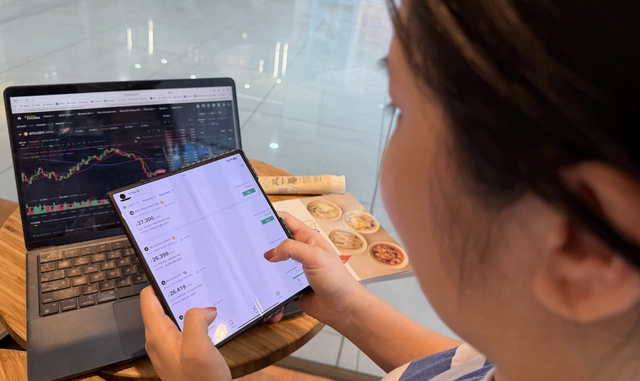
A user checks USDT prices, transaction limits, and merchant ratings before placing an order on a peer-to-peer cryptocurrency trading platform in Ho Chi Minh City, Vietnam. Photo: Cong Trung / Tuoi Tre
On major cryptocurrency exchanges, hundreds of merchants offer to buy and sell USDT around the clock, allowing users to convert Vietnamese dong into digital assets and back through direct bank transfers.
The system has become a key gateway for Vietnamese investors because the dong is not widely supported in direct trading pairs with cryptocurrencies such as Bitcoin and Ethereum.
Profit opportunities stem largely from the spread between buying and selling prices.
Traders can earn margins by rapidly recycling capital through repeated transactions, although actual returns depend on market conditions, settlement times, banking limits and disputes.
Some traders said the market’s apparent simplicity masks significant operational risks.
Buyers may face delays in receiving digital assets after transferring funds, while accidental overpayments can lead to prolonged disputes because counterparties are often identifiable only through exchange profiles and transaction records.
More serious risks arise when funds used in a transaction are later found to be linked to fraud.
In some cases, cryptocurrency sellers have had their bank accounts frozen during investigations after unknowingly receiving money from victims of online scams, even though the digital assets involved had already been transferred.

Tran Xuan Tien, general secretary of the Ho Chi Minh City Blockchain Association, said illicit funds and digital assets could be fragmented and routed through multiple P2P transactions, making due diligence essential.
He warned that newly created accounts offering unusually favorable exchange rates may carry elevated risks.
Tien advised users should conduct transactions only through exchange platforms, accept payments only from accounts matching the buyer’s registered identity, avoid third-party transfers, and retain all transaction records, including receipts, chat logs and blockchain data, to help resolve potential disputes.
Vietnam’s legal framework for digital assets entered a new phase on January 1, 2026, when the Law on Digital Technology Industry took effect, providing the country’s first legal framework for digital assets as a form of digital data.
Under a separate government pilot program running from 2026 to 2030, digital assets may be owned, stored, and traded through licensed domestic entities, although cryptocurrencies such as Bitcoin cannot be used as payment for goods and services in place of the Vietnamese dong.
While the domestic market framework continues to develop, many Vietnamese investors remain active on overseas exchanges including Binance, OKX, Bybit, and MEXC, primarily through P2P transactions that offer convenience but also expose users to significant financial and legal risks.
Bao Anh - Cong Trung - Duc Thien / Tuoi Tre News
Link nội dung: https://news.tuoitre.vn/vietnams-booming-p2p-crypto-market-attracts-traders-despite-mounting-risks-103260615151707144.htm