
Vietnam's Ca Mau forest workers earn nearly $80 daily from catching eels
During the current rainy season, a group of forest workers in U Minh Ha forest in Ca Mau, the southernmost province of Vietnam, can earn more than US$76 a day from catching eels, according to a recent field report by Tuoi Tre (Youth) online newspaper's reporters who accompanied them.
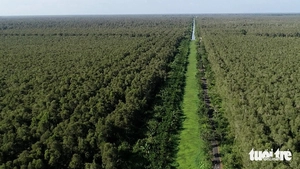
The four-member group, led by Bui Ut Bay, jointly leases more than 300 hectares of land in the production forest in Ca Mau's Khanh Lam Commune to harvest natural products beneath the forest canopy.
They divide the leased area into sections of about 50 hectares and harvest them on a rotating basis, returning to the first area after working in the other sections to give fish and eels time to reproduce, according to the report.
Currently, with 50 traps set, the group catches more than 10 kilograms of wild eels in one night, with large eels selling for more than VND200,000 ($7.65) per kilogram.
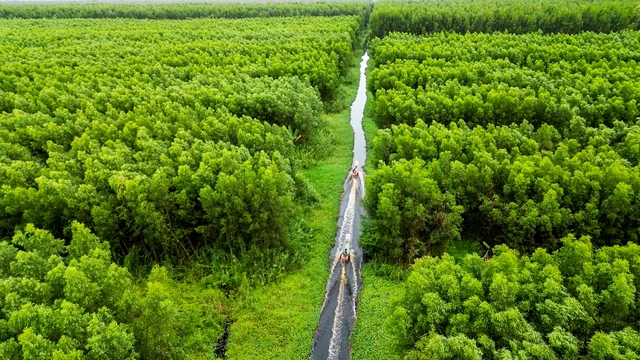
Motorized canoes travel along forest canals as workers head out to set eel traps in the U Minh Ha forest in Ca Mau Province. Photo: Thanh Huyen / Tuoi Tre
During the annual rainy season, from around the sixth to the 12th lunar month, vegetation grows densely beneath the production forests of U Minh Ha, attracting freshwater eels to canals covered with sedge, water grass and water hyacinths.
At around 3:00 pm every day during this period, the workers travel by motorized canoe along the canals, looking for suitable spots to set their eel traps.
The traditional trap, known as a 'trum,' was once made from mature thorny bamboo, but plastic tubes are now commonly used because bamboo has become scarce and plastic is lighter.
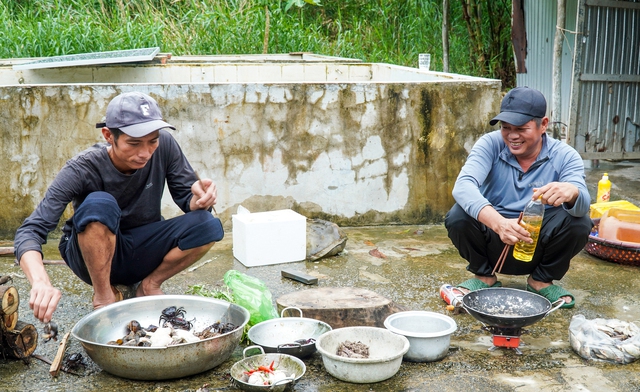
Forest workers make bait for eel traps in the U Minh Ha forest in Ca Mau Province. Photo: Thanh Huyen / Tuoi Tre
The key part of the trap is a funnel-shaped entrance that allows eels to crawl inside toward the bait but prevents them from turning around and escaping.
The bait is considered the most important factor in attracting eels.
In addition to traditional bait made from chopped snails, crabs, fish and frogs mixed with dried coconut residue and fried fish, U Minh Ha forest workers have their own recipes, adding herbs such as rice paddy herb and sawtooth coriander as well as fish oil.
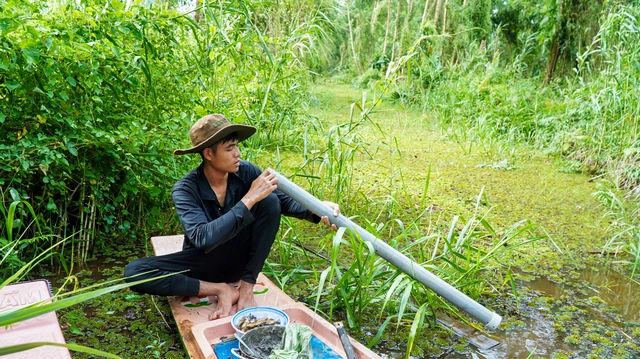
Trinh Trong Tin, a forest worker in the U Minh Ha forest in Ca Mau Province, prepares to set an eel trap. Photo: Thanh Huyen / Tuoi Tre
The scent of fish oil and herbs spreads through the flowing water and attracts eels, while garlic and chili are also added to the bait, according to the report.
Experienced trappers also rely on their knowledge of the forest and weather to determine where to place the traps.
Trinh Trong Tin, 25, a group member, said he has followed his father and grandfather into the forest since childhood and can identify where eels are by observing the color of the water and the direction of the wind.
The traps are generally placed near the heads of canals, with their openings facing downwind so the bait's scent can spread farther.
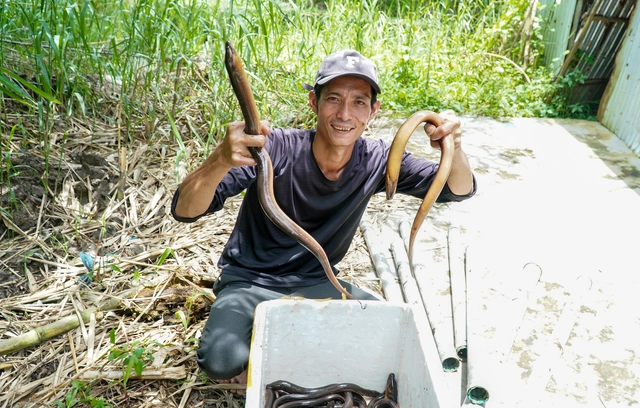
A forest worker holds up two eels from a carton holding 45 eels harvested by his group from 50 traps set in the U Minh Ha forest in Ca Mau Province. Photo: Thanh Huyen / Tuoi Tre
When heavy rain is approaching, the workers move the traps to shallower water because eels tend to move to higher ground to look for food.
To catch large eels, the opening of the trap is placed deep underwater while its tail is kept about half a hand's width above the surface to prevent the eels inside from suffocating.
Hinh Minh Tri, another group member, said he previously worked on fishing boats but decided to make a living in the melaleuca forest because the work was less physically demanding and fostered a stronger sense of camaraderie.
The forest workers also try to preserve the forest resources they depend on.
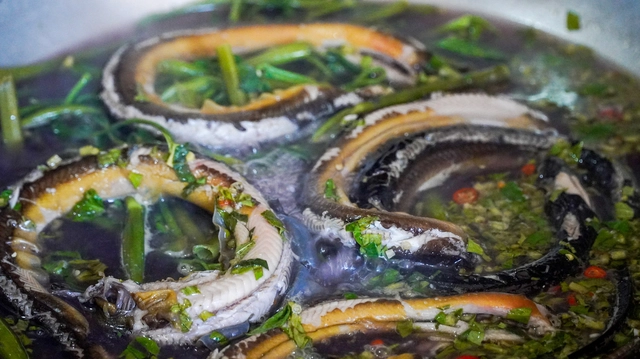
Sweet and sour eel soup made with 'giac' — the fruit of the slender watervine — is a popular dish among residents of the U Minh Ha forest area. Photo: Thanh Huyen / Tuoi Tre
They release small eels, fish and snakes back into the wild to help their populations recover for the next season and avoid catching protected species.
The eel-trapping trade has provided an income for generations of forest residents while also contributing to the distinctive culinary culture of U Minh Ha.
These Asian swamp eels (Monopterus albus, known locally as lươn đồng) are freshwater air-breathing fish native to East and Southeast Asia, inhabiting flooded paddy fields, muddy ditches, and wetlands.
In Vietnamese gastronomy, it occupies a prized place, celebrated for its tender, sweet, and nutrient-dense flesh that is traditionally considered both nourishing and restorative.
At the end of each working day, the forest workers gather around a warm meal of stir-fried eel with lemongrass and chili and sweet and sour eel soup made with 'giac' — the fruit of the slender watervine — and wild water spinach.
Their lively laughter and conversation echo through a corner of the vast forest.
While often conflated under the general umbrella of "eel," the Asian swamp eel (Monopterus albus) and the Japanese eel (Anguilla japonica, or unagi) belong to entirely different biological orders with distinct life cycles, physical traits, and culinary profiles.
The Japanese eel spawns in the deep ocean and migrates to freshwater rivers, possessing pectoral fins and a rich, high-fat flesh that caramelizes into a melt-in-the-mouth texture during the traditional charcoal-grilling and basting process of kabayaki.
In contrast, the Asian swamp eel is a swamp-dwelling synbranchid that spends its entire life in muddy freshwater wetlands and rice paddies; it lacks pectoral fins, possesses a specialized vascular breathing cavity to survive out of water, and yields a much leaner, firmer, and earthier meat.
Vinh Tho - Thanh Huyen / Tuoi Tre News
Link nội dung: https://news.tuoitre.vn/vietnams-ca-mau-forest-workers-earn-nearly-80-daily-from-catching-eels-103260823201246796.htm