
Vietnam’s EV charging sector races to unify fragmented networks
Vietnam’s fast-growing electric vehicle (EV) market is fueling a race among technology firms, automakers, and mobility companies to unify a fragmented charging ecosystem, as drivers grapple with multiple apps, payment systems, and inconsistent access to charging services.
The effort comes as rapid EV adoption exposes the limitations of a fragmented market, where finding and paying for a charge can vary widely from one provider to another.
Rapid EV growth exposes charging fragmentation
Vietnam was Southeast Asia’s second-largest EV market in the first quarter of 2026, with at least 53,685 electric cars on the road, according to regional transport data.
The figure trails only Thailand’s 57,147 vehicles and underscores the region’s accelerating shift toward electrified transport.
However, the charging ecosystem remains fragmented.
Stations are operated by multiple providers using separate applications, payment systems, and technical standards, creating a fragmented experience for drivers.
V-Green, an energy subsidiary of VinFast, the EV arm of Vietnam’s largest private conglomerate Vingroup, operates around 150,000 charging ports for electric cars and motorbikes across 34 provinces, making it the country’s largest charging network.
The network, however, is primarily designed for VinFast vehicles, limiting access for drivers of brands such as BYD, Geely, Wuling, and Ford.
As a result, many non-VinFast owners rely on a mix of independent charging operators, dealership facilities, shopping mall stations, and home chargers, often requiring multiple applications and payment accounts.
The difference is evident in everyday use.
A VinFast driver in Ho Chi Minh City said he can locate charging stations, check availability, and monitor charging sessions through a single interface, with vehicle data and payments integrated into one ecosystem.
For many other EV owners, the process is more complicated.
A BYD Atto 3 driver said long-distance travel often requires checking charging compatibility, plug types, operating hours, charging capacity, and payment methods in advance.
Drivers may also need to download multiple apps, register accounts, complete one-time password verification, and top up digital wallets before charging.
The challenge is even greater for ride-hailing drivers, who typically travel 200–300 kilometers a day and must constantly manage battery levels while ensuring a charging station is available nearby.
Companies race to consolidate EV charging services
The fragmented charging landscape has created opportunities for companies seeking to consolidate charging services on a single platform.
One of the most active players is Vietnam Electronic Toll Collection (VETC), which began as an electronic toll payment provider before expanding into parking, insurance, roadside assistance, and EV charging services.
Through its platform, users can locate charging stations, scan QR codes, select charging packages, make payments from a single account, and monitor charging activity in real time.
As of June 15, VETC said it had integrated Tasco Smart Charge, Ford Vietnam, ESKY, and Rabbit EV, covering about 200 charging stations.
The company expects to add two more partners, increasing coverage to roughly 250 stations.
Grab has adopted a similar strategy through its ‘EV Utilities’ feature in the Grab Driver app, powered by e-mobility platform Voltality.
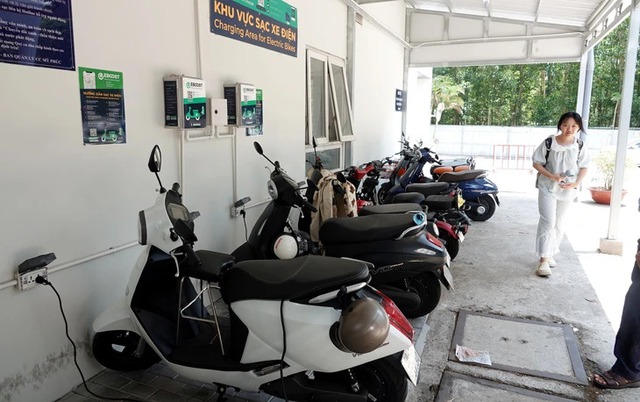
Electric motorbikes are charged at a dedicated charging area at an apartment building in Phu Dinh Ward, Ho Chi Minh City. Photo: T.T.D. / Tuoi Tre
The service allows drivers to locate stations, check availability, activate chargers, and make payments without leaving the app.
Voltality executives said expanding charging infrastructure is only part of the solution, arguing that finding, navigating to, and paying for charging should be as seamless as refueling a gasoline-powered vehicle.
Grab Vietnam executives echoed that view, noting that charging delays directly affect driver earnings.
Meanwhile, automakers are expanding physical infrastructure.
Tasco Auto JSC and Ford Vietnam have deployed more than 30 fast-charging stations through dealership networks and plan to increase that number to about 89 by year-end.
Technical, cost, and investment challenges persist
Despite progress, industry participants say significant challenges remain.
Some drivers report that chargers listed on aggregator apps occasionally fail to activate, forcing them to switch to proprietary applications to complete charging sessions.
According to charging network operators, successful charging depends on stable communication among user applications, backend systems, and charging hardware, where inconsistencies still exist.
As a result, many EV owners continue to keep operator-specific apps as backups.
Industry experts say any nationwide solution must provide accurate real-time information on charger availability, capacity, pricing, and operating hours, while establishing clear procedures for failed transactions and refunds.
Beyond technical challenges, cost remains an important factor influencing adoption.
At around VND8,800 (US$0.3) per kWh, charging a BYD Dolphin costs roughly VND111,000 ($4.2) per 100 kilometers, while a Geely EX2 costs about VND104,000 (nearly $4).
By comparison, a gasoline-powered vehicle consuming six liters per 100 kilometers costs nearly VND125,000 (nearly $5) at current fuel prices, although the gap narrows once parking fees and charging losses are taken into account.
Looking ahead, investment needs remain substantial.
According to the World Bank, Vietnam will need approximately 6.3 million charging units by 2050, requiring an estimated $32.6 billion in investment.
By 2030 alone, the country is expected to need about $2.2 billion for charging infrastructure and another $9 billion to upgrade the national power grid.
Analysts say the next phase of competition will be defined not simply by the number of charging stations installed, but by the industry's ability to create interoperable systems that offer drivers a seamless experience.
Without common standards for data sharing, payments, and service reliability, Vietnam's charging ecosystem may remain fragmented even as the number of EVs and charging stations grows.
Vinh Tho - Cong Trung / Tuoi Tre News
Link nội dung: https://news.tuoitre.vn/vietnams-ev-charging-sector-races-to-unify-fragmented-networks-10326062911594651.htm