
Vietnam’s high-income ambition by 2045 seen as achievable but challenging: Fulbright scholar
Vietnam aims to reach high-income status by 2045, requiring average per capita GDP growth of about six percent annually over the next two decades, a target that appears ambitious but attainable given the country’s strong growth trajectory over the past 20 years.
Editor’s note: The following article was submitted to Tuoi Tre (Youth) newspaper by Jonathan Pincus, dean at the Fulbright School of Public Policy and Management.

Photo: Tuoi Tre
Vietnam has set a target of achieving high-income status by 2045. Reaching the World Bank’s cut-off for high-income countries—now set at about $14,000—would require average output per person to grow by six percent per year on average for the next 20 years.
At first glance this sounds ambitious, but when we consider that per capita growth over the past twenty years was only slightly below this figure, high-income status by 2045 is well within reach.
Twenty-five years ago, Vietnam embarked on a strategy of export-led growth.
Multilateral, regional bilateral trade, and investment agreements reduced barriers to foreign investment, imports of machinery, raw materials and industrial components, and access to export markets.
Transport and energy infrastructure were planned and constructed to relax bottlenecks to industrial growth and trade.
Vietnam emerged as a leading manufacturing hub, attracting foreign investment in labor-intensive industries like garments, shoes, electronics and furniture and achieving close integration with the East Asian industrial economies.
This proved to be a winning strategy.
Exports have grown by 12 percent per year in real terms since 2000, equaling the pace in China.
Rapid growth of manufacturing output created millions of steady jobs and generated billions of dollars in foreign exchange.
Labor productivity rose at an average annual rate of 5.5 percent from 1990 to 2023, second only to China in Asia.
Vietnam is fast becoming a prosperous urban, educated, productive and sophisticated society.
However, any investor will tell you that past performance is not a guarantee of future success.
The export-led growth strategy is still generating good returns, with exports growing in 2025 by 16 percent, supporting output growth of eight percent.
Last year’s performance surprised on the upside because it was achieved despite new American tariffs and weak consumer demand in the major importing countries.

Photo: Tuoi Tre
However, without a change in strategy growth is likely to slow down in the coming years for at least three reasons.
The first problem is demographic.
The availability of cheap labor was a major impetus to Vietnam’s rapid growth.
The relocation of millions of workers from low productivity jobs in agriculture and traditional services to relatively low-skilled jobs in factories generated most of the productivity gains recorded during this period.
Mobility was facilitated by two factors that were present in Vietnam and often lacking elsewhere.
First, unlike India and much of Southeast Asia, a large majority of Vietnamese women work outside the home for wages and salaries.
Second, most Vietnamese workers have some experience of secondary education, if not high school diplomas. They are literate, numerate, and learn new tasks quickly.
However, the fast pace of urbanization, combined with lower fertility rates, has reduced the number of the underemployed rural workers.
In future, employers will have to compete to attract workers, which will mean higher wages.
Productivity growth will come from increasing value added within manufacturing rather than from moving people from farms to factories.
Declining fertility rates will ultimately increase the share of the elderly in the population, resulting in a shrinking workforce and a larger cost burden on working age adults.
Demographers predict that Vietnam’s demographic dividend, a period of relatively low dependency rates, will come to an end in 2036, after which growth rates will slow down.
The second problem is access to foreign exchange.
Like most developing countries, Vietnam faces a balance of payments constraint on growth.
The economy needs dollars to finance imports of machinery, industrial inputs and consumer goods.
A shortage of dollars forces the central bank to raise interest rates to attract dollar inflows and reduce consumption. But why would Vietnam, a world leading exporter, face a dollar shortage?
There are several reasons for the persistence of dollar shortages.
First, Vietnam’s exports are import-intensive. Each dollar’s worth of exports generates $0.55 worth of imports, according to the OECD.
The second reason is capital flight, which is recorded as errors and omissions in the balance of payments.
Dollars leave the economy, legally and illegally, through unrecorded gold and dollar transactions, trade misinvoicing, and, more recently, cryptocurrency transactions.
Errors and omissions in 2024 amounted to $33 billion in 2024, or 6.9 percent of GDP.
Finally, Vietnam has enjoyed high rates of inward foreign direct investment, averaging five percent of GDP over the past 25 years.
This is good, as foreign investment brings technology and access to foreign markets and creates jobs and exports.
But it also gives rise to outflows in the form of profit remittances, and these have grown consistently as a share of GDP over the past two decades, reaching a high of 5.2 percent of GDP in 2023.
The third, and probably the most important problem, are the weak technological linkages between foreign-invested and local companies.
One of the main benefits of foreign investment is that foreign companies create local demand for technologically sophisticated inputs, and in some cases share technologies to enable domestic companies to produce these inputs.
These supply linkages raise the productivity of local firms, which makes them more internationally competitive, enhances their growth prospects and improves their capacity to learn and adopt new technologies and practices.
Studies of FDI firms in Vietnam have found weak evidence of backward supply linkages in most industries.
FDI firms in Vietnam prefer to import inputs or to source domestic inputs from other FDI firms.
One reason is that FDI firms have stringent design, quality and timeliness requirements that domestic firms cannot satisfy.
Also, the design and technological content of industrial inputs change rapidly, and local firms do not have the knowledge and information needed to keep pace with new developments. As a result, productivity growth within manufacturing has been relatively slow.
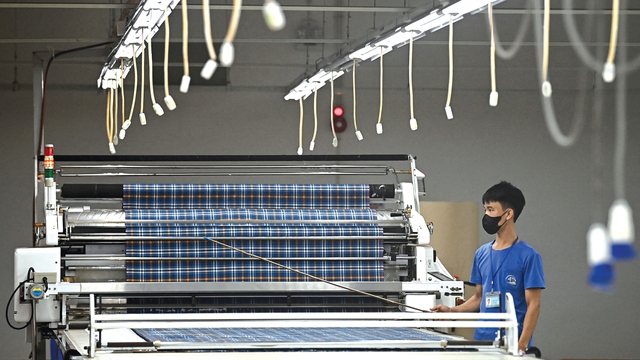
Photo: Tuoi Tre
Taken together, these three problems represent a challenge to the current growth strategy and have prompted the government to propose a new model based on science, technology, innovation and digital transformation.
Vietnam will move aggressively into high-tech industries such as semiconductors, robotics, artificial intelligence, advanced materials, renewable energy, aerospace and quantum technology.
The government will increase support for research and development from currently low level to two percent of GDP and five percent of government expenditure.
Resolution 57, issued in December 2024, aims for the digital economy to contribute 30 percent of GDP by 2030 and 50 percent by 2045
Upgrading of national and regional universities will improve workforce quality and create new centers of research and innovation.
The new growth strategy addresses the three challenges that we have identified: the demographic challenge, the foreign exchange constraint and the technology challenge.
Vietnam will move up the industrial value chain in emerging industries to reduce dependence on assembly operations and increase the domestic content of exports.
Skills and capabilities embedded in the labor force will take precedence of the size of the labor force.
Upgrading domestic industries will reduce demand for imported components, saving scarce foreign exchange and generating higher export revenues.
And increasing the technological capabilities of domestic companies will generate technological spillovers from foreign to local firms, making them more productive and competitive.
While circumstances in every country are different, several countries have adopted a similar strategy consisting of trade openness, leveraging foreign direct investment in advanced industries, upgrading of domestic universities, and integrating domestic firms into global value chains.
This model was pioneered in Ireland and later adopted by new entrants to the European Union, including Estonia, the Czech Republic and Poland.
Ireland and Estonia have focused on high-value services in communications, finance and pharmaceuticals, while Poland and the Czech Republic have emerged as European Union manufacturing hubs.
All four have combined macroeconomic stability, competitive tax rates and special economic zones, efficient and transparent public sector institutions, with investment in universities and the development of a tech-savvy, English speaking workforce.
Digitalization has helped to lower the costs of doing business and attract global talent.
Membership in the European Union was a key component of these growth strategies, as the single market provided the market size required to attract large-scale investments.
Economists have also shown that linkage effects between FDI and local firms are more likely to emerge when products are sold into the domestic market.
European Union support for infrastructure development in the form of the Cohesion Fund, the EU Regional Development Fund and the Connecting Europe Facility improved connectivity and reduced logistics costs across these countries.
While Vietnam cannot rely on a large trade bloc like the European Union, it can replicate these policies through closer integration with the East Asian economies, both through formal regional and bilateral trade and investment agreements and through informal industry-level arrangements organized around complex supply chains.
Vietnam's pivot to high-tech industries is a necessity and a challenge.
The exhaustion of the old model's drivers—cheap labor, structural transformation, and low-skill assembly—leaves no alternative to technological upgrading.
The examples of Ireland, Estonia, Poland and the Czech Republic demonstrate that this path is feasible for countries willing to invest in institutions, human capital, and connectivity.
Success depends on execution.
Vietnam must deepen technological capabilities in domestic firms while maintaining the macroeconomic stability and institutional efficiency that attracted foreign investment in the first place.
Regional integration with East Asia offers a pragmatic substitute for the market size and institutional support that EU membership provided to Central European economies.
The supply chains linking Vietnam to Japan, South Korea, Taiwan and China create natural channels for technology transfer and market access.
The transition will not be smooth.
Building research universities, fostering innovation ecosystems, and establishing technology spillovers take time and commitment.
But Vietnam has demonstrated adaptability before.
The country that survived decades of war and transformed itself from one of the world's poorest economies into a middle-income manufacturing powerhouse in a single generation has shown it can execute complex strategies.
Achieving high-income status by 2045 is just the latest in the long series of challenges that constitute the country’s path from subjugation to freedom and prosperity.
Tuoi Tre News