
Vietnam's Mekong Delta struggles to grow large businesses
The Mekong Delta of Vietnam has not added any new companies to its list of 30 leading businesses in the past two years, prompting firms to identify the causes and propose solutions for helping more companies grow into large enterprises.
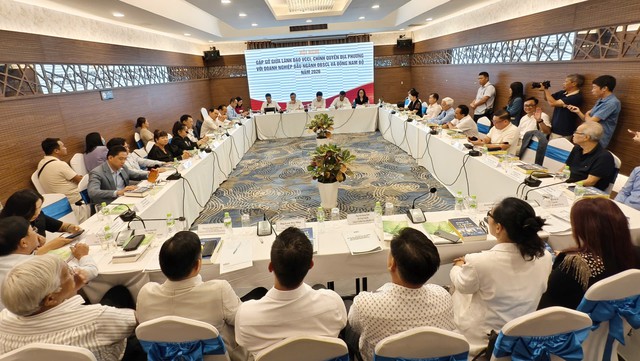
Leading businesses attend a meeting with VCCI leaders and local authorities in Can Tho City, southern Vietnam, October 16. Photo: Chi Quoc / Tuoi Tre
The Vietnam Chamber of Commerce and Industry (VCCI) held a meeting with local authorities and leading businesses from the Mekong Delta and southeast Vietnam in Can Tho City on October 16 to mark Vietnamese Entrepreneurs' Day on October 13.
At the meeting, businesses discussed why the Mekong Delta had not added any new companies to its list of 30 leading businesses over the past two years and proposed measures to help more companies grow into big enterprises.
Region needs more than businesses on paper
The Mekong Delta has around 30 leading businesses across various sectors, according to the Mekong Delta branch of the VCCI.
These companies have capital of more than VND500 billion (US$19.02 million), with a few having several trillion dong in capital, although such cases are uncommon.
Their annual revenue ranges from VND800 billion ($30.44 million) to VND1 trillion ($38.05 million).
A VCCI Mekong Delta representative said the 30 companies would be more accurately described as leading businesses in their respective industries.
The companies were selected for their influence in their respective industries, with examples including Long An International Port, associated with businessperson Vo Quoc Thang, MebiFarm JSC in poultry eggs, Sao Ta Food JSC in seafood, and Hanh Nguyen Logistics JSC in logistics.
Ho Quoc Luc, board chairman of Sao Ta Food JSC, one of the 30 leading businesses, said the region's underlying problem was not a lack of resources, markets or entrepreneurial spirit.
Instead, the regional economic ecosystem had not done enough to help businesses grow from small- to medium-sized and then large enterprises.
Luc said the region needed to address three bottlenecks simultaneously: infrastructure and operating costs; businesses' access to capital, technology and management capabilities; and targeted support mechanisms for companies capable of leading value chains.
He cited shrimp farming as an example, saying processors needed land for their own farms to better manage and lead value chains.
Large areas of land, particularly along the coast, remained unused due to a lack of mechanisms to put them to productive use.
Luc said authorities could consolidate small landholdings into investment projects instead of leaving the land idle.
Under this approach, local landholders could also work at the projects rather than leave their hometowns to seek employment elsewhere.
Luc warned that encouraging new business formation without helping existing firms expand could leave the region with more companies on paper but few leading enterprises capable of transforming its economy.
How to develop large agricultural businesses
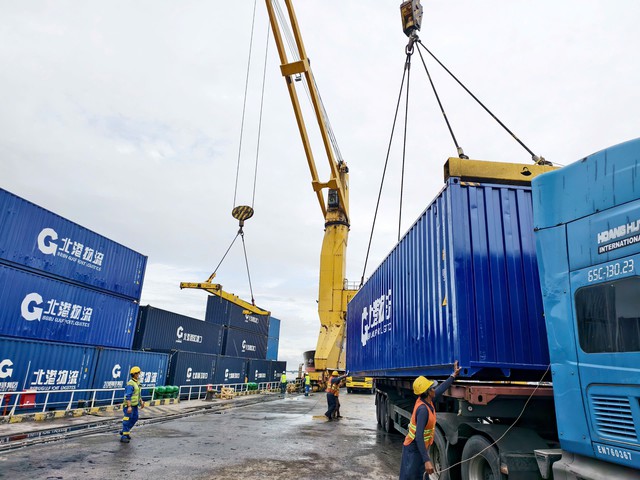
Goods from the Mekong Delta are exported through Can Tho Port. Photo: Chi Quoc / Tuoi Tre
The expiry of incentive policies for renewable energy had prompted wind and solar power businesses to suspend new projects after a period of strong activity, said Vu Ngoc Dinh, board chairman of Techpal JSC.
Industrial parks had also reached saturation, while logistics constraints continued to reduce their appeal to new investors, Dinh said.
The Mekong Delta has strengths in agriculture but it has yet to introduce sufficiently attractive policies to draw investment into the sector.
Meanwhile, Vietnamese businesses have invested in agriculture on a large scale in Laos and Cambodia.
He said that the Mekong Delta needs to examine the reasons behind this disparity and develop investment policies suited to large-scale projects and major investors.
Businesses face difficulties assembling sufficiently large areas of agricultural land, particularly for crop cultivation.
Agriculture differs from manufacturing, real estate, and energy because it has low profit margins and requires long-term, sustainable investment.
These characteristics make land clearance and the development of large-scale infrastructure more difficult.
The Mekong Delta could attract major agricultural businesses and better capitalize on its strengths by addressing these obstacles, Dinh said.
The Ky - Chi Quoc - Khac Tam / Tuoi Tre News
Link nội dung: https://news.tuoitre.vn/vietnams-mekong-delta-struggles-to-grow-large-businesses-103261019212606396.htm