
Vietnam’s ‘orange economy’ seen as new growth engine: Indian consul general
Vietnam could turn its “orange economy” — its cultural and creative industries — into a new source of growth while strengthening the country’s soft power, Indian Consul General in Ho Chi Minh City Vipra Pandey said.
The orange economy refers to economic activities built around culture, creativity and intellectual property, including film, music, fashion, design, advertising, media, publishing, gaming and digital content.
Pandey told Tuoi Tre (Youth) online newspaper that media, social networks and culture are increasingly important in shaping how countries are perceived internationally, arguing that soft power can often help build stronger economic and diplomatic ties.
South Korea provides a clear example of how cultural exports can build a powerful national brand.
K-pop, animation, games and other creative products have helped the country establish a distinctive cultural presence around the world.
India has followed a similar path, with Bollywood and its film industry becoming some of the country's most recognizable cultural exports.
While many people outside India may not know its political leaders, internationally known actors such as Amitabh Bachchan and Shah Rukh Khan are widely recognized, Pandey noted.
Vietnam, meanwhile, is undergoing rapid transformation, but many people around the world may not yet be aware of the changes taking place in the country.
A stronger creative sector could help Vietnam tell its story more effectively and showcase its culture, people and development to international audiences.
Creative industries offer room for faster growth
Pandey said Vietnam could draw on India's experience as it seeks to develop its cultural industries and pursue double-digit economic growth.
Culture can be an effective vehicle for communicating a country's identity, he said, noting that Vietnam is already taking steps in this direction, including a draft law on cultural industry development.
Vietnam has set ambitious targets for the sector, including annual growth of 10 percent and a contribution of 7 percent of GDP by 2030.
The country is also identifying major cities that could become cultural hubs.
In Ho Chi Minh City, plans include developing cultural spaces along the Saigon River and seeking UNESCO World Heritage status for the Cu Chi Tunnels.
The development of stadiums and other facilities could also provide venues for large-scale cultural and entertainment events, helping create the infrastructure needed for the creative economy to expand.
Pandey described this direction as a positive one, saying creative industries could become an increasingly important source of future growth, as they have in India.
For Ho Chi Minh City, its international character could provide a particularly strong foundation for creative and cultural development. The city's diverse population and extensive international connections create opportunities for cultural exchange and collaboration, he said.
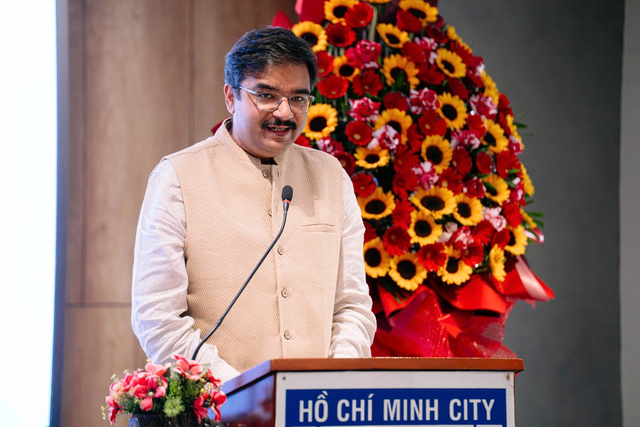
Indian Consul General in Ho Chi Minh City Vipra Pandey. Photo: Thanh Hiep / Tuoi Tre
Room remains for Vietnam-India creative ties
Cooperation between Vietnam and India in culture and creative industries is also expected to expand as bilateral ties continue to deepen.
The two countries have upgraded their relationship to an enhanced comprehensive strategic partnership and have identified a broad range of areas for cooperation, including digital technology, information technology and emerging technologies.

They have also signed the Vietnam-India Cultural Cooperation Program for 2026-30, covering creative industries, arts and culture, people-to-people exchanges and efforts to encourage more citizens of both countries to visit and experience each other's cultures.
Around 900,000 Indians visited Vietnam last year, and the figure is expected to exceed one million this year, Pandey said.
Greater travel and cultural exchange should create more opportunities for cooperation, while Indian companies in high-tech, IT and related sectors are increasingly coming to Vietnam to explore business opportunities.
Moonfolks, an Indian creative company, has recently opened an office in Vietnam and plans to work directly with Vietnamese talent, which Pandey cited as an example of the type of collaboration the two countries could develop.
AI to support, not replace, human creativity
Artificial intelligence (AI) is also set to reshape the creative industries, but Pandey said it should be viewed primarily as a tool rather than a replacement for human creativity.
AI adoption is no longer a matter of choice, he said, as the technology is already transforming industries and is becoming part of bilateral cooperation in many areas.
"AI is already transforming the world and will continue to do so," the Indian consul general added.
However, particularly in the creative industries, AI should remain a supporting tool rather than become the core of the creative process. It can help create better products and work more efficiently, but human creativity and originality remain at the heart of the creative industries.
According to the Indian Chamber of Commerce, India's creative economy is estimated to be worth around US$30 billion, while exports of creative products and services have exceeded $11 billion.
Thanh Ha - Nghi Vu / Tuoi Tre News
Link nội dung: https://news.tuoitre.vn/vietnams-orange-economy-seen-as-new-growth-engine-indian-consul-general-103260818122524782.htm