
Vietnam’s science minister backs possible AI ban for younger students
Vietnam’s Minister of Science and Technology Vu Hai Quan has expressed support for restricting, and potentially banning, the use of artificial intelligence (AI) among younger students, amid concerns that excessive reliance on the technology could undermine their independent thinking, creativity and critical reasoning.
The minister made the remarks on Thursday afternoon during a question-and-answer session, as part of the National Assembly (NA)’s second sitting, following a question from NA deputy Si Thi Mai Anh of northern Lao Cai Province about the growing risk of students becoming dependent on generative AI platforms.
Deputy Anh noted that the Ministry of Education and Training had issued guidance on the safe and responsible use of AI, including measures to prevent students from becoming overly dependent on the technology.
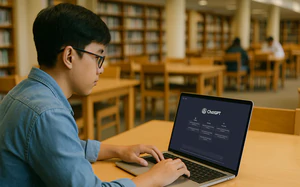
However, outside the classroom, students can still independently access AI platforms to obtain instant answers to homework questions or generate complete essays.
This could deprive them of opportunities to think independently and develop critical thinking, creativity and self-learning skills, she warned.
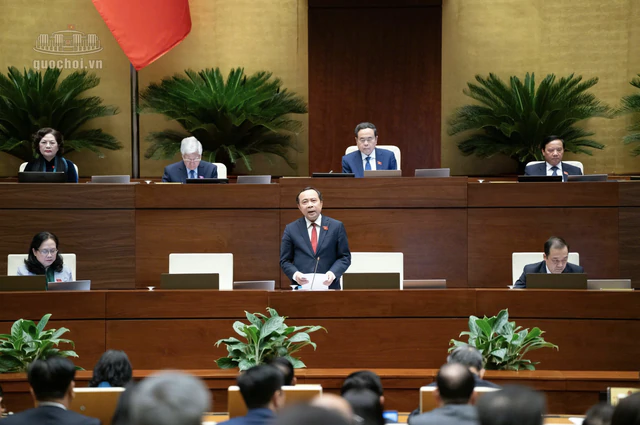
Minister of Science and Technology Vu Hai Quan speaks during a National Assembly question-and-answer session, November 12, 2026. Photo: Minh Chau
She asked the minister what measures could be taken within the government's AI regulatory framework to protect young users, particularly students, while ensuring appropriate access to technology and reducing the risks of data exposure and technological dependence.
In response, Minister Quan said the Ministry of Science and Technology had classified AI risks into three categories: high, medium and low.
Corresponding safety mechanisms had also been established to ensure responsible use.
However, he drew a distinction between his responsibilities as an official and his personal view on the issue.
In his personal view, rather than his position as a minister, he agreed that it is necessary to impose AI use restrictions on young students.
The minister noted that several countries had recently begun restricting, and in some cases banning, students from using AI.
"I agree that we should probably consider imposing certain restrictions, especially on younger students,” he said.
“When they grow older and become more mature, encouraging them to explore and use AI to ask questions is a very good thing.
“However, when they are still young, this is something we need to consider carefully.”
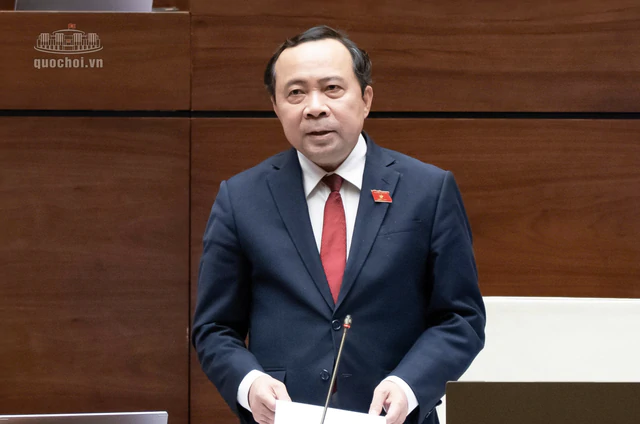
Minister of Science and Technology Vu Hai Quan. Photo: Minh Chau
AI-enabled impersonation raises concerns, families urged to play greater role
During the session, deputy Pham Van Hoa of Dong Thap Province, southern Vietnam, raised concerns about the misuse of AI to forge signatures, images, voices and handwriting for fraud and extortion.
He also pointed to students using AI to solve examination questions and complete assignments, as well as cases in which the technology is used to infringe copyright.
Hoa noted that although Vietnam ranked 45th out of 195 countries and territories in the 2025 Government AI Readiness Index, the country's capacity to assess AI systems in specific real-world applications remained limited.
He said independent verification of AI accuracy was still lacking and that dedicated national technical standards for high-risk AI systems had yet to be established.
He called on the minister to outline measures to prevent violations and address these emerging problems.
Responding, Minister Quan said issues involving the impersonation of people's faces and similar forms of AI misuse had been addressed under Vietnam's AI Law and its implementing regulations.
He stressed that effective AI governance required clearly defined responsibilities across three groups.
The first comprises AI providers and developers responsible for creating the platforms, while the second includes deploying organizations, such as entities bringing AI platforms into Vietnam or providing AI-related services.
The third consists of end users.
"These three groups are intrinsically interconnected and must work together to fulfil their responsibilities," he said.
One key requirement, the minister emphasised, is that AI-generated content must carry labels identifying it as artificially generated.
"Failure to label such content is considered a violation of Vietnamese law.”
However, he argued that legislation and technological safeguards alone would not be sufficient to protect children from AI-related risks.
Families must also play an active role.
He explained that while AI can generate fake facial images and imitate human voices, it cannot truly understand the emotional relationships, intelligence and personal character that define human beings.
To protect students from scams and manipulation, parents should spend more time with their children, show greater interest in their lives and communicate with them regularly, he said.
"When parents do that, it becomes much harder for AI to deceive the children.”
The negative aspects of AI should serve as a reminder of the importance of strengthening emotional bonds and communication within families.
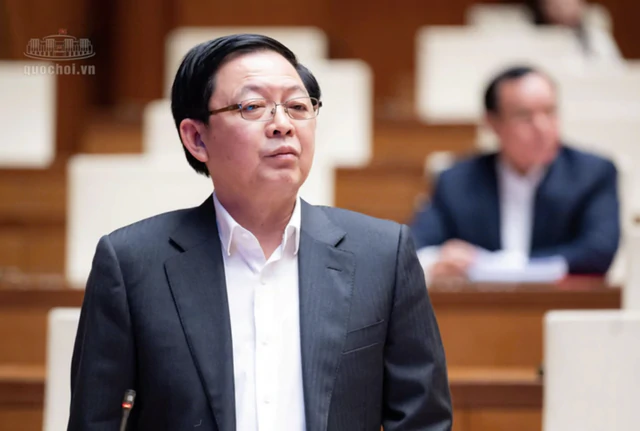
Deputy Prime Minister Ho Quoc Dung. Photo: Minh Chau
Vietnam must master AI technology
Providing further clarification on the issue, Deputy Prime Minister Ho Quoc Dung described AI as a major topic that had attracted considerable attention from NA deputies.
He said that AI represented a technological breakthrough capable of boosting productivity, expanding knowledge and strengthening creative capabilities.
Nevertheless, the technology also carries significant risks.
The central challenge was to harness AI's benefits while safeguarding national sovereignty, security and public safety, protecting citizens and ensuring that Vietnam could master the technology, he said.
"Going forward, we must have AI under a Vietnamese brand,” the deputy prime minister emphasized.
“Therefore, we must be able to control the development and use of AI to a level at which we can truly master it.”
Tieu Bac - Tien Long - Thanh Chung / Tuoi Tre News
Link nội dung: https://news.tuoitre.vn/vietnams-science-minister-backs-possible-ai-ban-for-younger-students-103261112174819052.htm