
VinFast plans to test 200 driverless taxis in Vietnam by late 2027
VinFast plans to test 200 Level 4 autonomous taxis in Can Gio, Ho Chi Minh City, by late 2027, with the vehicles capable of monitoring their surroundings, responding to traffic situations and operating without drivers under specified conditions.

VinFast plans to begin testing autonomous vehicles at the Vinhomes Green Paradise urban development in late 2027. Photo: VinFast
VinFast is planning to test 200 Level 4 autonomous taxis at the Vinhomes Green Paradise urban development in Can Gio, Ho Chi Minh City, by late 2027.
The pilot program will only be implemented after receiving approval from relevant authorities.
If carried out as planned, the program would mark a notable step in the development of autonomous driving technology in Vietnam.
However, Level 4 autonomous taxis differ from vehicles currently equipped with driver-assistance features.
How Level 4 autonomous vehicles differ from conventional cars
According to the Society of Automotive Engineers (SAE) International, automated driving technology is classified into six levels, ranging from Level 0 to Level 5.
At Level 0, drivers directly control their vehicles.
At Level 1, the system can assist with certain driving functions, such as speed control or steering.
Level 2 allows vehicles to control both speed and steering simultaneously under certain conditions, but drivers must continuously monitor the road and remain ready to intervene.
A significant change occurs at Level 3.
The system can perform all driving tasks under specified conditions.
However, drivers must still take control when requested.
At Level 4, vehicles can operate without human intervention within their designated operating conditions.
If a situation exceeds the system's capabilities, it must have a mechanism to bring the vehicle to a safe state.
Level 5 represents the highest level of automation.
Vehicles are allowed to drive autonomously under all conditions in which human drivers can operate.
Therefore, the Level 4 autonomous taxis being developed by VinFast will not necessarily be capable of operating on all roads, regardless of traffic or weather conditions.
Their operating areas and conditions must still be defined and controlled.
How autonomous vehicles detect and respond to traffic situations
Autonomous vehicles generally use sensors, including cameras, radar and light detection and ranging (LiDAR) systems, to collect information about their surroundings.
The data is then transmitted to processing systems, where artificial intelligence (AI) software analyzes the information and makes decisions.
The process can be divided into five stages: observation, recognition, prediction, decision-making and execution.
First, the system collects data to identify the positions of vehicles, pedestrians, obstacles and other road features.
AI then analyzes the movements of these objects to predict potential situations.
For example, when detecting a pedestrian preparing to cross the road, the system must assess the person's direction of movement, distance and potential collision risk.
Based on that assessment, the vehicle determines whether to slow down, apply the brakes or adjust its direction if necessary.
The resulting decisions are then converted into steering, acceleration and braking commands.
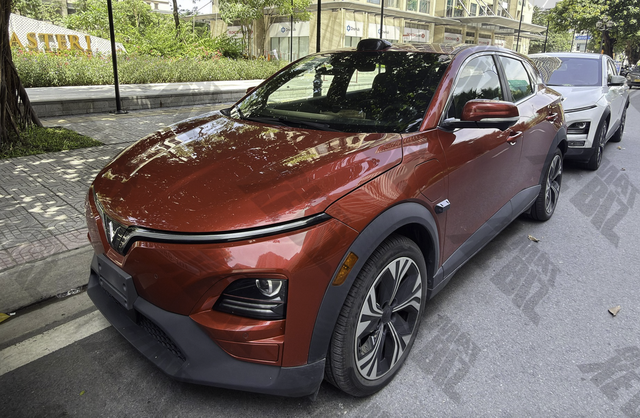
A VinFast VF 6 with unusual exterior features was spotted in Hanoi. Based on their shape and placement, the equipment mounted on the roof and two protruding units on the sides are believed to be light detection and ranging (LiDAR) sensors, suggesting the vehicle may be equipped with technology that enables smoother operation than current Level 2 systems. Photo: Bi Mat Xe Biz
The entire process must operate continuously while the vehicle is moving.
For autonomous taxis, this technology must also be integrated with positioning and navigation systems.
In theory, passengers would only need to select a pickup location, book a ride and enter their destination.
The vehicle would then calculate the route and travel autonomously within its permitted operating area.
VinFast develops autonomous taxis with NVIDIA and Autobrains
On June 1, 2026, VinFast announced a partnership with NVIDIA and Autobrains to develop a Level 4 autonomous taxi program for Southeast Asian markets.
Under the plan, the system will use the NVIDIA DRIVE Hyperion 10 computing platform alongside Agentic AI software developed by Autobrains.
NVIDIA will provide the hardware and software platform for data processing.
Autobrains will be responsible for AI technology, using specialized agents activated according to the requirements of individual driving tasks.
Southeast Asia is considered a challenging environment for autonomous driving systems due to high traffic density, the presence of multiple vehicle types on the same roads and diverse road-user behavior.
The Ky - Thanh Linh / Tuoi Tre News
Link nội dung: https://news.tuoitre.vn/vinfast-plans-to-test-200-driverless-taxis-in-vietnam-by-late-2027-103261024113208424.htm